The Connection Between Tinnitus and Hearing Loss

In another guest article today, Karen Simpson wanted to speak about tinnitus, specifically tinnitus and its connection to hearing loss.

Assessing the connection between tinnitus and hearing loss can be difficult. There are measurable tests to determine between the varying degrees of hearing loss, but no such tests exist for tinnitus. Yet, many audiologists promote hearing loss treatments to assist those who are suffering from tinnitus.
Connection between tinnitus and hearing loss

For those of you who are struggling with tinnitus and aren’t sure if your tinnitus is being caused by what you consume or other issues, one thing you can be sure of is that hearing loss and tinnitus are strongly connected.

Frequency Of Tinnitus And Hearing Loss Combination

As tinnitus cannot be measured by anyone outside of the person suffering from tinnitus, all information linking hearing loss and tinnitus have been self-reported. The American Tinnitus Association has confirmed that this self-reporting makes connecting the two hearing issues difficult. The organization states that some patients have reported a 56% comorbidity of tinnitus and hearing loss in one large research project and 39% comorbidity in a 2014 survey.

Those numbers cast the connection between hearing loss and tinnitus into doubt. However, there are some key this you should remember as you look at self-reported information:

  • Survey inaccuracies – There can be some control factors put in place so real data can be collected. But the accuracy of the data can be difficult to determine as it relies on the honesty of the survey respondent.
  • Gradual hearing loss – In most cases, hearing loss is a gradual process. Often, our bodies compensate for the loss until it cannot make up the difference. Due to the slow nature of hearing loss, many individuals can have hearing loss long before they recognize their loss.
  • Tinnitus perception – As subjective tinnitus can only be heard by the person suffering from tinnitus, it is easy for the person who has tinnitus to dismiss the symptoms. Tinnitus also can come and go, making it difficult to confidently say you are experiencing tinnitus. 

Due to the above considerations, most audiologists and clinicians posit that subjective tinnitus cannot exist without some level of hearing loss.

Managing Hearing Loss Helps With Tinnitus

In a sweeping overview of multiple tinnitus management studies, one group of researchersdetermined that the majority of tinnitus management studies (17:1) recommended managing hearing loss. Specifically, it was determined that hearing aids are one of the best ways to manage tinnitus. There were multiple factors which went into this conclusion.

  • Most major hearing aid brands have developed tinnitus management tools which are built into their hearing aids. Many hearing aids with tinnitus support will emit soothing background noises and can be further programmed to match the wearer’s tinnitus. This integrated design feature allows the hearing aids become a multipurpose tool.
  • Thanks to hearing aid technology advancement which has made hearing aids smaller and less visible, individuals are less resistant to wearing hearing aids. By wearing the hearing aids regularly, tinnitus sufferers can have more consistent relief.
  • Any minimal amount of hearing loss is addressed when the tinnitus sufferer wears the hearing aids with tinnitus support. With the hearing loss solved, the tinnitus sounds will be less noticeable as the wearer can finally hear the sounds they want to hear.

It can be tough for some people to acknowledge the link between hearing loss and tinnitus, as hearing loss is often considered a problem only for the elderly. However, rather than suffering needlessly from tinnitus, it is better to deal with hearing loss if it means an end or lessening of tinnitus symptoms.
Lancashire Police have officers trained in BSL

The Lancashire (UK) police force now have 14 officers trained in British Sign Language (BSL).

The Constabulary also has a Deaf Liaison Officer, PC Paula Robertson, who promotes sign language and deaf awareness training.

She said: “Those who are deaf are a very isolated group and by improving the service we provide we will encourage them to report crime and other issues to us.”

Supt Bob Eastwood, head of Lancashire Constabulary’s Diversity Unit, added: “Lancashire Constabulary has come a long way in recognising and meeting the needs of the deaf community and it is our aim to make it as easy as possible for everyone to contact us.”

Lancashire Constabulary has an emergency text messaging service for people who are deaf, hard of hearing or have a speech impairment, designed to enable them to contact all emergency services without needing help from anybody else.

The caller simply sends their message with their name, location and nature of incident to 66247.

All divisions across Lancashire also now have Deaf PACT (Police and Communities Together) meetings. These meetings allow people to raise their concerns to the officers who are trained in BSL.

Seen on The Lancashire Telegraph.

The glove that talks sign language

Researchers from the Canergie Melon university are developing the HandTalk – a glove that converts sign language into text messages that are sent to a mobile phone.

There are a number of sensors on the glove that record the ASL signs and convert them into text on the fly.

Three of the four team members who are developing HandTalk, senior computer engineering students Bhargav Bhat, Hemant Sikaria and Jorge L. Meza , demonstrated the prototype yesterday at Carnegie Mellon’s “Meeting of the Minds” expo of undergraduate research projects.

“That could be a big advantage” for hearing-impaired people, Mr. Bhat said. “It would cut out the need for an interpreter.”

The device works in a very interesting way. When it is first held in the fist it greets ‘Good Morning’ and when one extends the index finger, second finger and thumb, the device responds ‘I’m having a good time’ and hold out the index finger, little finger and thumb, The Handtalk glove will courteously respond as ‘Thank you for your time’. The inventors have a strong hope that the glove can be put into use as soon as possible.

As you can see from the picture, it’s a bit unwieldy at the moment but if this could be packaged into a more comfortable glove then this cold be a great device. Would also be nice if the text could be converted to speech or some other more immediate form of communication – with text messages there is always going to be pauses in the conversation while you wait for the text to arrive.

The SolarAid

Newsweek has an interview with Howard Weinstein, the designer of the SolarAid. He talks about the hurdles he faced when trying to get it into production and how he hopes it will help bring better hearing to Africa:

Weinstein knew what he had to do: change the business model. Drawing on his years in the corporate bunker, he started working the phones, chatting up financiers, consulting with electronics wizards and haggling with manufacturers. He landed a small grant from the U.S. government-run African Development Foundation and, with help from some dedicated electronics geeks and industry execs willing to forgo their usual profits, came up with something new: a cheap hearing aid powered by rechargeable solar batteries. It looked ordinary enough—just a cashew-shaped piece of plastic to tuck behind the ear—but it cost less than $100, a fifth the price of the cheapest retail model. Rechargeable batteries, $1 apiece, last two to three years. None of this was much use without a reliable power source, so he also built a pocket-size recharger that can either plug into a wall outlet or use its own built-in solar panel.

Weinstein has tapped into another source of underused energy: deaf people. “Because mastering sign language takes acute hand-eye coordination, deaf people are well suited to the fine soldering and microelectronics that go into making hearing aids,” he says. Today the once empty room in the African semi desert has become the hub of a thriving nonprofit business. Some 20,000 people in 30 countries are using SolarAid brand hearing aids, chargers and batteries. With funding from the Ashoka Foundation and the Oregon-based Lemelson Foundation, Weinstein is working with engineers from the University of São Paulo on a second-generation, digital hearing aid. He sees Brazil as a beachhead for all of Latin America; he plans to set up another nonprofit company in Jordan to reach the entire Middle East. Then he’ll take on China and India. All told, he hopes to employ 1,000 deaf people over the next three to five years.

Read article on Newsweek. Seen on Medgadget.

Interview with Pearl from SayWhatClub.com

Pearl got in touch with me recently and let me know about www.saywhatclub.com – she is a long-standing member of the club and editor of their newsletter. I asked if her if she would answer a few interview questions via email and let us know what the club is all about.

Steve: Before we talk about the SayWhatClub, tell us a bit about yourself?
Pearl: My name is Pearl and I am hearing impaired for what seems forever. I always had difficulty hearing in school. My parents were told that I was smart but “lazy” and that I wasn’t “paying attention.”. My response to that was always, “what the heck do they know?”.

When I entered sixth grade, I failed a hearing screening test and my adventures with hearing loss really began. I was told I had otosclerosis and had a stapedectomy done in my late teens only to have been hit by a car three months later, and lost all the hearing in my good ear. I tried several hearing aids over the years and was very disappointed. In fact, I was a terrible role model for the hearing aid industry. At that time, I did not know why I was disappointed, but understood it better as I became more involved in my working with the hearing impaired/deaf communities.

Due to my hearing loss, I decided to to work within the field of deafness or hearing impairments as I felt connected.
As a Social Worker, I worked in various areas of deafness. First in a large deaf/blind vocational rehabilitation center, then for a School for the Deaf and then finally, for the NYC Dept. of Education. I work mainly with children who are Deaf/deaf, hearing impaired, and/ or blind/visually impaired. I am part of the evaluation team that tests and manages these student’s cases. From intake through the recommendation of services to writing up the Individual Educational Plan so that the student will be ready for the classroom setting. While I worked for the Dept of Education, I met some wonderful Audiologists who gave me good advice and I began wearing a well fitted aid.

Steve: Tell us about the SayWhatClub? When did it start? What is its mission? How many members do you have and are they all from the USA?
Pearl: The SayWhatClub (SWC) started officially around 1997. However, back in 1992, the founders of SWC were on a bulletin board for deaf and hearing impaired individuals and several of them began communicating off the list. Eventually the group of friends became larger and more unmanageable because of the numbers participating. The idea of a listserv came up, was started and the rest is history.

SWC is a not for profit Internet based organization run by volunteers for people with hearing loss or late deafened or people interested in hearing loss issues. We have a membership of approximately 400 people of which about 20 % are internationals. We have 8 lists of which one is for people interested in, thinking of or have C.I.’s. Each list has its own personality. The membership consists of everyday people. We have writers, artists, engineers, lawyers, psychologists, housewives, dog walkers, cat lovers, librarians, teachers, young people (18 plus) and older people, all who have gone through the hearing loss experiences.
We don’t just discuss hearing issues though that is what brings us together. What happens is that we are able to discuss things on the list that we are just not able to do in public at a party, for example.
However, we do encourage each other concerning when our hearing issues effect us on our jobs, home front, friendships and the environment as a whole.

We also have something called “flings.” Several members in a state may decide to gather and party. These are informal gatherings. Then we have whats called “Cons” short for convention obviously. Every year we have a convention in a different part of the United States. Last year it was held in Las Vegas. This year it will be held in Philadelphia in July. We have morning workshops and then spend the rest of the time touring the city or just hanging out with new friends.

Families are always welcomed.

We provide CART (real time captioning) for all our meetings and workshops as well as a Sign Language Interpreter.

Steve: What do you feel that people gain from being a member?
Pearl: Well for me, it meant feeling less isolated, knowing others feel as I do, and having a discussion without saying “what?”….
I truly believe most members gain some confidence from being able to relate to others who are in the same situation. The I’ve been there and done that experience.
We also have a wonderful online newsletter that provides some great info, personal stories, news events, and an audiologist corner.
I guess what people gain is an enormous feeling of relief once they realize they are not alone. There’s a feeling that its okay to be hearing impaired or late deafened and that we are just as entitled as the “hearing” person.

Steve: What does the future hold? Does the club have any plans for 2008 and beyond?
Pearl: I wish I had a crystal ball that would give us the answer to what the future holds? Well, I hope that people who are hearing impaired or late deafened will join us and help themselves by taking the steps needed to cope with their hearing loss. I would hope that we can also forge alliances with the deaf/Deaf communities so that we can come to terms with our similarities as well as differences. Though we are different communities, we share similar problems. SWC is one of several online groups that wants to bring people together.
Concerning our goals for 2008? Well, the computer is clearly the future and technology is getting faster and smarter than we ever imagined. We’re looking at starting a blog in the near future so that bloggers can read up on events happening on SWC as well as in the hearing impaired/deaf world. We want to provide information that’s needed for our membership and our readers.

I feel the most important thing for us is having the information in our hands. The more we educate ourselves about hearing aids, CI’s, cellphones, assistive listening devices, alarm systems, etc, the less problematic our lives will be. We have to take responsibility for obtaining the info needed and that’s where SWC can help as well. Isn’t better communication what we strive for? Being heard and hearing or understanding what is being said? SWC has done all of this for me.

Thank you very much to Pearl for taking the time to answer my questions. I will be joining the SayWhatClub and I hope you will too – you can get more info about joining by sending an email to info <at> saywhatclub.com or going to www.saywhatclub.com.

Can vitamins and minerals prevent hearing loss?

About 10 million people in the United States alone—from troops returning from war to students with music blasting through headphones—are suffering from impairing noise-induced hearing loss.

The rising trend is something researchers and physicians at the University of Michigan Kresge Hearing Research Institute, Ann Arbor, Mich, are hoping to reverse, with a cocktail of vitamins and the mineral magnesium that has shown promise as a possible way to prevent hearing loss caused by loud noises. The nutrients were successful in laboratory tests, and now researchers are testing whether humans will benefit as well.

“The prevention of noise-induced hearing loss is key,” says Glenn E. Green, MD. assistant professor of otolaryngology at the U-M Health System and director of the U-M Children’s Hearing Laboratory.

“When we can’t prevent noise-induced hearing loss through screening programs and use of hearing protection, then we really need to come up with some way of protecting people who are still going to have noise exposure,” he says. “My hope is that this medication will give people a richer, fuller life.”

The combination of vitamins A, C ,and E, plus magnesium, is given in pill form to patients who are participating in the research. Developed at the Institute, the medication, called AuraQuell, is designed to be taken before a person is exposed to loud noises. In earlier testing at U-M on guinea pigs, the combination of the four micronutrients blocked about 80% of the noise-induced hearing impairment.

Now, AuraQuell is being tested in a set of fourmultinational human clinical trials: military trials in Sweden and Spain, an industrial trial in Spain, and a trial involving students at the University of Florida who listen to music at high volumes on their iPods and other PDAs, funded by the National Institutes of Health (NIH). This is the first NIH-funded clinical trial involving the prevention of noise-induced hearing loss.

“If we can even see 50% of the effectiveness in humans that we saw in our animal trials, we will have an effective treatment that will very significantly reduce noise-induced hearing impairment in humans. That would be a remarkable dream,” says co-lead researcher Josef M. Miller, PhD, the Lynn and Ruth Townsend Professor of Communication Disorders and director of the Center for Hearing Disorders at the U-M Department of Otolaryngology’s Kresge Hearing Research Institute. Miller is leading the research along with colleagues at Karolinska Institute, where Miller also has an appointment; the University of Florida; and the University Castille de La Mancha.

Until a decade ago, it was thought that noise damaged hearing by intense mechanical vibrations that destroyed the delicate structures of the inner ear. There was no intervention to protect the inner ear other than reducing then intensity of sound reaching it, such as ear plugs, which are not always effective. It was then discovered that noise caused intense metabolic activity in the inner ear and the production of molecules that damage the inner ear cells; and that allowed the discovery of an intervention to prevent these effects.

The laboratory research that led to a new understanding of the mechanisms underlying noise-induced hearing loss was funded by the NIH; the preclinical translational research that led to the formulation of AuraQuell as an effective preventative was funded by General Motors and the United Auto Workers.

Miller notes that the military tests in the new study could be of particular importance because of the high number of soldiers who develop hearing loss in the line of duty, due to improvised explosive devices and other noises.

Last year, he says, the Department of Defense spent approximately $1.5 billion in compensation for hearing impairment, and Veterans Affairs’ hospitals spent close to $1 billion for clinical care and treatment of hearing impairment. The most recent figures in a report by the Institute of Medicine indicated that one-third of returning soldiers fighting in Afghanistan and Iraq cannot be redeployed specifically because of hearing impairment.

“Not only is it an enormous factor in quality of life for the individual affected, in cost to society for health care and compensation, but it fundamentally compromises the effectiveness of our military at this time,” Miller says. He has launched a U-M startup company called OtoMedicine, which holds the license to developed the vitamin-and-magnesium pill for human application.

Hearing loss commonly occurs, Green says, when loud noises trigger the formation of molecules inside the ear and these molecules cause damage to the hair cells of the inner ear. The cells then shut down and scar, and they cannot grow back.

The U-M researchers discovered that this new combination of vitamins, when mixed with magnesium, can prevent noise-induced damage to the ears by blocking some of these complex cellular reactions.

Disclosure: If and when revenues are generated by the vitamin and magnesium formulation developed at U-M, the University and the developers could benefit financially.

Deaf Awareness week 2008

5th – 11th May 2008 is Deaf Awareness Week and organisations working with deaf people across the country are inviting everyone to ‘Look At Me’. The theme aims to improve understanding of the different types of deafness by highlighting the many different methods of communication used by deaf, deafened, deafblind and hard of hearing people, such as sign language and lipreading.Supported by over one hundred deaf charities and organisations under the umbrella of the UK Council on Deafness, Deaf Awareness Week involves a UK wide series of national and local events. “The UK Council on Deafness are delighted to coordinate the all-inclusive Deaf Awareness Week campaign, promoting the positive aspects of deafness, social inclusion and raising awareness of the huge range of local and national organisations that support deaf people and their family and friends.”

The Deaf Awareness week website.

If your hearing aid gets wet, The Seven Steps To Saving It

Hearing Aid Got Wet !

If your hearing aid gets wet DON’T PANIC! Electronics and water are two things that generally don’t go well together but all is not lost if your aid does get a soaking. I’ve had several that have been waterlogged and have managed to get them working fully again.

Seven Things to do if your hearing aid gets wet

  1. Remove the aid from the water as quickly as possible – the less water that’s in it in the first place, the better chance it has to work again.
  2. Turn it off straight away and remove the battery. Throw the battery in the bin. Don’t be tempted to wait and see if it comes straight back on – turn it off as soon as possible.
  3. Close the battery door, remove the tube (if you have one) and dry gently with a towel. Shake it gently to try and get as much water out as possible.
  4. Use a hairdryer or a fan to blow-dry it. It’s very important not to let the aid get too hot so don’t use a hair-dryer on a high-heat – use a low-heat and keep the dryer some distance away from the aid. Excessive heat is much worse for electronics than a brief dunk in water. Blow-drying will speed up the dry-out time but you can skip this step if you are worried about the heat or don’t have a fan.
  5. Leave the aid to dry out. The amount of time to leave it will depend on how wet it was. I’ve had to leave an aid for two days before it completely dried out. Leave it sitting with the battery door open so that as much air as possible can get it. Better still, place it in a dehumidifier pot – this will speed up the dry-out considerably.
  6. Once you are happy that the aid is dried, put in a fresh battery and try it out. You can also use one of the cleaning tools you received with your aid to make sure the water has not left any residue behind but be very careful poking tools inside your aid.
  7. If the aid still does not work then you can either recharge your dehumidifier pot and leave it a while longer or ask your audiologist to send it back for repair.

What not to do

  1. Never put your hearing aid into a microwave or conventional oven. It’s too much heat and you’ll melt something.
  2. Don’t just assume it’s broken. Give it time to dry and then get it sent away for repair if you need to.

The important thing to remember is: It is unlikely that you will need to buy a new hearing aid just because it got soaked – electronics are more resilient to water than most people think.

If All Else Fails, See A Local Hearing Aid Provider

Arrange a consultation with a trusted Independent hearing healthcare professional in your area

Drying hearing aids

How To Dry Out Hearing Aids

The best way to dry your hearing aids is with a purpose designed dryer. They can be very simple things like a box and a drying tablet or more complex electronic devices that will dry and sterilise your hearing aids at the same time. The drying boxes and tablets are relatively inexpensive while the electronic devices retail from between 100 and 150 of your favourite currency. It is well worth investing in them, they will ensure that your hearing aids last for longer even if you never drop them in water. 

Emergency Hearing Aid Drying

In an emergency you can use a hairdryer on a low setting to take the excess moisture off, but you should still leave it to thoroughly dry out before putting a battery in it.

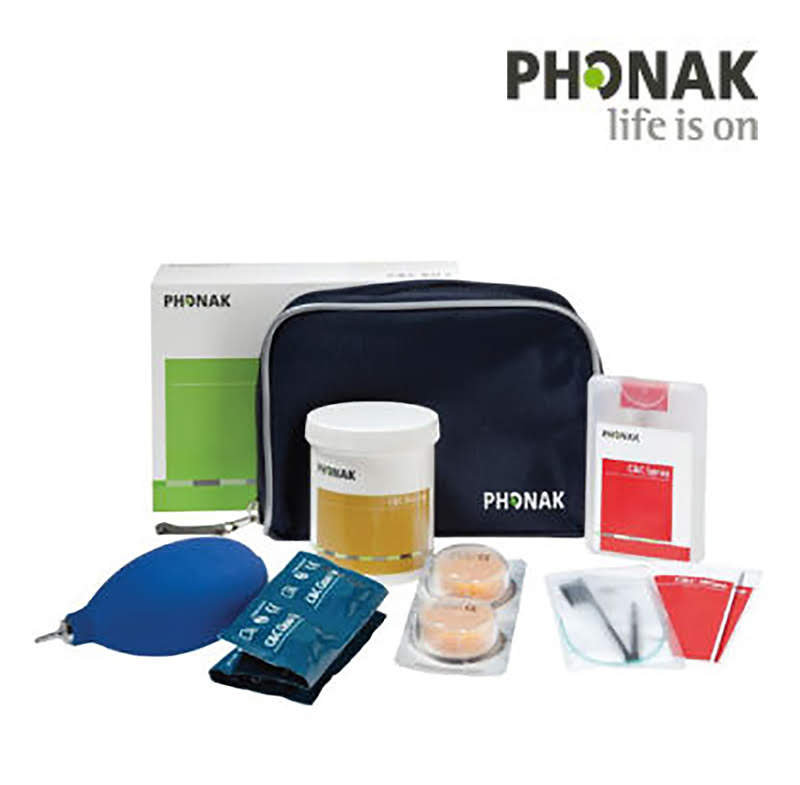
Phonak Clean and Care kit

Hearing Aids You Can Shower With

Can You Get Hearing Aids Wet?

Generaily speaking there are only a few hearing aids that you can shower with. It’s best to remove your hearing aid from your ear before showering, bathing or swimming. Many modern hearing aids like Phonak’s latest lines are IP67 rated for moisture, which basically means that they are okay in three feet of water for thirty minutes. So, you can get those hearing aids wet. However, if you are wearing a receiver in ear device the receiver is not protected by the case and therefore can be damaged.

You are better off just taking it out. Don’t worry about getting caught in the rain though. Follow the guidance of each hearing aid brand, that is the best and safest way to do things. We recently wrote an article called What’s The Best Hearing Aids For an Active Lifestyle? If you are active and you think you might face moisture a lot, it is worth taking a look at. 

Don’t forget, take the battery out quickly, that alone will help a great deal. Don’t put the battery back in until you are sure the hearing device is dry. 

America Hears: A customer’s view

David from –>Hearing Mojo has blogged about his recent purchase from America Hears.

America Hears is a vendor that manufacturers and distributes hearing aids via the Internet. You send them an up-to-date audiogram and impressions of your ears and they will manufacture and mail back to you the hearing aid model of your choice. You are also supplied with some computer software that enables you to modify your aid’s settings so that they are perfect for you.

I’ve also just noticed from their website that they are doing a trade-in on old hearing aids, an excellent idea. There are lots of old and unused hearing aids lying around in people’s homes – a trade-in will see some of them put back into use.

Read about –>David’s experience as an America Hears customer.

Hearing loss is the third most common health problem in US

Hearing loss reportedly affects more than 36 million Americans. Although hearing problems are commonly associated with the normal aging process, more than half of all hearing-impaired persons are younger than 65. With the increased use of personal audio devices and earbuds, the number of Americans experiencing hearing loss at a younger age is growing.

In response to the growing number of Americans experiencing hearing loss, the American Academy of Audiology has launched the annual National Audiology Awareness Month and National Protect Your Hearing Month, starting October 2008.

“This initiative will expand the academy’s efforts to educate the public about audiology, hearing loss, noise-induced hearing loss, and the importance of hearing screenings,” says M. Patrick Feeney, PhD, president, American Academy of Audiology, and associate professor and chief of audiology in the Department of Otolaryngology, Head and Neck Surgery, at the University of Washington. “Most Americans consider hearing loss a condition that is associated with aging; they don’t know how to recognize the condition; and they don’t know who is qualified to diagnose and treat the condition.”

For more information about hearing loss and to find an audiologist, visitwww.audiology.org and click on “Find an Audiologist.” For more information on noise-induced hearing loss, visit http://www.TurnIttotheLeft.com, the Academy’s public awareness campaign about the dangers of exposure to high-level sound.

SOURCE: American Academy of Audiology