Eardrops May Cause Hearing Loss or Damage

A new study, led by researchers at The Montreal Children’s Hospital (MCH) of the MUHC, has revealed that certain over-the-counter earwax softeners can cause severe inflammation and damage to the eardrum and inner ear. The results of the study, recently published in The Laryngoscope, suggest that use of these medications should be discouraged.

“Patients often complain that wax is blocking their ears and is causing discomfort and sometimes deafness,” says Dr. Sam Daniel, principal investigator of the study and director of McGill Auditory Sciences Laboratory at The Children’s. “Over-the-counter earwax softeners are used to breakup and disperse this excess wax. However, the effects of these medications on the cells of the ear had not been thoroughly analyzed.”

“Because some of these products are readily available to the public without a consultation with or prescription from a physician, it is important to make sure they are safe to use,” says Dr. Daniel. “Our study shows that in a well-established animal model, one such product, Cerumenex, is in fact, toxic to the cells of the ear.”

Dr. Daniel and his team studied the impact of Cerumenex on hearing. In addition, overall toxicity in the outer ear and changes in the nerve cells of the inner ear were analyzed.

“Harmful effects to many of the cells were observed after only one dose,” says Dr. Melvin Schloss co-author and MCH Director of Otolaryngology. “We observed reduced hearing, severe inflammation, and lesions to the nerve cells.”

“We believe these findings are applicable to humans,” add Dr. Daniel. “The animal model we chose has been widely used to test toxicity. In addition, this model has a very similar hearing mechanism. Overall, our findings suggest that Cerumenex has a toxic potential and it should be used with caution.”

From The Hearing Review.

Super Bowl ad – Bob’s house

Pepsi’s Super Bowl advert uses a Deaf joke:There’s also a making of video:
PepsiCo are sponsoring the closed captions for the game. I can’t wait to see what reaction this gets from the fans at the game and the mainstream media afterwards. A bold move by Pepsi and a welcome one as it should help raise deaf awareness.

Dave Grohl talks about his hearing loss

Foo Fighters star Dave Grohl has revealed that his deafness is causing problems in his marriage because his wife has to repeat herself all the time. The former Nirvana drummer admits all rock star marriages have the same issue – because loud music kills normal conversation.

Grohl told women’s magazine Elle: “Any woman who’s going to date a rock musician has to be prepared to repeat herself every 10 seconds. I’m virtually deaf… my wife asks me where we should go for dinner and it sounds like the schoolteacher from the TV show Charlie Brown!”

I checked the original article on Elle and he doesn’t say whether he has hearingaids or whether he might get some. Dude, people don’t have to sound like the teacher from Charlie Brown!

From –>Elle, via The Deaf Blog.

Hearing aids suck!

There’s an article in WIRED magazine by Erin Biba called “Why Things Suck: Hearing Aids”.

The article starts by, quite rightly, stating that hearing aids are too expensive – I couldn’t agree more. It then goes on to talk about directional microphones, inadequate feedback and noise reduction and, finally, the the fact that insurance rarely covers hearing aids.

Why Things suck: hearing aid

Do you agree that feedback and noise reduction systems aren’t good enough?I don’t have a problem with feedback and I am wearing my Starkey Destinys at almost full volume all the time – the feedback reduction works for me. I don’t use the noise reduction so I’m not sure how good that is.

I think the Wired article is overly negative but that’s probably because I’ve have mostly good experiences with my hearing aids over the years and have come to ignore the little problems like occasional excessive background noise and so on. Do you think hearing aid tech is good enough as it is or is there a lot of room for improvement?

Deafening call for new toy law

Health Canada is examining the way it tests noisy toys to make sure they aren’t damaging childrens’ tender ears.

Many toys seem to sing, shout, beep and wail at deafening decibels.

And the current testing method — holding a toy at an adult arm’s length — doesn’t reflect the reality that kids hold toys close to their ears, audiologists warn.

Noise-induced hearing loss is growing. Studies in the U.S. show 12.5% of children have hearing problems caused by noise in one or both ears.

UNDER REVIEW

“A number of elements of the (laws) for toys that make or emit sound are under review, including the sound emission limit, the parameters used to assess sound emissions and the test methodology,” Health Canada spokesman Paul Spendlove said.

The section of the Hazardous Products Act — which was drafted when Pierre Trudeau was prime minister — bans toys emitting noise levels exceeding 100 decibels. Audiologists say this level is too high.

A private members’ bill, introduced by Winnipeg NDP MP Judy Wasylycia-Leis, would see the act revised to allow 75 decibels as the maximum level.

“I was floored to hear that so many toys on the market are way above what the World Health Organization recommends,” Wasylycia-Leis said.

“It made me realize we’ve got a problem here in Canada and it shouldn’t take too much to fix it.”

“This bill will lead to the protection of the hearing health of millions of Canadian children,” said Ondina Love, Association of Speech Language Pathologists spokeswoman.

A lot of hearing damage caused in childhood is preventable, said Ottawa audiologist Karyn Bursch. “We’re putting hearing aids on younger and younger folks.”

Health Canada’s national consumer product safety program is reviewing the laws and their application, Spendlove said.

Hearing aid prices and the perception of value

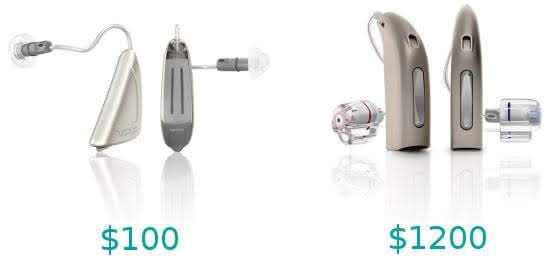
Hearing aids are too expensive, right? Right. Below is an image I created for my totally-made-up hearing aids store:

What do you think of the two hearing aids for sale here? One is $100 and the other is $1200, which one is better? Which would you buy? If you are like most people then your gut-feeling is that the $1200 hearing aid is much better than the $100 one simply because it is more expensive. We think that more expensive is better.

Many studies have shown that we don’t make rational decisions when we buy things, we don’t thoroughly research all our buying options and go with the cheapest and/or best option for us – instead, we go with gut-instincts, predefined ideas about how much something should cost, make comparisons based on side-by-side offers, basically we make bad snap-decisions. But it’s not our fault, it’s the way our brains work! See thisthis or this for examples. Two great books that go into how and why we make bad decisions when we buy are: Predictably Irrational and Influence.

Some companies are starting to offer more affordable hearing aids, both online and on the high street. Because hearing aids have been so expensive for so long the common thinking is that they are expensive because they need to be, because they are high-tech or because they are difficult to make and fit. We’ve been trained to believe that hearing aids are expensive items and this will give the people who are starting to offer lower prices a problem: How do you sell at a lower price without making it look like you are offering an inferior product?

Hearing Review top ten of 2007

The Hearing Review’s editor, Karl Strom, has compiled a list of last year’s top ten news items from the hearing aid / health industry. It’s an interesting list and also a very positive one – Karl talks about the advances in hearing aid technology and research as well as the increased exposure of hearing aids and hearing problems in the media last year.

Karl’s list:

1) Sonova-GN deal is blocked, putting into question future consolidation. Announced in October 2006, the $2.6 billion purchase of GN’s hearing care divisions by Sonova (formerly the Phonak Group) represented the biggest acquisition in industry history that would have resulted in the industry’s largest company. Just when it looked like the deal was to be finalized, in March, a German court nixed it on grounds that it would have created a German oligopoly (watch for this new exciting game by Parker Bros coming to a toystore near you). The result: not only was the deal quashed, but it also complicates any further mergers or acquisitions between large companies with significant market shares in Germany. GN will retain its hearing care divisions.

2) Mini-BTE revolution continues. BTEs—thanks to open-fit, over-the-ear, and receiver-in-the-canal aids—now constitute half the US market (about 51%) after making up 26.4% of the market in 2004 and less than one-fifth of the market in the 80s and 90s.

3) Wireless and younger users. BTE hearing aids have not only become instant-fit devices, but are increasingly linked to a constellation of communication devices like cell phones, MP3 players, and even the other hearing aid in a binaural fitting. The big question: Will these devices (combined with mini-BTEs) attract a new, younger user population and/or reduce stigma-related issues?

4) Amazing research. The next time you hear some blowhard going off about how the government spends all our money on useless research, please slap them. Hearing researchers—and NIH-funded researchers specifically—published crucial findings on auditory processing, stem cells, gene therapy, cochlear mechanics, neuroplasticity, SIDS and TEOAEs, and childhood hearing loss. If you’re a hearing science nerd, 2007 was a banner year for reading. How about allocating a few billion dollars from our $2.8 trillion budget to help 21+ million US citizens hear?

5) Great marketing and media exposure. The above, combined with some truly innovative marketing concepts by the hearing industry and non-profits, generated more positive press than any other time except possibly when Presidents Reagan and Clinton obtained hearing aids. How good has it been? Consider this: Leslie Nielsen plays the role of Starkey Laboratories Founder Bill Austin in the MGM movie Music Within!

6) Continued forward consolidation. Dispensing networks and many hearing instrument manufacturers continue to purchase dispensing offices and lock up distribution.

7) Other acquisitions/sales. Intricon (formerly RTI) purchased Tibbetts; Sonic Innovations sold its Tympany division; the principals of Advanced Bionics modified a merger agreement to obtain the auditory business (including the HiResolution Bionic Ear cochlear implant) of Boston Scientific; Cardinal Health purchased VIASYS Healthcare, owner of Grason Stadler and Nicolet Biomedical; Sound Design Technologies bought Gennum’s hearing division; and, in November, 3M announced plans to purchase Aearo for $1.3 billion.

8 ) Implants. Cochlear and middle ear implants, auditory nerve implants, and cochlear implant/hearing aid hybrids continued to make great strides relative to research, clinical testing, and new devices.

9) Passings. Our field lost several great leaders, researchers, and innovators, including John Duffy, Earnest Zelnick, Dick Vessella, Stuart Gatehouse, Merle Lawrence, G. Donald Causey, George Osborne, and in November, Gordon Stowe.

10) Sales flat, but okay. Based on Hearing Industry Association (HIA) statistics in the first three quarters of the year, the average dispensing office experienced unit volume increases of about 2%, while total US sales rose by about 3%. However, one needs to bear in mind that 2006 was a strong year by industry standards, with sales rising by 7.5% compared to 2005.

The original hearing review of 2007 article. Found via Hearing Informed.
KT-Tunstall writes songs for her deaf brother

KT Tunstall wants to write music for her profoundly deaf brother.

The ‘Suddenly I See’ singer, whose 28-year-old younger sibling Daniel was born with the hearing condition, is planning to create some hi-tempo beats to please her brother.

KT said: “I’ve always wanted to write some music for Daniel, and find out scientifically what would be really pleasing to him. He loves beats. He tells me about these brilliant deaf raves he has been to, where all hearing aids come out and the volume is turned up.”

Daniel, who had a cochlear implant fitted a few years ago to help him hear pitch, has started joining KT on stage during her shows.

Read the original article in full.

Merry Christmas and a Happy New Year

I hope you have a Merry Christmas and a Happy New Year.

Thank you to everyone who visited this blog over the last 12 months and a special big thank you to everyone who took the time to comment on my ramblings.

I’ve really enjoyed reading a lot of great deaf / hard of hearing blogs this year, here are some of my favourites:

Beethoven’s Ears

Stone Deaf Pilots

Hearing Mojo

Speak Up Librarian

Audiologist sells NHS batteries on eBay

A SENIOR hearing specialist at the Great Western Hospital has admitted selling NHS stock on eBay during work hours – then using hospital franking machines to send off his sales.

Paul Jones, 28, was yesterday given a 16-week suspended sentence and 280 hours’ community service by Swindon magistrates after he admitted selling £276 of hearing aid batteries on the Internet auction site.

The senior audiologist pocketed around £600 from his sales, which took place between April and June this year. He was told his immediate admission to the theft and fraudulent sales had saved him from being sent to prison.

Read more.