New US Website Offers Hearing Aids Online With Remote Care Aftercare

Buy Hearing Aids & After Care From the Comfort of Your Own Home

I noticed a new website recently called Lively Hearing Aids who are based in New York. They are offering hearing aids sold online. Not something that’s new perhaps, but this is the first time I have seen this type of offering with so many high-level and well-respected Audiologists involved. There is a lot of Audiology weight behind the business and they are using Remote Care systems to provide ongoing follow up and care. Let’s dig a little deeper. 
Lively Hearing Aids

Audiological Authority

The site names some well-respected Audiology names as both the Head of Audiology Research (Dr Harvey Abrams, Ph.D.) and the Head of Clinical Audiology (Dr Christina Callahan, Au.D). It also names some well-respected Audiological names as Board Members. So there is a lot of Audiological authority behind this business. 

Showing my inherent bias, I want to talk about the website. The site is beautifully built and a lot of thought and expertise has gone into it. That means investment, to me that screams a business who plans to be around for a while. Just based on the website alone, I would have to say that a lot of thought and care has gone into this business. That is further validated by the choice of hearing aid technology for sale. 

The Hearing Aids

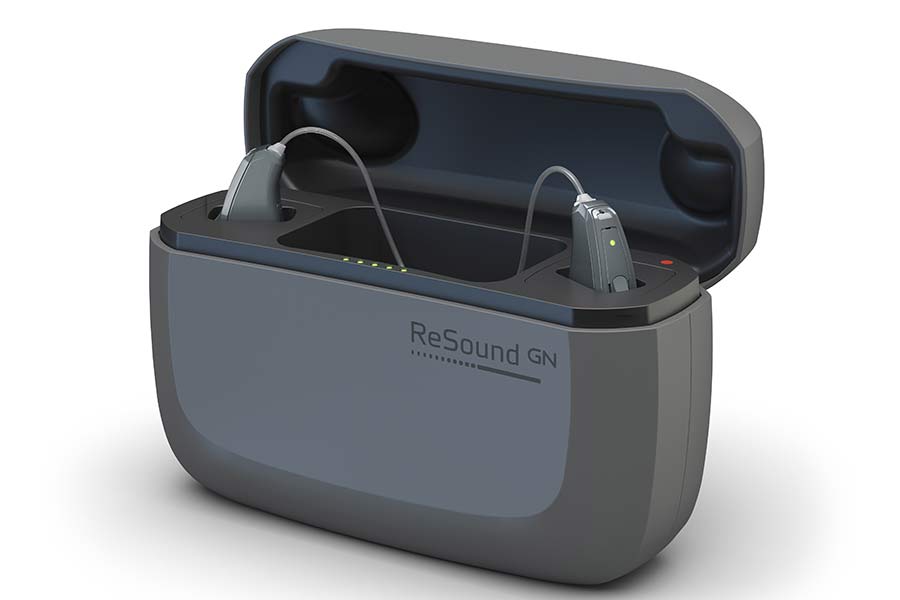
While the site is a little vague about the hearing aid technology level, it couldn’t be clearer that the hearing aids involved are Resound LiNX 3D Receiver In Canal devices. They are a good choice for several reasons, firstly, they are pretty good devices and secondly, they can be remote fine-tuned. Which leads me to the process involved.

What Are You Buying?

For $2350 you are buying a pair of LiNX 3D hearing aids (not sure of the tech level but we hope to update later) Updated: You are buying a pair of LiNX 3D 5 hearing aids (thanks to Jeff Helm for the info) and the following:

  • Support from trained specialists, 7 days a week
  • 1 year supply of batteries
  • Lively app for smartphone/tablet control
  • 2-year manufacturer’s warranty (standard warranty programme, Lively say they will also fix out of warranty repairs for a price)
  • 2-year loss and damage protection

What is The LiNX 3D 5?

The Resound LiNX 3D 5 is the lowest level of technology in the LiNX 3D range. Because of the way Resound offer hearing aids, I wouldn’t call it entry level as such. To compare it with other hearing aid brands, the LiNX 3D 5 would be similar in nature to the 50 level in Phonak hearing aids or the 220 level in Widex hearing aids. 

The Buying Process

Lively has a clear process for you to buy:

  • Take their online hearing test: They say “With this fast and free online test, you can give our licensed audiologists the info they need to program your hearing devices. Already took a test? You can also upload an audiogram”.
  • Buy them and try them: They say “Order from Lively and we’ll ship our state-of-the-art hearing devices to your door. Try them for 100 days and if you’re not satisfied, we’ll refund 100% of your purchase (even return shipping)”.
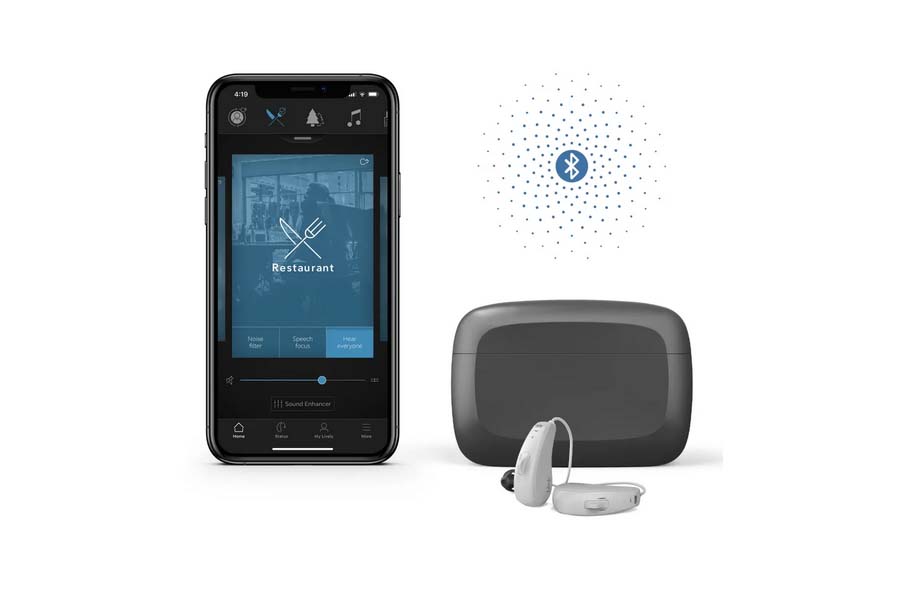
  • Get aftercare from the convenience of your own home: They offer two years of support with the hearing aids and they say “Tell your Lively audiologist about your hearing experience via phone, video chat, or our app. They’ll make the necessary adjustments remotely, so you can hear the difference instantly”.

Well Designed Service

All in all, it seems like a well-designed service which more or less meets the Blamey and Saunders standard (the standard we use to assess online hearing sales). The online hearing test is interesting, if you go above a certain level it informs you that Lively can’t really help you and you should see a local Audiologist. You have to see that as a good thing.

I am always concerned with online hearing tests though, we have one here on Know and it is scientifically validated, but it isn’t used to output an audiogram, it is just used to tell you if you might need to see someone. The other thing is that while the test may be scientifically validated, is the user? 

The Problems I see

I still see some issues with this type of model and I have expressed them before. They are as follows:

  1. No one looks in your ears, what if it is wax or a medical condition?
  2. There is no bone conduction information, so we aren’t sure if it is conductive
  3. How accurate is the hearing test considering people may take it in non-ideal conditions?

One way or the other it will be interesting to see what happens with Lively over the next while. I have put a request to the site to ask a few questions and I will either update this article or write a new one if I get a response.

As remote audiology care system become ever more prevalent, I would expect to see more sites like Lively to crop up, I do believe that is the way the hearing aid world is going.


7 Things the Public Should Know About Hearing Dogs

We recently had a chap named Richard Cross from thedogclinic.com get in touch with us. He said we hadn’t written enough about hearing dogs, and on reflection, we agreed. So we asked him to contribute a post to us on the very subject. He did and you can read it below.

The Dog Clinic UK

Hearing dogs are trained to alert their owner to sounds around the home, such as alarms or doorbells. They can also provide emotional support, give signals about outdoor hazards, and provide more independence to people with hearing disabilities.
Many people don’t understand the purpose of hearing dogs or how they are trained though. Here are seven things everyone should know about these wonderful service dogs.

1. Hearing Dogs Take Months (or Even Years) to Train

The process of training a hearing dog is long and expensive. Training usually starts with simple obedience commands and socialisation. This lays the groundwork for future training and ensures the dog has the right temperament. The dog is then trained to recognise and respond to specific sounds, such as doorbells or alarms. Some dogs use their paw to get the owners attention, while others nudge their leg. Once the dog understands the basics, it may be taught to listen for more specific sounds that are relevant to its future partner. These could include the owner’s name or the sound of a household appliance. Finally, the dog is taught how to behave in an outdoor environment. The length and cost of the training process varies depending on the organisation. It’s estimated that training a dog from scratch can cost over $20,000 though.

2. Hearing Dogs Alert and Lead to a Noise Source

The primary task of a hearing dog is to alert the owner to sounds such as fire alarms, doorbells and alarm clocks. To do this, the dog gets the owner’s attention, before leading to wherever the sound is coming from. Teaching a dog to recognise a certain sound is hard enough, but the task is more difficult when outside. The owner probably doesn’t need to be alerted to distant car horns, people shouting and other ambient sounds, but it’s hard for the dog to determine which sounds are important. For this reason, dogs don’t alert their owner to ambient sounds. Instead, the owner is taught to read the dog’s body language cues. By doing this, the owner is warned about people, vehicles and other potential dangers, without being overwhelmed by constant signals from their dog.

3. Small or Medium-Sized Breeds Are Often the Best Hearing Dogs

All hearing dogs need intensive training – there’s no such thing as a “natural” hearing dog. While almost any dog could be taught, some breeds have traits that make them better suited to becoming a hearing dog. The best hearing dogs need to be interested in sounds, friendly, have the ability to focus, and are naturally alert. They should also be comfortable around both humans and dogs. Most hearing dogs are small or medium-size breeds, as these are easier for the owner to handle. Hearing Dogs for Deaf People in the UK, for example, exclusively uses Cocker Spaniels, Miniature Poodles, Cockapoos and Labrador Retrievers. Other organisations use Terrier mixes or Golden Retrievers.

4. You Shouldn’t Interact With a Hearing Dog Without the Owner’s Permission

Most people know that guide dogs for blind people shouldn’t be approached, but the same is true for any service dog – including hearing dogs. Owners of a hearing dog rely on the dog’s body language to alert them to danger. It can be frustrating if the dog is constantly distracted by people stroking or talking to it. A distracted dog is also more likely to miss another sound that the owner needs to know about. It’s also important to keep your dog away from a hearing dog. Aside from being a distraction, it can be distressing for the owner if there is a dispute between the dogs.

5. Hearing Dog Puppies Are Usually Raised by Trained Volunteers

The puppy socialization period is roughly between six and 16 weeks. During this time, the puppy’s experiences shape its future personality. This is why volunteer puppy raisers are crucial to the training of a hearing dog. These volunteers are taught how to slowly introduce new environments and experiences, while teaching basic obedience commands. The process is different if the organisation is using a shelter dog though. These dogs have finished their socialisation stage, so need to be carefully selected for their temperament. The advantages of using a shelter dog, aside from giving a dog a second chance, are that the dog’s personality is already developed and there is no need to find a puppy volunteer carer.

6. Hearing Dogs Need to be Carefully Matched With an Owner

Training a hearing dog is only half the equation. Once the dog understands its duties, the next stage is to match it with a suitable owner. There are many considerations when placing a hearing dog. These include everything from the person’s age and lifestyle, to the temperament of the dog. An energetic dog with a fast walking speed, for example, probably wouldn’t make a good match for an elderly person. On the other hand, a naturally sleepy dog with a slow gait wouldn’t be a good choice for an active 25-year old. A lot of time and thought goes into matching a hearing dog, as selecting the right match is essential for a successful partnership.

7. A Hearing Dog Can Re-Build a Deaf Person’s Confidence in Life

The benefits of a hearing dog go far beyond alerting the owner to certain noises. Many deaf people feel isolated by their disability. By having a companion who can alert them to dangers or just someone trying to say hello, many feel more confident, independent and able to enjoy life. Hearing dogs also make wonderful pets. They provide emotional support and loving companionship, which can make a big difference to a person’s life.

Summary

A hearing dog isn’t a replacement for a properly functioning hearing device. But they can provide extra safety, independence and confidence for people with a hearing disability.
Many people don’t realise the time, money and thought that goes into training a new hearing dog. The life-changing benefits are worth the expense though.

Preparing for your first date with hearing aids

First date jitters can be really bad whether you are seventeen or seventy. If you are wearing hearing aids, it just adds to the complexity. Cassie Lomax, a regular contributor to Hearing Aid Know has come up with some tips to get you ready. 

Eating Out

If you have just taken home your new hearing aid or had cochlear implant surgery, welcome to the club! There are around 11 million people in the UK affected by hearing loss, with 6.5 million of these aged 60 or over and around 3.7 million of working age. Studies have shown that these technologies can significantly improve hearing. Those with cochlear implants achieve an average of 80% sentence understanding, which allows them to have conversations with others in meetings, at restaurants, and at other social functions. Studies carried out on thousands of people in Germany, France and the UK, meanwhile, have shown that 77%, 84% and 70% of hearing aid wearers (respectively) are satisfied with their hearing aids, which they don for up to nine hours a day to relate to others at work and at home.

Hearing Aids Boost Your Chances of Romance

Research shows that those who wear hearing aids or opt for a cochlear implant report improvements in their work and personal relationships, which is great news for those on the dating scene. For one, having a hearing aid or implant increases the sense of safety and independence. These are crucial elements for those venturing forth into the exciting world of dating, sometimes with people one meets online or on a blind date. Hearing aids have a positive impact on one’s overall sense of wellbeing as well, which boosts one’s confidence when getting to know others.

First date

Photo by Alin Dragu on Unsplash

Planning Well for Your Date

You may be a little nervous about wearing your hearing aid for the first time on a date. The best way to quell jitters, of course, is to be prepared. Think of fun topics to bring up, read a little about perfect pairings of food and wine, and think of interesting questions to ask your date. Try to ensure you have plenty to ask, to show you are truly interested in getting to know them. When they ask you questions, feel free to be spontaneous and give your true opinions. Sincerity is appealing and you might as well begin your relationship with honesty.

Picking the Right Venue

Ambience is key when it comes to choosing the perfect spot for a first date. Most people still prefer to centre a date around food – and that often means coffee, lunch, or a dinner date, perhaps in a romantic, candlelit dinner in an al fresco setting. A restaurant that plays classical or soft jazzy music is preferable to one in which loud music or dancing is a focal point of entertainment. It might be a good idea to visit the venue beforehand to check out the table layout. If there is a piano or dancefloor but the restaurant is sizeable, for instance, book a table that is far enough from the source of music but that has a beautiful view and is comfortable and inviting.

Having a cochlear implant fitted or taking home a brand new hearing aid opens new worlds, especially when it comes to romance and getting to know people. By planning well for your date, quelling nerves with relaxation exercises and picking the right spot to meet, you are well on your way to building something that could be quite magical.

Remote Hearing Care Systems, What do You Need to Know?

I was asked a question on Twitter recently about remote hearing care and the differences between the systems that are now available. So I thought it was worthwhile sitting down and writing about it. Signia was the first company to introduce the concept, but the offering was quite limited. Resound quickly followed with the introduction of their system. It wasn’t limited in any way, but it wasn’t a live system. Since then Signia has introduced a live system with video calling that allows full fine-tuning. Both Oticon and just recently Phonak has also gone down this route. Let’s talk about the different systems. 

Telecare for hearing aids

Resound Remote Care

I will talk about Resound first because their system is unique. The Resound remote care system is available with the LiNX 3D, The Enzo 3D and the new LiNX Quattro ranges. It works via your Apple or Android Smartphone through the accompanying app. In order for the system to work, the aids have to be initially programmed for you in the office. Your professional will set you up on the Resound system and once that is done, you can request changes to your aids through the apps. 

You simply send your professional a message with as much details about your problems and where you are having them as possible. Your professional can then push out changes to your hearing aids through an update that is sent to your app.

You then apply the changes and try them out. If you like them, you simply keep them. However, if you don’t like them, you can roll them back to what you had before. With some smart organising, you can do this in the environment that you are having the problem with. It should allow you to know instantly if the issue has been solved. The system is easy to use and while there is no video calling, you can give live feedback messages through the app.

Phonak Remote Care

Phonak Remote Care system

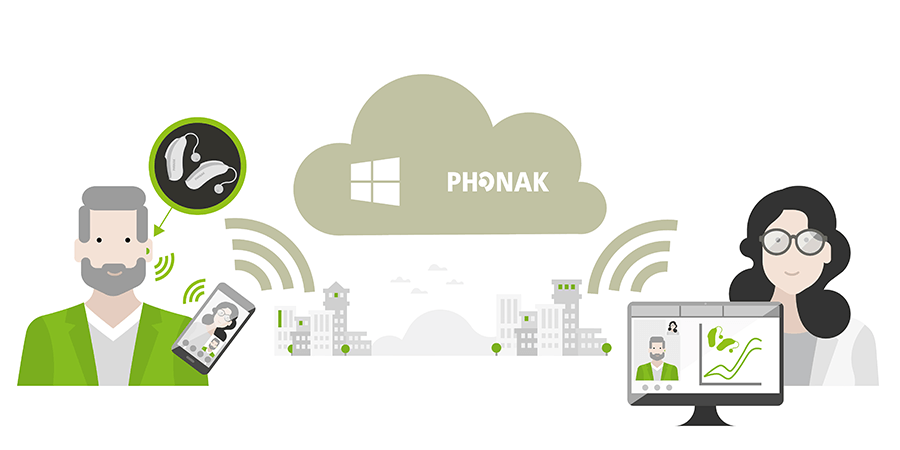
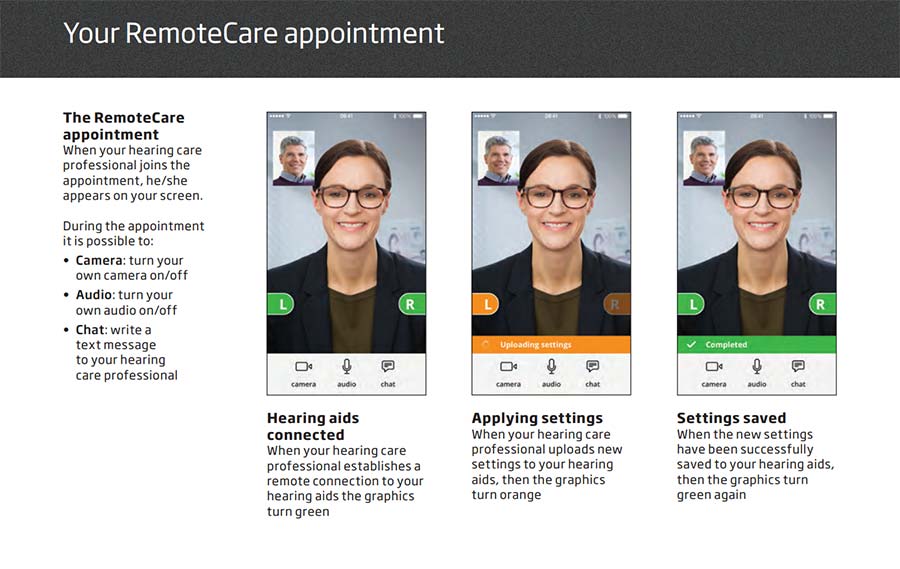
The Phonak remote care system is only available with the new Marvel hearing aids and the Audeo B-Direct. The new Phonak system works via your Apple or Android Smartphone and again it is app based. To get the best from your hearing aids they first need to be programmed on a face to face basis. The feature which is available through the new Phonak app allows hearing aid wearers to communicate with hearing care professionals by smartphone audio and video. It also allows professionals to adjust their hearing aids in real time anywhere.

The new myPhonak smartphone app is used to enable the system. It utilizes Microsoft’s Azure cloud-based technology platform to manage audio, video and digital communications. The Azure platform is pretty robust and it offers the stability needed for the numerous data exchanges going on. 

The system is pretty cool, it offers video calling which enables the user and their hearing care professional to see and hear each other while the hearing care professional makes simultaneous real-time updates to the hearing aid programs.

It opens up a lot of opportunities for change and benefit to hearing aid users and professionals alike. It means that you could potentially have your hearing aids adjusted while sitting in a restaurant, or cafe, or just on the couch at home. The system offers:

  • Full fine-tuning capabilities. The audiologist can make nearly all the same changes remotely as in the clinic.
  • Real-time adjustments. The audiologist makes the tweak and the patient instantly hears the difference—enabling efficient fine-tuning in a variety of listening settings.
  • Video chat. Face-to-face interaction between professional and patient results in much better communication. At the same time, the audiologist controls the hearing aid adjustments from the desktop computer.

Oticon Remote Care

This is a recent introduction by Oticon and it is available only through an Apple phone appThe Oticon remote care app is only available with the Opn and Siya ranges of hearing aids. Your hearing aids will first need to be programmed on a face to face basis in-clinic. The feature which is available through the new Oticon remote care app allows hearing aid wearers to communicate with hearing care professionals by smartphone audio and video. It also allows professionals to adjust their hearing aids in real time anywhere. Unfortunately, as I said, it is only available to people with iPhones. 

Oticon remote care app

The system offers strong benefit to hearing aid users and professionals alike. It means that you could potentially have your hearing aids adjusted anywhere. The system offers:

  • Full fine-tuning capabilities. The audiologist can make nearly all the same changes remotely as in the clinic.
  • Real-time adjustments. The audiologist makes the tweak and the patient instantly hears the difference—enabling efficient fine-tuning in a variety of listening settings.
  • Video chat. Face-to-face interaction between professional and patient results in much better communication. At the same time, the audiologist controls the hearing aid adjustments from the desktop computer.

Signia Remote Care

Signia was the very first to introduce remote care and they have consistently built upon that foundation. Their new system, Telecare 3.0 is available with their new Nx range of hearing aids. Your hearing aids will first need to be programmed on a face to face basis in-clinic. The feature which is available through the Signia myHearing app allows hearing aid wearers to communicate with hearing care professionals by smartphone audio and video. It also allows professionals to adjust their hearing aids in real time anywhere.   

  • Full fine-tuning capabilities. The audiologist can make nearly all the same changes remotely as in the clinic.
  • Real-time adjustments. The audiologist makes the tweak and the patient instantly hears the difference—enabling efficient fine-tuning in a variety of listening settings.
  • Video chat. Face-to-face interaction between professional and patient results in much better communication. At the same time, the audiologist controls the hearing aid adjustments from the desktop computer.

Telehealth in the Audiology setting is becoming more prevalent and all of the hearing aid brands are gearing up for it. While most of the brands now offer it, as you can see some offer it in different ways. Again, your decision to buy a particular hearing aid shouldn’t focus on just one feature, you should take a more holistic view about what you need. Sometimes, you will need to make compromises. 

What Do Consumers Want From Hearing Aids?

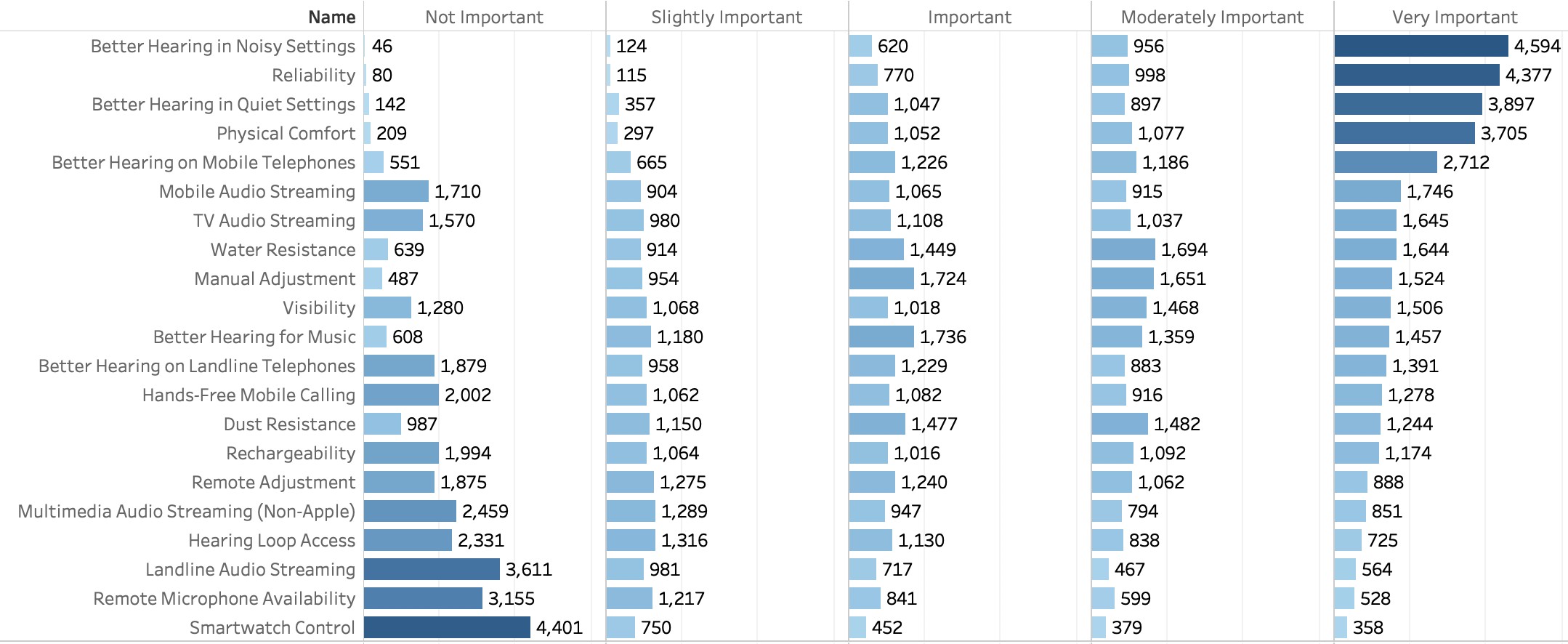
Hearing Tracker recently released an update of what people want from their hearing aids. 6,340 hearing aid consumers scored the needs, so that’s a pretty big cohort. I thought it worthwhile to go over it. There is an image of the data below; you can click on it to bring you to a much bigger picture that is easier to read. Let’s talk about hearing aid user needs and the features that meet them. 

Linx Resound Quattro rechargeable hearing aids

Hearing Better in Noise

Top of the list is the ability to hear better in noise; I don’t think that is a surprise to anyone as it is the one thing that everyone with hearing loss says. Just 6,300 people thought hearing in noise was necessary with the bulk saying it was imperative. If you want to hear better in noisy situations, you need to be realistic about the hearing aids you buy. You need upper mid-level or premium hearing aid technology. You might also need a remote mic. If those technology levels are out of your budget, then you need a remote microphone with lower level technology. Which leads me onto remote mics

Remote Microphones

While everyone wants to hear better in noise, nearly five out of ten think that remote microphones are not necessary. That is a diametrically opposed position; if you want to guarantee better hearing in noise, you need a remote microphone. The best remote microphones are available on the direct connection devices, so, you need to be thinking Made For iPhone hearing aids which are all direct connection. Direct connection means no intermediary streamer. So you can use the remote microphone directly, streaming your companion’s voice directly to your hearing aids. Funnily enough which brings me onto streaming. 

Streaming Audio

Both mobile audio streaming and TV audio streaming were important for over seven out of ten people, while numbers for hands-free calls were slightly less but still crucial for over six out of ten people. Non-Apple multimedia streaming was important for around six out of ten people, and landline phone audio streaming was critical for just over four out of ten people. In general, it proves that Bluetooth connection and audio streaming is pretty essential to modern consumers. While talking about streaming, it is interesting to note that access to loop systems was crucial to around six out of ten people. This technology seems to grow in perception with consumers. 

Important Features

Rechargeability was important for almost seven out of every ten, while reliability, water resistance and the ability for manual control were important for nearly everyone. 

Hearing in Quiet

The ability to hear better in quiet situations was also hugely important to most of the cohort. That surprised me a little because most people say they understand fine in quiet in a one to one conversation. Generally, they don’t, but they don’t realise it. Which says that the cohort is enlightened and probably experienced. 

Reading through the needs, it strikes me that there is not one single hearing aid available that meets them all. Yes, plenty of devices will meet the requirements with some compromises. For instance, you can have hands-free calls with many direct connection devices, but you will have to wear a phone clip of some sort. You can, of course, have hands-free calls with the new Phonak Marvel, but you can’t have a remote mic. 

You can have direct multimedia streaming from non-apple phones only with the Marvel; soon, the Quattro will deliver direct streaming from Android. Like I said, compromises. The best thing is to work out what is important to you and how best to achieve it. Don’t necessarily focus on one feature, try to understand the options more holistically.

The Phonak Marvel, My Day to Day Experiences

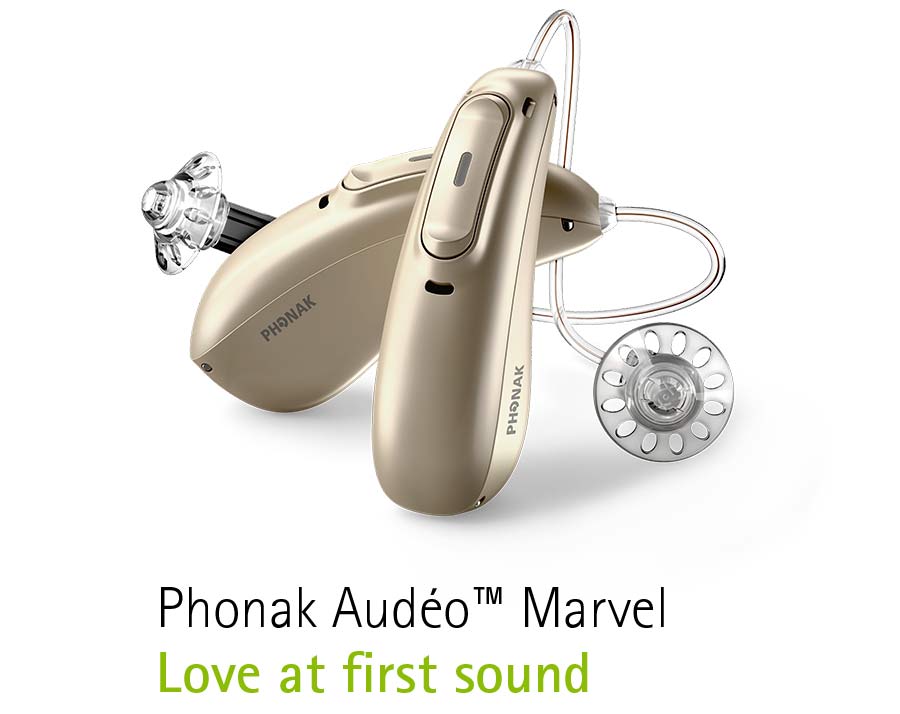
In the last article, I spoke about the Marvel and its quite amazing Bluetooth connectivity. The connectivity options with the Marvel are outstanding. Phonak’s choice of Bluetooth connectivity protocol was inspired. It is the leader of the class when it comes to connectivity, however, is there more than that to the Marvel? It seems that the profession has almost lost its collective mind with excitement over the devices. Is that warranted? I would have to answer yes, but with an addendum. Let me explain.

Phonak Audeo Marvel

You Know I Love Lithium-ion Rechargeable, Right?

I have written elsewhere here that I recently realised that I love rechargeable hearing aids. In particular, lithium-ion rechargeable hearing aids. Steve has said, “Any product with a rechargeable battery is only useful if it lasts a decent amount of time between charges, annoys the hell out of me that I have to charge my phone twice a day.” I managed to use my Marvels for a full day without recharging in general. There were some exceptions.

I connected the Marvel direct to a Bluetooth enabled television, you know because I could. Don’t do it, just don’t, after a couple of hours my hearing aids died. Direct Bluetooth streaming from a television chews through the battery like a damned hungry hog. In fairness, many of you would probably never consider doing it, but I am here to tell you, don’t.

I also used the TV Streamer provided for the devices. The sound from the TV streamer is outstanding and it is a lot less power hungry. I didn’t test it to destruction as is my want, but I will in the near future as I want to do a comparison article and get a clear idea of how power hungry the new types of direct streamer are. 

Get The Bigger Charger Case With a Power Pack

I said in the last article that I have the mini charger case. It is a lovely thing. However, you need to think about the larger case and a power pack. That will give you tremendous versatility, and if your hearing aids do die, you will be able to charge them on the go. Like I said, in general, I got a full day out of the rechargeable aids. However, I would have liked the extra assurance of being able to quickly and easily charge them up if I had to.

Hands-Free Calls

During the trial, I made and received many phone calls and the hands-free system is pretty cool. I still get a little tingle of excitement every time I reach up to push the button on the hearing aid to take a call. Although wandering around seemingly talking to yourself can lead to some pretty strange looks in shopping centres. I had a child ask me “are you one of the crazy people?” I so wanted to say yes hahahahahahahah. However, I settled for no I am on the phone and showing her the hearing aid. She seemed a bit disappointed.

I almost felt honour bound to twitch a couple of times and laugh maniacally, but I held off. During the trial, my experiences during phone calls were pretty good. I heard the caller very well in most cases except for dodgy connections. They seemed to hear me pretty well. In noisier situations or windy situations, it appeared that the caller had a little trouble hearing me. However, I heard them just fine. Overall, I was more than happy with my experience here.

During my testing, I had no dropouts or refusal to recognise or pair episodes. I had one issue of refusing to stream which I quickly solved by turning off and on the Bluetooth on my phone. There is no delay in streaming, when your phone rings, you hear the ring in your hearing aids. When you answer the call, you are straight into the call without stutter. When you finish the call, it just reverts to the programme you were in or the streamed audio you were playing.

Environmental Awareness

Phonak has ensured that the Marvel strikes a good balance between streamed audio and environmental sounds. You can hear the streamed audio well, but you are still aware of what is going on in the environment. Your hearing care professional can fine-tune the balance between them, and you can change it in the Remote app. I was happy with the Phonak pre-set and didn’t fiddle. That’s a good point when I trial hearing aids; I just fit them with the manufacturer defaults. I always do this so that I can get a clear idea of the tech before I change anything.

My Call-To-Text App

This is a shining example of modern thought in hearing aid development. The app transcribes phone calls into text, allowing you a better chance to have a phone conversation with strangers that make sense. I used the app a couple of times, and I was impressed with its functionality. It occasionally threw up some weird stuff especially when I was using common Irish technical terms. Overall though, great app and I can see the benefits it will provide for many people.

Remote App isn’t Great

Unfortunately, the Remote app from Phonak just doesn’t cut it. I mean it offers volume control, allows you to change programmes and allows you to alter the balance between streaming and environmental sound, but that is all it allows you to do. It doesn’t allow you to customise the sound or to change the focus of the hearing aids which I missed. I know I am a power user and not everyone wants this type of functionality. The thing is, in my experience, they don’t want it until they have it, then they really want it.

Great Sound in Everyday Environments

I like the sound of the Phonak Marvel, it isn’t quite what I am used to, but it is pretty decent. They sound excellent, perhaps a bit tinnier than I am used to, but that could have easily been the open tips I was wearing allowing more low-frequency sound escape. The devices worked well in all of the different sound situations I found myself in on a day to day basis.

The devices handle the noise versus speech equation very well. The clarity of speech is excellent in noisier situations. The Marvel delivers that clarity well while managing the sounds of plates banging, cutlery clattering or water running. Speech understanding is pretty solid, and in noisier situations, you can hear whom you are speaking to relatively well.

An Excellent Hearing Aid Option

In finishing, does the Marvel live up to the hype? I think it does. The Marvel is a really excellent hearing aid option. It has outstanding connectivity and offers truly unique features. I liked the day to day sound, and the streaming experience is amazing. There are two things that I take issue with, the first is the app, it doesn’t offer me enough in-depth power of the way I hear. Having said that, during the trial, I probably didn’t need to use the app that much.

The second is the charger, I think Phonak need to re-consider the standard charger and go down the route that other brands have gone. There is a lot more to the Marvel than just the connectivity, and I do think that there is a lot to be excited about. All round, these devices are pretty damned good, and I would have no issue with recommending them to anyone. 

Our dog, my ears when I need him.

I have a severe hearing loss and wear hearing aids. My hearing is so bad that I can’t hear any normal conversation, can’t hear the TV, traffic or any other of your everyday sounds. I can though, just about, hear a dog bark.

I’m still operating in the “hearing world” most of the time, i.e. relying on my ears to communicate. I’m not deaf and Rolo, our Labrador, is not a trained hearing dog. But he does help me out from time to time.

Even though I need my hearing aids to be able to hear anything it is often nice to leave them out for a bit of quiet time (well, quiet if you ignore the tinnitus) and just to let the ears breath a bit with nothing in them. I like to go “no ears” for at least an hour after having a shower and quite often when I’m working from home I will leave them out for a while.

Which is all great until I missed parcels being delivered a few times.

So now we’ve trained Rolo to bark when someone is at the door, not agressively but he gives it plenty of noise so there’s no chance that I will miss the delivery now.

If you are interested in finding out about properly trained hearing dogs who do really amazing work then check out a charity that is pretty local to me, called Hearing Dogs For Deaf People. They have been training dogs since 1982 and currently have over 900 in the UK who are working hard to help their deaf owners. It’s an amazing charity and the dogs make a real difference to the lives of the people they are partnered with.

If you like what you see, share it so others can benefit

My Experience With the Phonak Marvel Hearing Aid, Part 1

Excellent Hearing Aids, Impressive Sound Quality and I Love The Rechargeability

I have never worn a Phonak hearing aid before, odd but true. So when Phonak offered the opportunity to try the new Marvel, I was intrigued. I mean the Marvel is a pretty sexy hearing aid, good looks, rechargeability, notable Phonak features and direct connection to a considerable amount of equipment. I mean what’s not to love? As I said, never tried their stuff, so I was interested in how it would sound and work out for me. Let’s talk about the Phonak Audeo Marvel.

Phonak Audeo Marvel

Where’s the damned Made For iPhone?

Their investors have scourged Phonak in recent years because of the lack of a Made For iPhone solution. So the introduction of the Made For Any Phone Audeo B-Direct was welcome. However, it was not received with overwhelming excitement.

The lack of stereo streaming from mobile phones ensured that the devices were not the dramatic success that many thought they would be. However, they were still fascinating devices offering a glimpse of both the possibilities and the route Phonak were taking. I am glad they stuck the course, because the Marvel, really is a marvel.

Rechargeable for convenience

I am using the Marvel rechargeable devices, and I was a little worried about battery life on the devices. Phonak have chosen a route to the connection that offers enormous possibilities but is quite a power hungry solution. I would say I am a power user; I like to stream much audio from my phone. I would listen to at least five hours of streamed audio a day, just from my phone. I was pleasantly surprised, during my trial period I never ran out of battery life.

Obviously, if you stream via Bluetooth a lot (for phone calls or music), then the battery does drain a bit quicker, but I still managed to get a whole day of use out of them, worry-free. There is an addendum here, I don’t watch television, so I never tested the battery life with TV streaming in mind. I will do so in the future and write up a separate article on it. The case the devices come in charges the hearing aids. However, unlike some of the other brands, the case does not hold extra charges, I think this is a mistake.

The chargers

I received my Marvels in the mini charging case. It is a pretty nice case, reminiscent of a clamshell. There is another larger case available which also acts a dryer unit. The larger case can be used with an add-on power pack that will allow charging on the go. I like the mini-charger, but if I were you, I would go for the larger charger and the power pack. It will give you far more versatility and peace of mind.

Recharging them aids

Recharging the devices could not be more straightforward: You take your hearing aids out of your ears and place them into the charging box, that’s it. No grief, no hassle, they simply slip into the slots. You will see a little green light flashing on each aid to indicate that it is charging. Taking them out has a knack though, do not try to pull them straight out! You lean them back toward the front of the case then lift them out. If you don’t, you will break your fingers trying to get them out.

Bluetooth streaming for phone calls, music and TV

Before I speak about the daily use of the device I want to speak about the much vaunted Bluetooth connection. I have used the Marvels with an iPhone 7, I have used them with a Samsung Galaxy S8, I have used them with an iPad and a Galaxy Tab, I have even used them with my laptop. So I can honestly say I have put them through their paces.

The connection to all of the devices was robust and pretty stable. While the literature talks about 30 feet, in the real world that is only thirty feet line of sight, when you add walls and floors, things get a little quirky. For normal use, the Marvel performed admirably well. I had uninterrupted audio streaming within normal parameters, and while I did have one incidence of issues, that is markedly less than any other Bluetooth enabled hearing aids I have ever tried.

Problems with Bluetooth are common, it isn’t a hearing aid brand issue, it’s just damned Bluetooth! The Marvel, however, seems to suffer from fewer issues which is interesting. As I said, I had one incident where the aids were connected but stubbornly refused to stream audio. As is the case whenever this happens I simply turned the Bluetooth off on my phone and then turned it on again. Problem solved. I didn’t suffer any of the usual issues of drop out.

A quick addition here, one of my professional colleagues pointed out that there are some documented issues with the connection between the Marvels and the iPhone X. For some reason, there is a lot of dropouts during phone calls. 

There is one other thing, but it isn’t an issue as such. When you are using your phone, switching through apps or such like, there is a moment of silence in your hearing aids. It is the phone momentarily grabbing the Bluetooth connection. It isn’t a problem as such, it just happens. 

The streaming sound

Phonak has made quite a lot of their new automatic streaming programmes, one for streaming speech and the other for streaming music. They both seem to work exceptionally well. Initially, I used open tips on the Marvel devices, even with open tips, the sound was pretty good. My audiobooks were clear and audible. The music I listened to was pretty full, perhaps a bit tinny, but not too bad. I changed the tips to the comfort tips that I normally use to get a clearer idea of the comparison.

The difference was amazing, it made the sound fuller and warmer giving the bass tones of music the extra boost they needed for enjoyment. Again, that is not to say that the sound with traditional open tips was not acceptable, it was. Unfortunately, the comfort tips are not made by Phonak and I was a little concerned that they may slide off the receiver tip and end up stuck in my ear canals. So I stopped using them. I only bring it up so that I am clear about the sound quality.

Taking phone calls

The Marvel is extraordinary because it provides completely hands-free phone calls. In fact, it is the only hearing device to do so with stereo sound. The Marvel handles phone calls very well, the phone rings in your ear and you simply press the button on the hearing aid to answer the call. The call audio was excellent at all times. There was occasional difficulty with the caller hearing me from time to time. Especially in noisier situations and occasionally in windier situations. Overall though, I was impressed with the phone experience.

Like I said, the phone call experience was excellent, especially when I used the speech to text app on my smartphone. The app works very well, transcribing the call so that you have the very best opportunity to understand what is being said by your phone call companion. It really is a fantastic use of technology, while I heard quite well on phone calls, having the text transcription to validate what I thought I heard was really good. This is a new concept, and it is brilliant thinking by the Phonak design team. I mean joined up thinking. You don’t have to hold the phone to make calls, so what can we do with it???? Whoever came up with this is a rock star or rock stars if it was a team, and I want them to know it.

The other app capabilities

There are in-depth remote fine-tuning capabilities with the Marvel and an excellent way to record your experiences on a day to day basis. I didn’t try them out. I thought it would be a little trite talking to myself as I fine-tuned remotely! Having said that, I think this is an interesting feature that offers real versatility of experience to users.

Best and Worst Private Hearing Aid Retailers 2018 by Which?

Independents Win Again, Scrivens Found Lacking, Hidden Pushes Too Hard & Cheap May Not be Value For Money.

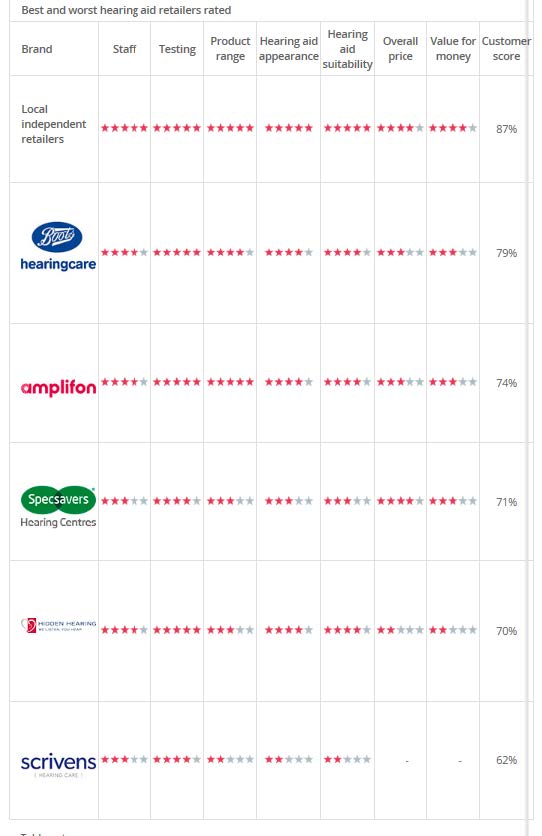
Which? has undertaken another series of surveys about hearing aids and their providers. In this the second article covering their findings, I want to speak about their Best Hearing Aid Providers 2018 article. Which? surveyed thousands of hearing aid users about their experiences asking questions that covered places that offer the best hearing tests and product choice, to those that deliver the best value for money. I will let you in on a secret, Independents won out, but you can see which other hearing aid providers scored best in the table below.

Linx Resound Quattro rechargeable hearing aids

Why does it matter where you buy hearing aids from?

A hearing aid is a major investment, not just in monetary terms. That investment of time and money should result in a better life for you. It’s important that you choose a trusted, knowledgeable retailer to ensure you increase your chances of getting the best hearing aid for you. While Which? Feel that all hearing aids are pretty much the same, I wouldn’t ascribe to that view. That is probably an argument for another day. Having said that, I do agree with them when they say, “It’s the professional fit and service given by the provider that matters more”.

Hearing aids don’t just work, or at least not all of the time. It can take time to fit and adjust a hearing aid correctly so that it’s working to maximise your hearing. You need the support and aftercare of a decent professional to get the best out of your hearing aids. If you don’t get it, the hearing aids will often end up in a drawer forever. Most hearing aid users reported in the survey that they wear their aid/s every day (69%), with 13% wearing them three to six times a week. Interestingly enough, Which? Reported that the hearing aids providers were rated quite differently on the hearing aids themselves. Scrivens customers rated the store poor for the range of hearing aids offered, its appearance, comfort and suitability of the hearing aids for the individual. Elsewhere, Boots and Amplifon customers rated them good or excellent on all of these measures.

Best hearing aid providers

The survey results show that local independent hearing aid providers are rated most highly by customers. They reached an overall customer score of 87%. At the other end of the table was Scrivens, with 62%. Which? Reported that Independents excelled in pricing transparency and value for money. The survey respondents also gave independents the highest ratings in the categories covering professional and knowledgeable staff and the way they deal with questions and concerns.

Out of the national high street brands, Boots Hearing Care came top with an overall customer score of 79%. It received three-star or higher ratings for each of the 21 aspects of service that Which? quizzed its customers about. Boots got full five-star ratings for the quality of its hearing testing, follow-up care, privacy and clarity. Interestingly Scrivens fell down on its product offering – including a poor rating for the comfort of its hearing aids and how well they suit the individual.

Pressure sales

Interestingly, nearly a quarter (23%) of private hearing aid customers felt under some pressure to buy, and just over one in five (21%) felt that they were under pressure to select a more expensive option from a range of suggested products. This varied considerably between providers, with the biggest difference between Hidden Hearing and local independents.

How did hearing aid retailers differ?

It’s fascinating when you dig a little deeper into the survey, one thing that was interesting was that what you pay for hearing aids isn’t necessarily rated the same as value for money or transparency of price. For instance, Specsavers was rated good for price and price transparency but it was only rated average for value for money. So the survey seems to suggest that they are cheap and transparent but don’t deliver value for money no matter what they charge.

That’s a really interesting concept and I wish I could have delved deeper to identify why. I mean is it the service and aftercare, is it the efficacy of the aids? Why is cheap, not good value for money, did they feel that they would have to spend again to get better? I wish that Which? had asked questions about loyalty to the brands. If they did, they didn’t discuss them. 

Customers rated independent hearing aid retailers excellent for transparency of price, and good on overall price and value. Hidden Hearing got spanked in those categories, customers rated the brand poor for price and value for money. It was rated average for price transparency, which is lower than the other brands rated (Hidden is the only high street brand that doesn’t put its hearing aid prices online).

Hearing aids cost?

According to the survey respondents, the average amount spent on a pair of hearing aids, was £2,475. The lowest average price paid by Which? members for a pair of hearing aids was with Scrivens at £1,583, but Scrivens also got the lowest customer satisfaction score, with 62%. Which seems to prove the old adage when you buy cheap, you pay dearly. 

The highest average price paid for a pair of hearing aids with local independents was £3,217.74. Average prices paid at other chains for a pair of hearing aids were £2,657 at Amplifon. £2,882 at Hidden Hearing. £3,646 at Boots. and £1,767 at Specsavers.

In finishing, independent hearing aid providers are again rated top as providers. Other key lessons are that when it comes to hearing aid success and satisfaction, you get what you pay for and surprisingly, independents appear to be a little cheaper than Boots. 

Which? Survey, NHS vs Private High Street Hearing Aid Retailers

Satisfaction With High Street Retailers High, But NHS Not Far Behind

Which surveyed hearing aid users in April 2018 to compare satisfaction rates of people provided services by the NHS and by private High Street retailers such as Boots, Specsavers, Hidden Hearing and Amplifon. The results were interesting, to say the least, and overall; private retailers pipped the NHS generally. The only area that was dramatically different was in the hearing aid questions. People were overall much happier with private hearing aids. The survey raises questions about what consumers are looking for as well, let’s take a look. 

Linx Resound Quattro rechargeable hearing aids

The Survey

Which? surveyed members who have recently got a hearing aid via the NHS or bought hearing aids from a private provider. They asked questions that covered the entire process and asked them to rate their experience. The results reveal that overall satisfaction with hearing aid providers is high among UK consumers, whether they use the NHS or go private. Of 3,183 Which? members surveyed, the total average satisfaction score was 84%.

Which? reported that there was not a significant difference in overall satisfaction between those paying privately (88%) compared with those who got their hearing aids from the NHS (84% ) and those for whom the NHS paid to go privately through the Any Qualified Provider scheme (75% satisfaction score). But I think that is a pretty strong spread and statistically significant. For me, it appears that the NHS and Private providers are similar while the AQP scheme lags significantly behind. As I said, the most significant differences in answers were all to do with the hearing aids provided as you can see below

NHS hearing aids vs privately bought hearing aids
NHSPrivate sector
Waiting times78%95%
Cleanliness of hearing test facilities96%98%
Comfort of hearing test facilities86%90%
Level of privacy96%98%
Professionalism and knowledge of staff93%95%
Dealing with questions or concerns91%95%
Clarity of written and verbal information provided89%93%
Thoroughness of examination/ testing94%96%
overall customer service92%95%
Range of hearing aids offered23%84%
Appearance of the hearing aids72%95%
Comfort of the hearing aids75%92%
Extent to which the hearing aid/s suited you74%91%
Replacing lost or damaged aids88%90%
Dealing with repairs87%92%
Ease of booking follow-up appointments78%95%
Continuity of care (e.g. seeing the same audiologist)48%88%
Follow-up serv1ce74%92%
Overall priceN/A72%
Value for moneyN/A75%

The Hearing Aid Questions

Hearing aids provided was really where the difference between NHS and private showed up. While I wasn’t surprised by the difference in satisfaction in either the answers to the range or appearance questions, I was surprised by the answers to the answers to the comfort and extent of suitability responses. I expected them to be pretty level. Some of that could be explained by the fact that NHS users weren’t satisfied with what was offered, therefore their feelings about comfort and suitability were swayed. 

Up to 84% of private customers rated the range of aids as above average in the private sector, compared with just 23% of NHS patients. While customers can access the same hearing aid brands on the NHS as they can by buying privately (not the latest models). The NHS does not offer a choice of different models. Interestingly enough, where people could name the brand of hearing aids that the NHA had provided, they didn’t really differ between the NHS or private. The bulk of the aids were Phonak, Oticon or Signia. 

Having said all of that, the satisfaction rates that were achieved by private retailers also have a story to tell. For instance, why was the range of hearing aids provided only met with an 84% satisfaction rate? That surprised me considering that many of the high streets would offer a full range of models from many of the leading hearing aid brands. What more where the consumers looking for? I would dearly love to know the answer to that question.