In the canal (ITC) hearing aids

There are four main types of hearing aid: Behind The Ear (BTE), In The Ear (ITE), In The Canal (ITC) and Completely In Canal (CIC). Each have their own set of advantages and disadvantages. If you are thinking of buying a new hearing aid, it is worth spending some time thinking about which type would be best for you – ideally you should visit an audiologist or aid vendor who will give you a hearing assessment and advice on which aids would be most suitable for you.

In the Canal (ITC)

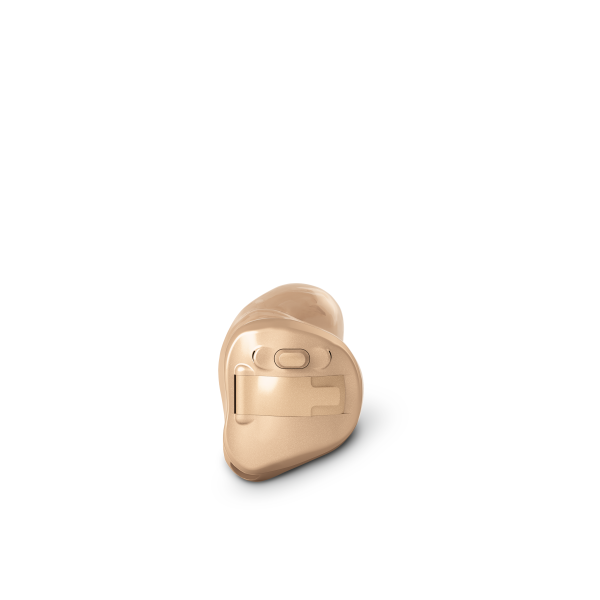
In the canal models are smaller than ITE aids, but larger than CIC ones. They tend to fill roughly half of your ear, whereas the ITE models usually fill the entire ear. ITC models are usually visible to other people; although they do come in range of skin-matching colours that make them difficult to spot unless someone is looking directly into your ear.

I have some problems with feedback with my own pair of Siemens ITC aids – particularly when I’m listening to music through headphones or wearing a tight fitting hat. I also find that many phones produce feedback with my hearing aid and I have to hold the phone at about a 45 degeree angle to stop it. This is not to say that all ITC hearing aids will produce feedback in these situations but it is something to find out about if you are thinking of buying a pair.

This type of hearing aid is normally recommended to people with mild to moderately-severe hearing loss.

Because the electronic components of ITC hearing aids are inside your ear they are suspectible to damage from ear wax and moisture. You should receive a set of brushes and other tools to help you keep your ITC aid clean and in good working order. 
Follow me on Twitter

I’m now on Twitter, so you have one more place where you can listen to me bitch and rant. I’ll be posting snippets of hearing aid related news that don’t warrant a post on here and no doubt some other stuff too, no idea what yet though, let’s see how it goes…

Follow me on Twitter.

Completely in the canal (CIC) hearing aids

There are for main types of hearing aid: Behind The Ear (BTE), In The Ear (ITE), In The Canal (ITC), and Completely In Canal (CIC). Each have their own set of advantages and disadvantages. If you are thinking of buying a new hearing aid, it is worth spending some time thinking about which type would be best for you – ideally you should visit an audiologist or aid vendor who will give you a hearing assessment and advice on which aids would be most suitable for you.

Completely In the Canal (CIC)

CIC hearing aid

Completely in the canal hearing aids are the smallest of all the models that are available today. They fit completely into your ear canal (hence the name!) and are virtually invisible to other people – usually only a small plastic wire protrudes from your canal and maybe be visible to people who are looking very closely at your ear. The plastic wire is necessary to enable you to pull the hearing aid out of your ear – it sits too far down the canal for you to be able to pull it out without the wire.

Similar feedback problems to the ITE and ITC aids could be experienced with CIC models – always try them out first if you intend to buy a pair. Test them when you are speaking on the phone to make sure they don’t produce too much feedback. In my experience, feedback has been less of a problem with CIC hearing aids than with ITC models – I assume this is because the receiver is further down the canal and not so close to the phone when you place it to your ear.

Because of their small size, CIC hearing aids are the least poweful. They will most likely be recommended to people with mild to moderate hearing loss. You will usually find that CIC aids are the most expensive of all the models available.

Because the electronic components of CIC hearing aids are inside your ear they are susceptible to damage from ear wax and moisture. You should receive a set of brushes and other tools to help you keep your CIC aid clean and in good working order.

Hansaton launches in the US

From a Hansaton press release:

January 11, 2010 – Hansaton, the German-based provider of award-winning hearing systems, announced today they are now offering their products to US-based audiologists and hearing aid dispensers.  Hansaton (hanz-a-tone) has designed and manufactured superior hearing devices for more than fifty years. The family-owned company currently has licensed dealers in 70 countries worldwide. Hansaton recently named industry veteran Robert Eastman as President and CEO of Hansaton-USA.

“Hearing device experts around the world know that Hansaton products offer world-class technology, designed in the great tradition of German engineering. But not everyone knows we offer much more than that,” said Eastman. “There are many excellent hearing assistance products to choose from.  Hansaton has created a value equation that combines the finest hearing devices in the world with exemplary customer service, simple pricing and ordering systems and efficient operations. That’s really how we differentiate ourselves.”

Hansaton’s products include a full range of hearing systems to address virtually any hearing loss and stylistic preference. These systems include multiple sizes of Behind-the-ear (BTE) instruments, In-the-ear (ITE) instruments from full-concha to completely -in-the-canal and the latest receiver-in-the-canal (RIC) instruments with three available power levels.  Hansaton’s hearing systems for adults and children include the award winning VELVET, first-class technology with a sophisticated appearance in an attractive design housing.  Hansaton’s products are also fully wireless-enabled, with the latest in Bluetooth connectivity, stereo wireless listening and ear-to-ear control.

Hansaton products will be sold in the United States through audiologists and hearing aid dispensers. On all hearing instruments Hansaton is providing a comprehensive three-year product warranty along with many other features that come standard.

For more information visit www.hansaton-usa.com, email info@hansaton.com or call at 888.984.7432.

Here’s why you are struggling to move from analog hearing aids to digital

Analogue and digital hearing aids are very, very different things. Analogue aids use older and simpler technology. If you are a long-term analogue user and you are having problems hearing well with new digital aids then try this:

Ask your audiologist to turn off noise reduction on your digital aids, if they can’t turn it off completely then at least have then reduce it to an absolute minimum.

The problem is that analogue aids amplify all sounds in the same way and as a long-term analogue wearer you are used to this, you are hearing voices nice and loud but doors closing and traffic noise is also loud, but your used to that and it’s fine. When you switch to a digital aid with noise reduction everything is suddenly much quieter, the aid reduces the volume of the closing door and the traffic, which for most people is great, but for you is not – your brain is used to loud. powerful sounds and cannot cope with the new quiet sounds.

If you ask your audiologist to re-programme your digital aids to be more like analogue then you should be able to hear as you did before.

I’m like this, I wore analogue aids for years and I wasted at least six months trying different digital aids and being very frustrated by not being able to her anyone talking with any of them. Turned out that it wasn’t the new aids at all, it was just the my audiologist at the time was using the default programme with full noise-reduction. I still wear digital aids today with very little active noise reduction.

Wean yourself off the noise

It would be very good for you if you gradually increased the noise reduction on your aids over time, to try and train yourself to listen and understand with noise reduction active, you’ll have a much better hearing experience. People say it takes anything from two to six months to do it, I still haven’t!

If you like what you see, share it so others can benefit

CART (Communication Access Realtime Translation)

Communication Access Realtime Translation (CART) is the process of converting speech to text in real-time, it is not only useful to the deaf and hard of hearing, it can also help those whose first language is different to the one being used. CART is used in law courts, theatre, presentations and many other places to display a speaker’s words on a screen; it is also used to provide closed captions for live television programs.

TV programs captioned using CART appear in the same way as those whose captions were created before the broadcast, typically with the text at the bottom of the screen. Whereas the pre-made captions will match the spoken words verbatim and appear in sync, CART captions may be a second or so after the spoken word and may contain some errors.

How CART is performed

Obviously the text produced with CART needs to be shown as quickly as possible so that the reader can keep up with the proceedings, but an accurate representation of the spoken words is also needed for reader comprehension. Individuals and companies who offer CART services will use a stenography machine (also known as stenotype or shorthand machine) to convert the spoken words into a shorthand notation that is then converted into readable text for display. The shorthand notation that is produced will have one letter or symbol representing one of more words, making it much quicker to type than the full English representation.

Becoming a certified CART provider is no mean feat and can take years of practice, certified providers can convert around 260 words per minute with a 98% accuracy.

Cherished Charms for hearing aids

Want to add a bit of pizzazz to your hearing aid? Does your child wear hearing aids and love jewellery? Stuck for a gift idea for the aid wearer in your life?

Hayleigh’s Cherished Charms is just the thing for you!

Here’s Hayleigh explaining her awesome product and how it came about:

Hi!  I’m Hayleigh and I am 11 years old.  When I was little and attended a school for hearing impaired children I noticed that a lot of kids tried to hide their hearing aids behind their hair.  I wanted to make my hearing aids shine and be fancy and proud of my hearing aids.

I started drawing pictures along with my sisters showing how I could make my hearing aids shine.  My mom helped me make our designs into jewelry for my hearing aids and they were so fancy.  Other kids and adults started wanting them too!

And so with the help of my mom and dad, I started my own little business… Hayleigh’s Cherished Charms.  I have my own work area at my house where my sisters and I make all the jewellery. I even have a provisional patent on my creations and will have a full patent soon!

My patented clasp ideas, hearing aid scrunchies, and tube twists are made so that little hands can use them and the designs hanging from the clasps face forward for all to see.

My sisters and I also make regular earrings because sometimes a mom or sister who doesn’t have hearing aids or cochlear implants wants to match their child / sister / brother who is wearing the charms. Yes, we have charms for boys…and even for adults!

A better way to trial hearing aids

Whenever someone buys a hearing aid they have a trial period in which they can decide whether they want to keep the hearing aid or not. If you are buying a hearing aid and aren’t offered a trial period then shop somewhere else.

Normally the way the trial works is that you pay up-front in full for your hearing aid and you take it away. You get an amount of time for the trial and at the end of that you can give it back or keep it. During the trial period you would go back to the audiologist and make any tweaks to the aid’s programme to get it just right for you.

This is good in that the hearing aid is trialed in the buyer’s normal environment – at home, at work, etc, etc.

One thing I don’t like about this is that the money has to be paid in full up front. Of course, the vendor cannot allow you to walk out with an expensive piece of equipment – they’d probably never see you again. So the vendor has to protect their interest, but what about the buyer? It’s scary to have to part with that amount of money and not be sure that you even want the product. Will the vendor definitely give you your money back? It’s scary.

For first time hearing aid wearers it may take them a long time to build up the courage to actually wear their new aid outside. If they don’t start wearing it straight away they are losing trial time.

What I think happens a lot is that someone gets pressure to go and visit an audiologist, buys a hearing aid, never really wears it during the trial and then because it is not configured properly for them never wears it again. Waste of money. Waste of hearing aid.

I think the trial process could be broken up into separate stages to help, in particular, first time wearers.

The software demo

A hearing aid is really about the software inside it. The quality of sound it produces, the noise it limits, etc. It would be great if audiologists could fit people during visits with a basic ear mould that would run the hearing aid software they are thinking of buying.

The audiologist has all the programming software for each aid – why not have the actual aid software too? When someone visits and wants to try a particular aid they can simply pop a generic throw-away hearing aid into their ear, select the hearing aid of choice and then play some common sounds. The buyer can then experience, possibly for the first time, what a hearing aid sounds like.

Are some vendors already doing this?

Time-limited hardware

Once a hearing aid has been selected does someone have to pay up-front for it there and then? I don’t think so. How about the audiologist fitting the buyer with a basic hearing aid mould in which the software is time limited? I.e. the hearing would work perfectly but after say 3 weeks it simply shuts off. It would be a less scary option for the buyer, given them a real world trial and costing the vendor nothing.

What do you think? Are current trials OK? When you buy a hearing aid are you happy to lay out a lot of money up front?

UK hearing loss facts and figures

In the UK, hearing impairment is a common condition. The Royal National Institute for Deaf People (RNID) estimates that in the UK there are almost nine million hearing impaired people.

Approximately 28% of people who are hearing impaired are between 16-60 years of age, and 72% are over 60 years of age.

In terms of age-related hearing loss, about 71% of people who are hearing impaired are over 70 years of age. The severity of hearing impairment among this age group is as follows:

  • mild – 38%,
  • moderate – 52%, and
  • severe – 10%.

Approximately 42% of people who are over 50 years of age have some kind of hearing impairment. The severity of hearing impairment among this age group is as follows:

  • mild – 52%,
  • moderate – 41%, and
  • severe – 7%.

In the UK, each year, around 840 babies are born with a significant hearing impairment. About 1 in 1,000 children are deaf at three years of age.

Approximately 20,000 children between 0-15 years of age are moderately to severely deaf, and there are about 12,000 children between this age range who were born deaf.

Taken from here.

The kiss of deaf

This unusual news items comes from Reuters India. It finishes with an amazing piece of advice for avoiding hearing loss due to kissing.

A young woman in southern China has partially lost her hearing after her boyfriend ruptured her eardrum during an excessively passionate kiss, local media reported on Monday.

The 20-something girl from Zhuhai, in southern Guangdong province, went to hospital completely deaf in her left ear, the China Daily said, citing a report in a local newspaper.

“The kiss reduced pressure in the mouth, pulled the eardrum out and caused the breakdown of the ear. The woman’s hearing would likely return to normal after about two months” said the hospital’s Doctor Li.

“While kissing is normally very safe, doctors advise people to proceed with caution,” the paper said.

“Doctors advise people to proceed with caution”!