I might not hear you….

  • Just because I heard you yesterday does not mean I will hear you today
  • If my back is turned I might not hear you
  • If I’m concentrating on something I might not hear you
  • If it’s windy I might not hear you
  • If other people are talking I might not hear you
  • If I’m tired I might not hear you
  • If you are covering your mouth I might not understand you
  • If my tinnitus is bad I might not hear you
  • If you shout I might not understand you
  • If we’re in a big open room I might not hear you
  • If you are not looking at me I might not hear you
  • If I have a cold I might not hear you
  • If you have a cold I might not understand you
  • If you are behind me I might not hear you
  • If we are in a group I might not hear you
  • If it’s noisy I might not hear you
  • If you didn’t get my attention first I might not hear you

Just because I heard you yesterday does not mean I will hear you today.

This list was inspired by this post from SayWhatClub.com.

Understanding an audiogram (hearing test results)

Explaining The Audiogram

An audiogram is the document that we use in Practice to record of a hearing test. In other words, it is the hearing test graph that we record the hearing test results on to show how well a person can hear different types of sounds. It is used to determine if a person has a hearing loss, and if so, how bad that loss is. In essence the audiogram is a record of the lowest sounds you can hear.

Blank Audiogram

Blank Audiogram

Understanding an Audiogram

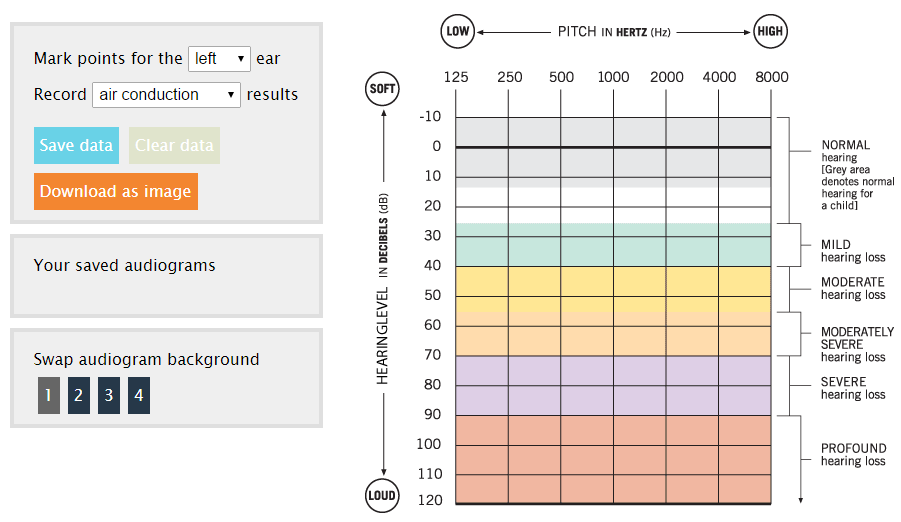
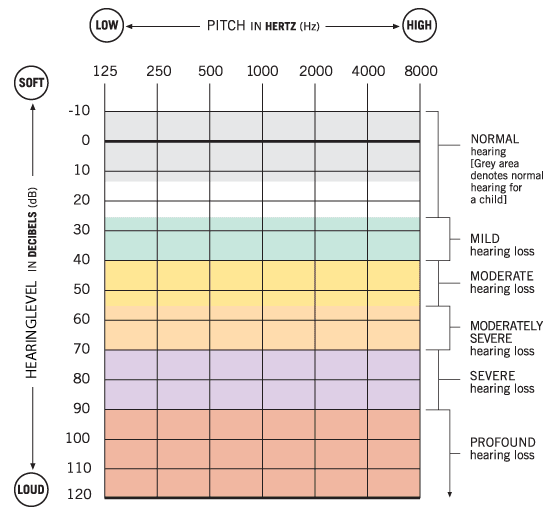
The audiogram above is empty, no test results have been recorded on it yet. You can see down the left hand side the numbers starting at -10 and going up to 120 – these numbers represent the decibel level (volume) at which you can hear a particular sound. The higher the number, the louder the sound. The decibels (-10 to 120) down the left hand side represent the full safe range of human hearing. The numbers running along the top, from 125 to 8000, represents the frequency or pitch of different sounds, from low pitch (for example a tuba, cannon shot or distant thunder and the vowels in speech) through to high pitch (for example breaking glass, a baby’s scream or a bird singing and the consonants in speech).

The Frequencies of Speech

These frequencies are tested because they are important frequencies for human speech. In essence, all hearing tests undertaken are primarily focused on speech. You may have the ability to hear at higher frequencies than are recorded on the chart or tested, but they are unimportant for the understanding of speech. Low frequencies in speech tend to be the vowel sounds in speech, high frequency sounds in speech are the consonant sounds in speech. Vowels have more power, they are formed in your chest and travel well, consonants are formed in your mouth, they don’t travel well but they are the sounds that form the clarity of speech. Without them, speech is all mumbling.

Levels of Hearing Loss

The wording on the right of the audiogram above groups the decibels to show different levels of hearing loss. If someone was tested on a sound and they heard it at 10 decibels (dB) then they have normal hearing ability for that sound – if they could not hear that sound until it was played at 50dB then they have a moderate hearing loss for that sound. You won’t see the groupings on the right hand side on most audiograms

The Hearing Test

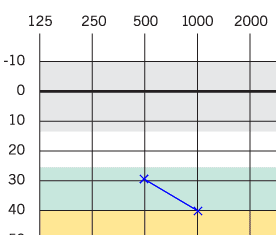
During a hearing test, different sounds will be played at different frequencies and intensities, usually starting at 1Khz (1000 Hz) and progressing through to the high pitches before testing low pitches. For each pitch the sound will be played clearly at an intensity you can hear, it will then be reduced to a level you can no longer hear. The intensity will be increased until the softest intensity you can hear it at is found. The the audiogram is then marked to show the decibel level for the tested pitch. In the example below you can see that the person tested was able to hear a 500hz sound at 30dB and a 1000hz sound at 40dB.

audiogram-snippet

Hearing Test Results

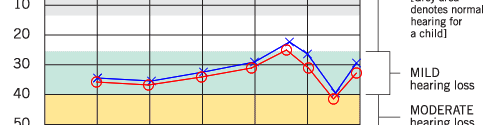
An audiogram will usually show three different results: pure-tone results for the left ear, pure-tone results for the right ear and bone conduction results. The pure-tone tests for the left and right ear are the “normal” hearing test, the one where you wear a pair of headphones and are asked to press a button when you hear a sound. The left ear results are shown as blue lines connecting blue crosses and the right ear is shown as red lines connecting red circles. A bone conduction test is where a small headset is placed just behind one of your ears rather than over it – the results for this are shown as green lines connecting green triangles.

In some cases further advanced audiometry needs to be undertaken. These tests are called masking. They are undertaken under strict rules where your original test shows particular parameters. Masking is undertaken by playing a rushing wind sound in one ear while tones are played to the other. It is done to keep one ear busy, while the other ear is tested.

If you like what you see, share it so others can benefit

Interview with Dr. Daniel Taft from Blamey & Saunders Hearing about Neurotone’s LACE listening enhancement software

Blamey & Saunders Hearing are a supplier of self-programmable hearing aids, they also sell Neurotone’s listening enhancement (LACE) software to compliment their hearing aid range. Dr. Daniel Taft, Australia Hears’ Chief Technology Officer, was kind enough to take the time to answer some questions about LACE.

Can you give us a brief introduction to LACE?

[Daniel Taft] LACE stands for Listening And Communication Enhancement. It was designed by leading audiologists at the University of California at San Francisco. LACE is an adaptive, interactive aural rehabilitation program that people can perform on their own PC, on their DVD player, or in a clinic under the supervision of their audiologist.
In the same way that physiotherapy helps rebuild muscles and compensate for physical weakness or injury, LACE training is used to help people develop skills and strategies to deal with situations when their hearing is inadequate. It helps people who have just acquired hearing aids (and also others who simply struggle in difficult situations) to make the most of their hearing.

Do you think people always understand the need for it? Hearing loss is obviously associated with ears, is it difficult to show the need to improve your brain’s ability to listen too?

[Daniel Taft] I think it is harder for some people to realise that there are real benefits to improving cognitive skills, unlike say physical training where the benefits are more obvious. Many people feel that purchasing a hearing aid is all that is needed to regain full communication abilities, but that is often unrealistic – just as it would be with any new tool or prosthesis. Hearing and listening are subtly different; one is a sense, the other is a skill.

Neurotone Inc. have a saying that “you hear with your ears and listen with your brain”.

How long typically would someone use LACE for before they start to see benefits?

[Daniel Taft] Data from Neurotone shows that after ten 20-minutes sessions, LACE users increase their ability to hear speech in a noisy room by up to 33%. Even after one or two sessions, LACE shows users that they are actually hearing more than they gave themselves credit for. LACE also offers lots of communication tips that help improve communication – every three minutes a new hint pops up.

You sell self-programmable hearing aids, seems like LACE is a perfect partner as it gives people complete control over their hearing?

[Daniel Taft] We agree! If a person is willing to regain control of their own hearing, and purchase and program their own hearing aids at home, then they are prime candidates to benefit from LACE. These sorts of people have no trouble becoming active listeners. We think we provide the perfect platform for LACE training.

Are there any plans for a iPod/mobile version?

[Daniel Taft] I’m told that Neurotone are developing a web-based program that will be platform independent. For now, there are Mac and Windows versions of LACE, and a DVD player version too.

Thanks again to Daniel for answering my questions. You can find out more about Blamey & Saunders Hearing by going to their website. To read more about LACE, or to download the free demo, go to the Neurotone website.

My audiogram

audiogram

The audiogram above shows my hearing as of November 2013. The hearing test was done at the John Radcliffe hospital in Oxford during my fitting for a pair of NHS hearing aids (Oticon Spirit II BTEs).

You can see from the audiogram that my hearing is in the moderately-severe to severe range – just touching on a profound loss in the higher frequencies. I have a progressive hearing loss, so my hearing hasn’t always been this bad but it has always been the same ‘shape’ – when I first got my hearing tested, aged 5, it looked more like this:

audiogram2

How much can I hear?

Short answer: almost nothing. Without my hearing aids I cannot hear much at all, I don’t hear any speech or music, I cannot hear the phone or the TV. Even if someone puts their mouth right to my ear I cannot hear what they say, if they try and shout it is just painful, but still no understanding. I can just about pick up a slamming door or a dog bark that is close by.

What about with hearing aids?

I wear a pair of Starkey S Series ITEs at the moment. With them in I can hold a conversation with someone one-to-one usually without too much hassle (even though I do have to concentrate all the time and it is hard work) – it’s much easier when the room is smaller and acoustics are good. I cannot hear well if someone is calling across a room or shouting from distance. Group conversations are really difficult, it’s tough to keep up with who is saying what.

Given that I have a progressive loss I don’t know how much longer I’m going to be able to use a hearing aid for – I don’t have far to go before my loss becomes profound across the range and a hearing aid won’t be much good to me by then. When that happens it’ll be time to seriously think about a cochlear implant or talking the family into learning BSL.

Hearing expert is pride of Scotland

A hearing expert who drove over 200 miles to help a patient is the pride of Scotland after being named the UK’s Audiologist of the Year for 2010.

David Bryce, who is from Aberdeen, has been chosen as the nation’s top hearing professional in a competition voted for by patients around the UK.

The competition is run by hearing aid battery maker Rayovac, the manufacturer of the world’s number one selling zinc air hearing aid batteries. It encourages patients with hearing difficulties to nominate professionals who go above and beyond the call of duty in the provision of care.

David, who runs Scottish Hearing Services centre with his family, is the first Scottish professional to win the Audiologist of the Year title. The competition is now in its third year and is held for the 3,000 plus hearing care professionals working in the UK today.

He is an experienced professional who has been caring for patients for over 20 years and was nominated for the award by regular visitor, Brian Johnston

David said: “Brian is someone who’s been coming to my clinic for many years so I’m very touched that he went to the effort of voting for me. I feel very proud to have won and happy that the service I provide is appreciated by patients like Brian.

“It’s very much a team effort as well, as I rely a great deal on my colleagues to provide on-going support and aftercare to patients.”

In his nomination, Brian praised the high quality of David’s care, highlighting his knowledge of hearing, his compassion and understanding of patients’ problems, particularly the time and care he takes to explain what he is doing and discuss any technical issues. This includes spending significant amounts of time trialling new settings on his hearing aids to find the perfect one.

He also highlighted David’s attention to care extended to driving more than 200 miles to visit him at home in Thurso and getting to know his family.

The award continues to attract a growing number of high quality entries year-on-year and was judged by an independent panel of industry experts including Alan Talbot, head of the British Society of Hearing Aid Audiologists (BSHAA), Tom Davison, a consultant at the RVI Hospital in Newcastle and Gillian Lacey from Hearing Dogs for Deaf People.

As winners, both David and Brian receive prizes, with David now in the running to be named this year’s European Audiologist of the Year – a title that will be awarded at the EUHA conference in Germany in October.

Paula Brinson-Pyke of Rayovac explains: “David demonstrates all the qualities of an outstanding hearing professional. He cares deeply for his patients, shows great sympathy and compassion and works incredibly hard to help them get them the right support they require.

“Reading through his nomination it was very easy to see the affection and regard in which he is held by his patients and the undoubted impact he has on their lives.

“He is a fitting winner of the award which has once again demonstrated the outstanding level of care and commitment provided by audiologists around the UK.”

Besides the winner, sixteen other hearing professionals were highly commended by the judges for their work. They include Gareth Morris, Hearing Aid Solutions; Tony Vaughan, Hidden Hearing; Tara Tripp, Tara Tripp Hearing Care; Robert Beiny, The Hearing Healthcare Practice; Jenny Crenshaw, Hidden Hearing; John Lloyd, Crystal Hearing UK; Jo Farquhar, Taylors; Alistair Kinsey, The Hearing Company; Ivind Thoresen, Kingscross Hospital; Alan Walshaw, Keighley Health Centre; Jo Rae, The Hearing Healthcare Practice; Nick Chitty, Oxford Hearing Centre; Stephen Fairfield, House of Hearing; Sid Sidhu, Regional Hearing; Deepak Jagota, Oxford Road; Shona Jackson, House of Hearing.

For further information about the Rayovac Audiologist of the Year competition visit: www.audiologistoftheyear.eu
Siemens Hearing Instruments is up for sale

Siemens is selling its hearing aid business. It has shortlisted one strategic buyer and five private equity firms as potential buyers. The New York Times reports that the sale price could be over 2 billion euros (1.8 billion pounds).

Siemens Hearing, which competes with Switzerland’s Sonova Holding and Denmark’s William Demant Holding A/S, is projected to make pre-tax earnings of some 170 million euros in 2010.

Seen on the New York Times.

Get hearing aids repaired or cleaned at The Hearing Aid Repair Shop

The Hearing Aid Repair Shop is part of the Mary Hare Foundation, a UK charity that provides schooling for deaf and severely hard-of hearing children.

The repair shop began operating in 2002 by repairing aids for children and young adults. Recently they’ve started fixing hearing aids for adults too and now offer a post service. Impressively, they will fix any make and model of hearing aid.

At the time of writing, you can get your hearing aid cleaned, checked and tested for £20, and you can get a repair for £78, which includes a 6 month warranty, postage and packing and a pack of batteries!

That’s really good prices and would be a great way to fix or breath some new life into your ailing or broken aid.

Visit The Hearing Aid Repair Shop or Mary Hare websites for more info.

Preventing hearing loss in noisy work environments

The following is a guest post from Samantha Harvey on behalf of National Hearing Care.

In our day-to-day life, most of us are exposed to noise; from the sound of a passing train to the noise of a nearby construction site. Normally, these sounds are not loud enough to damage our hearing, however, if we are exposed to loud noises that are above 85 decibels on a regular basis, it can result in noise-induced hearing loss (NIHL). Hearing loss may even occur if a person is exposed to an intensely loud noise just once, such as an explosion.

Within the ear, there are many small sensory cells, called hair cells. These hair cells work to convert the energy of sound into electrical signals, which are then sent to the brain. These hair cells are extremely sensitive and once they become damaged, they cannot be repaired.

Clearly, people who work in loud environments, such as construction workers or musicians, are at risk when it comes to NIHL. However, people who work in these types of professions are not the only ones at risk. According to a study carried out by a group of scientists from the Scientific Committee on Emerging and Newly Identified Health Risks, many people are damaging their ears just by listening to music on their MP3 players or iPods.

The study found that those who listen to their music players at high volume for around five hours a week were exposing themselves to more noise than is legally permitted in workplaces such as factories or construction sites. The study also found that the maximum volume on many popular devices can generate the same amount of noise as an aeroplane taking off.

The danger with this is that people are unaware of the damage they are doing to their ears, because it happens so gradually that the damage is only noticed years later when it is too late. The researchers advise listening to music devices at only about 60 percent of the maximum sound output in order to prevent NIHL.

Another way to protect your ears when listening to music on an MP3 player or iPod is to invest in a good pair of headphones. Noise cancelling headphones will prevent you from setting the volume too high when you are listening to music in a noisy environment, such as an aeroplane, bus or train.

Night clubs and concerts also present a risk to the young people who frequent them. According to research carried out by the Royal National Institute for Deaf People (RNID), between 60 to 70 percent of all frequent clubbers or concert goers have reported some form of hearing loss.

This is unsurprising considering that nightclubs can produce sounds up to 129 decibels, which is louder than the sound produced by a pneumatic drill. Those who work in environments where sound levels exceed 85 decibels are required by law to use hearing protection.

In order to minimise these risks the RNID recommends that people take regular breaks and stand far away from speakers when clubbing or attending a concert. If you visit these types of venues on a regular basis (every weekend for example) it is recommended that you use earplugs.

Special earplugs or earmuffs should always be used when engaging in any activity where noise levels exceed 85 decibels; this can include regular activities such as mowing the lawn or using power tools. NIHL is 100 percent preventable, so it is important to be aware of the risks and take the necessary precautions.

Buying a new hearing aid – it takes two to tango

I’ve written before about how important it is to have a great audiologistBut that’s not the whole story. You are involved too and you are just as important as the audiologist.

When you’ve been fitted with your new hearing aid for the very first time it will be set-up to match the results of your hearing test. You are in the audiologist’s office with your new aids in your ears and you are listening to lots of new sounds. If you experiencing any problems straight away like not being able to hear or your are getting some feedback, tell the audiologist and they will re-programme your aid to fix the problem.

So now your visit to the audiologist for fitting is over and you’ve started your trial period in which you decide if you want to keep the aids or not – most places will offer a one or two month trial with either a money back refund or a free swap to a different aid. It’s during this time that you are the important one, your audiologist has set the hearing aids for your hearing loss and now it’s up to you to find out what is working for you and what isn’t.

Your audiologist should have made a follow-up appointment for you so that you can report any problems and get them fixed – if they didn’t do that then book one yourself on the day of your fitting for a week’s time.

I can’t stress how important the trial period is for you, lots of people don’t like their new hearing aids because they don’t work as well as they thought they were going to. In worst cases, people will just dump their hearing aids in a draw and never use them because they’re pieces of junk. But they still have to pay for them.

The key thing is: it takes time to get used to new hearing aids. Your brain needs to adapt to the new sounds. If you’ve had an untreated hearing loss for a long time then your brain needs to re-learn how to interpret spoken words that it hasn’t heard for so long –  this isn’t easy. People with a mild hearing loss should find it easier to adapt than someone with a severe one.

If you have a two month trial on your new aids then it is absolutely critical that you wear them as much as you possibly can in all of the situations that you are going to want to hear in (at home, at work, bars, sports events, etc). And just as importantly: reports everything back to the audiologist on your visits, the good things as well as the bad.

If you can wear your hearing aids enough to find all of the problem and get them fixed then you are going to be able to make a much more informed decision at the end of your trial period. And worst case: you might have a problem with them that can’t be fixed, best to discover that while you are still in the trial.

And remember, it takes time to get used to new hearing aids. Your brain will be working hard to make sense of the new sounds and it will also adapt to them over time, so you might not hear exactly the same in the first week that you are wearing them as you will in the eighth week. If you wear glasses then you’ll know that everything seems a bit blurry and weird when you first put on a new pair but that soon disappears as your brain compensates for the new visual signals it is getting and it’s the same with your ears and hearing aids.