A possible new treatment for acute or sudden sensorineural hearing loss has showed promising results in animal trials. The company now hopes to press forward in their research with the end goal of developing a possible human treatment.
Sensorion, a French biotechnology firm has announced promising new preclinical results obtained with its investigational drug SENS-401. The drug is currently under development to treat acute or sudden sensorineural hearing loss. The results were presented at the Annual Meeting of the Society for Neuroscience (SfN) in San Diego, California, last week.
In the proof-of-concept study, animals were exposed to 120 dB of noise for two hours, then randomly treated over a forthnight with either a placebo or increasing doses (5 mg/kg, 10 mg/kg and 20 mg/kg) of the experimental drug.
After the 14 day treatment period, the placebo group had recovered an average of 7.1 to 12.9 dB, while the treated group had recovered an average of 20.8 to 29.2 dB. They reported that a dose-dependent effect was also observed, with greater recovery at the highest doses of of the drug compared with the lowest dose or placebo.
“On the basis of these positive results, we intend to continue the clinical development of SENS-401 in this particularly-debilitating pathology for which there is currently no effective treatment,” said Sensorion’s Chief Medical Officer, Pierre Attali.
Sudden sensorineural hearing loss is defined as the onset of unexplained one-sided hearing loss of more than 30 dB in three sequential sound frequencies in less than 72 hours. It strikes an estimated 5-20/100,000 persons per year.
While some sufferers spontaneously recover their hearing, many do not. The treatment at present for SSNHL is a tapering course of oral corticosteroids (prednisone or methylprednisolone). However, it is only effective if the condition is diagnosed early and treatment is undertaken immediately.
It is imperative for recovery that the treatment with steroids is undertaken quickly and there is only a short window or period of time to do so.
If you like what you see, share it so others can benefit
I had an interesting conversation with someone from Widex recently in relation to the new Widex Beyond Made For iPhone hearing aid. It was in relation to the tri radio set up they had decided upon for the device. I have said before it made sense for them to keep the WidexLink radio on board and I said as much. Although I was thinking about backward compatibility. He said a really interesting thing, he said yes it would have meant losing the inter ear features when streaming if we didn’t. It struck me that he was of course right, then it struck me if that meant that the others were losing inter ear features when streaming.
Important features
Wireless hearing aids were a groundbreaking move forward in hearing aid technology. While the new accessory devices that became available make a real difference to people with hearing loss, it is actually the wireless communication between the hearing aids that has made such a huge difference.
The interear features are important for the efficacy of the hearing aids especially in difficult situations. In the top of the range Widex devices the biggest benefit to the user is the fact that the devices act in unison as one system in so many ways. They can only do so when communicating with each other. Let’s talk about those features in a Widex aid, specifically the Unique which is what the Widex Beyond is based on, and what they do.
Interear features
Sound Classes
Widex introduced Sound classes for the first time ever in the Unique range of hearing aids. Sound classes are different pre-sets that are designed to deal with very different sound environments. They are automatically applied when they hearing devices classify a change in sound environment. In the 440 and 330 range they are inter ear, which simply means that the hearing devices act in unison to decide what to do and when.
Compression
Compression is quite a technical feature to explain, in essence it is how the hearing aids manipulate and amplify sound. Widex has delivered inter ear compression in all of their technology levels in the Unique. Interear Compression is one of the reasons that Widex hearing aids work so well and sound so natural, in essence the hearing aids work together to decide how the sound is delivered to you.
This allows them to deliver the sound to you in the most natural way possible, preserving the auditory cues in their most natural state. This allows your brain to sort it out in the best way possible. In essence, the sound is presented to your brain in a natural way, allowing the brain to do what it does best. This was actually the biggest break through delivered by wireless hearing aids and why I think wireless devices which offer it are superior to everything else.
Noise Reduction
In both the 440 and 330 from Widex the noise reduction strategy is applied in an interear fashion. It means that the hearing aids make a decision about how noise reduction is applied in a systemic way taking full account of the sound environment. This has to be the most effective way to deal with noise.
There are other interear features available on Widex devices but I think these are the most important. These features are what make wireless hearing aids far superior than non wireless hearing aids. Each manufacturer has different inter ear features that do different things. They all combine to provide the very best listening experience for the user. However, if those interear features are compromised by the act of streaming it means that the hearing devices are hobbled in a way.
While this might not neceessarily seem important for most streaming activities like listening to music or played audio from a phone. It does matter if you are using your phone as a remote microphone, in fact in this stype of situation you want all the help you can get. That is why you are using the remote microphone. So it would seem counter productive to hobble the hearing devices by disabling the interear features.
I don’t know if that is the case with the other hearing device manufacturers, however, I plan to ask them and update this post with their answers. If that is the case though, it would mean that the Widex Beyond is the best Made For iPhone hearing aid ever.
If you like what you see, share it so others can benefit
I have noticed more than a few times on the web older hearing aid technology being marked as obsolete, do not buy. I don’t necessarily agree, I understand why they are marked obsolete and it is a great service for the consumer, however, the do not buy statement, I don’t necessarily agree with, let’s talk about buying older hearing aid technology.
Educated Purchase
We always want to give good, fair and balanced advice about buying hearing aids here. We believe in giving consumers the tools and knowledge to make good educated decisions on purchasing hearing aids. I applaud all of the websites who point out that certain hearing aids have been replaced or are now out of date.
But, even if a hearing aid is out of date or has been replaced, it doesn’t mean it is a bad purchase. I mean if you weigh up the pros and cons, understand implicitly that you are buying older technology and most important of all are getting a fantastic price, then how bad can that be?
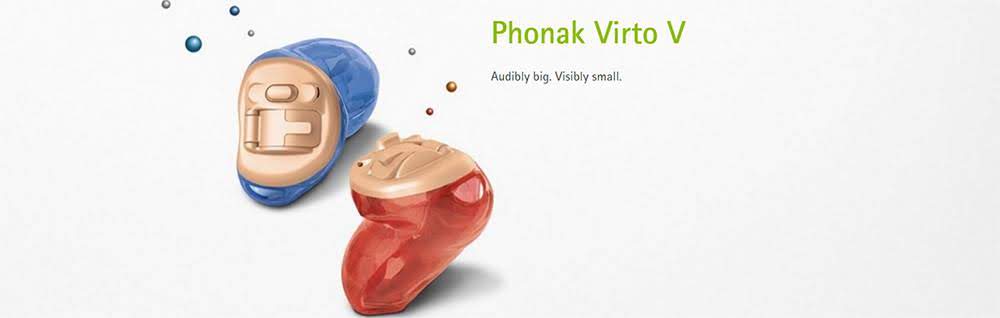
Take the Phonak Virto Venture hearing aids for instance. The Virto V has just been replaced by the Virto Belong range. I think many will probably offer a special discount offer on the Virto V range in the next couple of months. The Virto V90 was and is an exceptional hearing aid range which offers high-quality sound and an outstanding ability to hear in even complex sound situations. Yes, its last years and the Belong is even better, but it doesn’t reduce the fact that the Venture was good stuff.
High-End Technology is High-End Technology
High end or premium hearing aid technology is where it is at in order that you get the very best opportunity to hear better in even the most complex situations. However, for many, it is financially onerous or even out of reach. If you can buy the last generation high-end technology for half the price, that is an excellent opportunity. It is important though that you do your research, firstly, is it the last generation and what are the general reviews about it.
Tired of Listening to Bla? We Got You Covered
Our buying guide, no Bla, just clear easy to understand info, we guarantee it will help you pick the right hearing aid for you.
Life Cycle of Hearing Aid Technology
The life cycle of hearing technology tends to be four to five years. By that, I mean every four years hearing aid technology changes as to be almost unrecognisable from before. Some technology comes along that dramatically changes how they work. Several years ago it was the introduction of binaural or combined compression.
Every year or two we see something new, and it is genuinely new, however, it is usually an upgrade on what has gone before as opposed to a dynamic leap forward. Is it new? Yes. Is it an improvement? Yes. Will it help you hear better? Yes. Should you run out and buy it? Not necessarily, especially if you are wearing top of the range hearing aids from the last generation.
Don’t get me wrong, the new stuff is better, you will notice a difference, but that doesn’t mean the old platform is ready for the bin. Be smart about your purchase, educate yourself and then armed with the knowledge make a decision on whether the older technology will deliver for you. If you think it will buy it at the better price when it is offered and when you get the opportunity, but only if the offer makes financial sense and is made honestly.
If you like what you see, share it so others can benefit
You know it is nice sometimes to recognise the work of others. Especially when their selflessness has spurred them to help others. So I came across a great story about Nancy Gilbertson and I felt I had to salute her and her work. So who is Nancy? Glad You Asked That. Well we saw her story in the article Her Journey Through Hearing Loss
Nancy suffered irreversible hearing loss in one ear after surgery. Ironically, the surgery was to correct her hearing. To add insult to injury, not just did she lose hearing in one ear, medication affected the hearing in the other ear. She was told she would be deaf by 35. She says:
“That was a death sentence to me because I am a people person,” she said. “I’m sure I can speak for almost anybody that we get to be very good actors and actresses and we can hide it quite well.”
Nancy said that at the time there was no support groups, there was no one that she could speak to about her sense of loss. Nor was there anyone to speak to about experiences with hearing loss. She herself has experienced the emotions that go along with hearing loss, the denial, the depression, the fear.
Nancy was attending meetings of the Fox Valley chapter of the Hearing Loss Association of America, but she felt there was an aspect missing from the meetings so she helped form HOPE (Hearing Other People’s Experiences) in 2015.
HOPE is a place where people can share experiences and information. The group also supports family members of people with hearing loss. Last year Gilbertson also started a HOPE Chest, which is stocked with many communication devices to help others hear. Attendees of the group can borrow the devices to help in their decisions on what to use to help them hear better.
We think this is an outstanding idea, part of the underlying fear in hearing loss is not knowing what to expect. Having questions that are unanswered. The idea of groups like Nancy’s is to give answers to all the questions from people who have real experiences of the problems. Nancy was spurred by her own hearing loss, while working through the emotions of it she decided that she should and could help others. Myself and Steve have differing experiences but we are driven by similar feelings. So Nancy Gilberston, we salute you.
If you like what you see, share it so others can benefit
In this our second guest post in as many weeks, Andrew Lekashman of ClearValuediscusses words that can be difficult to understand when someone has a hearing loss and replacement words that can be used instead to give a person with hearing loss a better opportunity to understand. It’s a great article and worthwhile reading, in fact, I would like to thank him, because it is something that I will refer my Patients to from now on. Without further adieu, I will hand you over the Andrew.
Geoff
A person with hearing loss often has difficulty in understanding words or parts of words. When speaking, your voice may be audible, but separate words may sound mixed up or blurred together. Rhyming or words that are similar such as: cat/cap, bread/thread, pool/cool, etc. are extremely difficult to distinguish when the listener has a hearing loss. When your family member or speaking partner does not understand you the first time you say something, repeating the same words often will not make it more clear. This article explores other options, specifically rephrasing the sentence using different words which may be better understood.
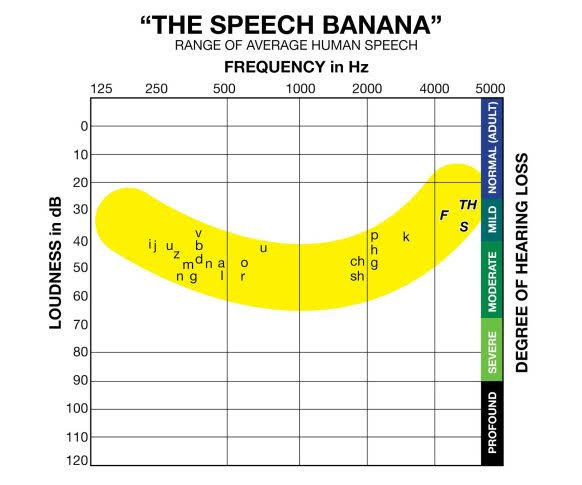
We introduce the “Speech Banana” as a useful visual tool for describing where the sounds used in everyday human speech occur. Commonly used parts of speech and letters are mapped out on a graph according to their frequency when spoken. In this instance, frequency doesn’t refer to how often a sound is used, but instead the audible frequency that the sound resonates at. All of the letters together on the graph form a banana-like shape, which is where the fun term “Speech Banana” comes from.
This graph can be useful in understanding the high frequency (4000 Hz and up) sounds in our everyday speech such as “f”, “th”, and “s”. Although there are other types of hearing loss, the most common is a high frequency hearing loss, it also tends to be the variant that affects everyone the earliest. To increase overall understanding, high frequency words and sounds should be substituted for easier to understand low frequency words and sounds. When substituting words focus on using sounds from the left half of the “Speech Banana”.
When reading the example sentences, try to imagine that the letters in bold won’t be heard by your conversation partner for the best effect.
This / That
“This” is one of the most common words in the English Language, and it is also a very easy word to hear incorrectly if you suffer from high-frequency hearing loss. The reason it is so challenging to hear lies in two parts. The first part is because it ends on a high frequency “s” sound, which is difficult for people with hearing loss to comprehend. The second part is because there are so many words that begin with a “th” sound that a listener will not have an easy time guessing which “th” word was said.
“That” is much easier to hear because of the flatter, bassier way by which “at” is often said. It isn’t a perfect substitute, but there are many instances where “that” can be used, such as the following:
“I would like this one.” vs “I would like that one.” “Would you hold this for me?” vs “Would you hold that for me?”
Taste / Flavor
Everyone must eat, it is one of the facts of life that brings all people together. One word that is used more than many others when describing food is the word “taste”. Unfortunately, “taste” and the frequently used “tastes” can be very tricky to hear. The first “t” sound that starts everything is a bit difficult to hear, and the “st” near the end is even more challenging.
“Flavor” is a much easier word to discern that appropriately covers many of the uses of “taste”. The first and second part of the word flavor are very drawn out, and it is not easily confused for other words.
“This sandwich tastes wonderful.” vs “This sandwich has a wonderful flavor.” “Does that taste good?” vs “Does that have a good flavor?”
House / Home
“House” is another prime example of a word that is difficult to hear based on the amount of words that have a similar sound. On top of trying to differentiate which word you are saying beginning with an “h”, the listener also struggles to hear the “s” at the end of the word. This combination of variables would make “house” hard to hear.
When replacing the word with “home” you may still have a slight difficulty with the beginning “h” sound, but the listener will be able to better understand the ending of the word due to the lower frequency “m” sound.
“Is that your house?” vs “Is that your home?” “What a lovely house!” vs “What a lovely home.”
First / One
“First” is a high-frequency sandwich word, made up of “f” and “st” bread. Imagine trying to hear a word within a sentence but only being able to hear the “ir”. While context clues may help you determine what word is being said, it will still be difficult to follow the speaker.
While the word “first” may be able to be eliminated completely from a sentence in certain instances, it can also be replaced with “one”.
“Let me show you this one first.” vs “Let me show you this one.” “What is first on the list?” vs “What is number one on the list?”
Nice / Good
It would be “Nice” if you could avoid this word too. The “c” makes a very light airy sound that could be missed easily. Imagine hearing “Ni…” and then trying to decide what was said.
“Good” would be an acceptable replacement. The “g” and the “d” have very deep sounding letters, making it a “good” low-frequency word.
“You did a nice job.” vs “You did a good job.” “What a nice meal.” vs “What a good meal.”
Thirsty / Drink
“Thirsty” is another combination of high-frequency sounds. The “Th” and “s” will get lost in conversation when using this word. Most words that contain these letters will be difficult to understand and it is most important to stay away from words that have two or more uses of these letters.
“Drink” avoids all of these high pitch sounds, making it a much better word for people with hearing loss. The “d” had a deep, low sound while the “k” has a hard, brisk sound making them easy to hear. In addition, there are few other words that begin with “drin…”, so there is a high chance of being understood.
“Are you thirsty?” vs “Do you need a drink?” “I am thirsty.” vs “I need a drink.”
Past / Before
In the “past” few paragraphs you have probably started to see a trend here. There are so many words that we use on a daily basis that end in “st”. If we can avoid it, we should that way there is less confusion to be had.
“Before” focuses on letters on the left side of the Speech Banana. We can say and hear these letters better and with lower tones that the word “past”.
“Have you been here in the past?” vs “Have you been here before?” “That was in the past.” vs “That was before.”
She / Her
“She” is made up of two out of three letters to avoid. The “sh” has the issue of not only being hard to hear due to the high frequency but also because so many other words start with the same sound. Being such a short word and quickly said, it will get lost in conversation.
While “her” is still a very short word, the “h” and the “r” can be pronounced clearly enough to be understood.
“Did she say something?” vs “Did you hear her?” “She looks good in that dress.” vs “Does that dress look good on her?”
Such / Very
“Such” can be a hard one because both the “s” and the “ch” are high-frequency sounds and they make up the majority of what is said. This word is easily replaced with “very”, which is also an incredibly common word. The “v” in very is a deep and unmistakable sound, making for a simple word choice that you likely already use.
“I had such a good time!” vs “I had a very good time!” “You are such a funny person.” vs “You are a very funny person.”
Almost / Nearly
“Almost” is unique on this list in that very few common words share a similar pronunciation. Words like “this” and “first” become difficult because there are so many other words that sound like them, but “almost” is the exact opposite. It is for this reason that it is an excellent choice for substitution, since a person who hears , “Almo….” will not be able to easily place what you meant. “Nearly” is a simple word to understand, replaces “almost” well, and has none of the especially challenging “st”, “th”, or “s” sounds that plague those with hearing loss.
“I almost made the shot!” vs “I nearly made the shot!” “Are you almost here?” vs “Are you nearly here?”
Communicating with our loved ones is a big part of our everyday life. When talking to someone with a serious hearing loss, you can make your conversations better by replacing high frequency sounds with low frequency ones. Other great tips to make your loved one feel more comfortable is to be looking directly at them when talking, and to talk slowly and clearly. Talking slowly will drastically increase your chances of being understood. Saying words slowly decreases the overall frequency of the word, by drawing out the sounds of the letters makes it easier to comprehend.
Speaking to hear the sound of your own voice is typically considered a poor use of time. While speaking with the purpose of helping people with hearing loss to hear, we strive to make sure that everyone involved understands their role in communication. It is important that the speaker aims to be understood, and that conversation always be a two-way street. Not all of the words suggested here are perfect substitutes for their more difficult counterparts, but the rules of the English language bend a bit when one party involved is physically incapable of understanding specific tones. The purpose of this short list of ten words is to provide you with a beginning framework to adapt your use of language and be more effective when talking to people with hearing loss.
It should be noted that the words listed here are specifically tailored to address the needs of people with High Frequency hearing loss. While the most common form of hearing loss, it is by no means the only type that occurs. To properly learn the best way to adapt your speech, it is strongly recommended that a hearing test be performed by a qualified and established audiologist or hearing specialist.
Disclosure:
This article was written by Andrew Lekashman of ClearValue Hearing, the Free Hearing Healthcare Benefits Plan. To learn more about how to have your hearing tested for free, please visit us online at www.clearvaluehearing.com.
If you like what you see, share it so others can benefit
In a statement recently it was announced that Starkey would partner with an Israeli start up company called Humavox to introduce a brand new wireless recharging system for their hearing aids. It would mean that Starkey would probably lead the field with the most advanced system to date if it is introduced. Let me explain.
Firstly, we are making some assumptions here and nothing other than the partnership has been announced, however, we think those assumptions can be called educated guesses. I would think that the devices will be based on Lithium-ion technology. That would make the most sense as it is hands down the best system available for hearing aid use.
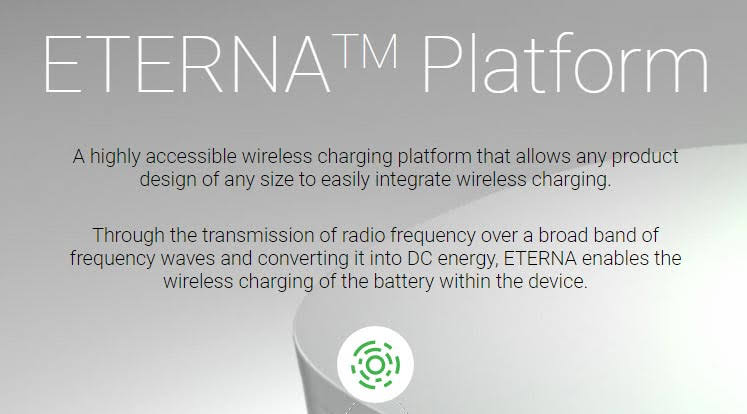
I also think that the system will be a true wireless charging system, because that is what Humavox is famous for. Let me explain what wireless charging is in this context. Humavox have designed a radio frequency system that allows them to charge a device via radio signals. Sounds fanciful but that is exactly what it does.
It does this in the near field, which means that the charging station and the devices to be charged have to be in proximity to each other. In one of their promotional videos they show a table which acts as a charging station. You simply charge your device by putting it on the table. Update here, we were talking to an engineer friend who told us that for the system to work without interference from other radio signals, the charging stations needs to enclose the object being charged. Which means that the devices would have to be dropped into a case or box. It still would be exceptionally easy as you wouldn’t have to think about putting them in a slot or lining up contacts, you would simply drop them in.
When delivered it should mean that Starkey devices can be charged easily and without fuss, you will probably just have to drop them into their case and they will charge automatically without any fuss. However, only time will tell and without doubt there will be difficulties that the engineers have to overcome.
If you like what you see, share it so others can benefit
I’ve been trying out a pair of Oticon’s OPN hearing aids over the last two weeks. Being a bit of a nerd, I have been excited for a while see how the Oticon ON app would work alongside the hearing aids to allow me to connect them to other Internet-connected devices using the IFTTT service.
But more on IFTTT and me being a nerd in a later article.
I’d been told by a few people that Oticon products sound a little different to other brands as they use different sound processing and compression models – I hadn’t worn Oticon before it was interesting to find out.
In the last week, I have been to two different restaurants and both were excellent tests of the OPNs capabilities in a lot of background noise.
The first was Oxy in Oxford, which is basically one very large open plan room. There are a few tables that have seating with high backs and I asked for one of those seats so I could at least use the high-backed seat to block out some noise behind me. I’ve been here many times before and it has always been noisy and a difficult hearing experience.
The first thing that struck me about the OPNs was that the background noise sounded different – people’s voices from other tables around us sounded a lot more natural with the OPNs, I was able to isolate different groups and know where their voices were coming from. The noisy room chatter felt a lot more manageable, much less of “Woah, its noisy in here” – it’s difficult to describe but it kind of felt to me that the background noise was really in the background, was at a pleasant volume, wasn’t distorted or overwhelming and had clarity about it. Which is quite a change from other hearing aids in this restaurant, where the background noise was almost like a wall of noise, more of an indistinguishable roar than a lot of individual voices.
Tired of Listening to Bla? We Got You Covered
Our buying guide, no Bla, just clear easy to understand info, we guarantee it will help you pick the right hearing aid for you.
The better management of background noise also meant that I was able to hear people around my table VERY clearly. The OPNs picked them out superbly, that goes for people sitting directly in front of me and to the sides – the voices from my table were brought to the fore and I could hear them very clearly over the competing noise. Again this was different to previous visits where voices I wanted to hear had a very tough time competing with the background rabble. The Oticon’s did a superb job of letting me hear who I wanted to hear without much effort at all.
The second restaurant test was at the Harvester. This is not as open-plan as Oxy but we got a table which had no surrounding walls or high seats to block out noise – just to make things more difficult, I had my back to the bar, so there was a constant stream of customers ordering and people milling about.
We were a table of six, so more voices coming from many different angles. The OPNs again performed very well and I was able to follow most conversations without a great deal of effort, there was one or two times where I was turned around facing someone on my left and someone to my right said something that I was not able to hear properly – I knew they said something and turned around to say “what?” but I couldn’t pick it up the first time, this was due to the OPN focusing most of the listening to the front of me and to be honest I wouldn’t expect, or want, to be able to hear things behind me as well as things in front of me all the time, that would not be my normal listening experience.
There was not any problem of overly loud noises in either restaurant, sometimes in the past, with different aids, plates banging or chairs scraping on tiled floors could be a bit uncomfortably loud but I had none of that this time.
I guess the OPNs have a specific restaurant mode on them, which I wasn’t using and even without it I was very comfortable listening to people I wanted to hear in noisy environments that would cause other hearing aids no end of problems.
Have your hearing aid fine tuned while you are sitting at home, what’s not to like?
Sivantos, formerly Siemen and now the artist that calls themselves Signia, has introduced a truly groundbreaking innovation in collaborative hearing care. They have introduced the first hearing aid app that has deep user/professional communications and the ability for a professional to fine tune hearing aids remotely. We know groundbreaking is used quite a bit, but this is truly earth shattering.
So first I think we need to clear up the confusion of the names, Sivantos is the private business that bought Siemens Hearing Aids from Siemens. They have the rights to use Siemens in their branding, Signia, is what they have begun to call their hearing aid brands. So at anyone time they can be Siemens, Sivantos and Signia, there not confusing at all (the voices in my head just giggled).
Communicating with your professional
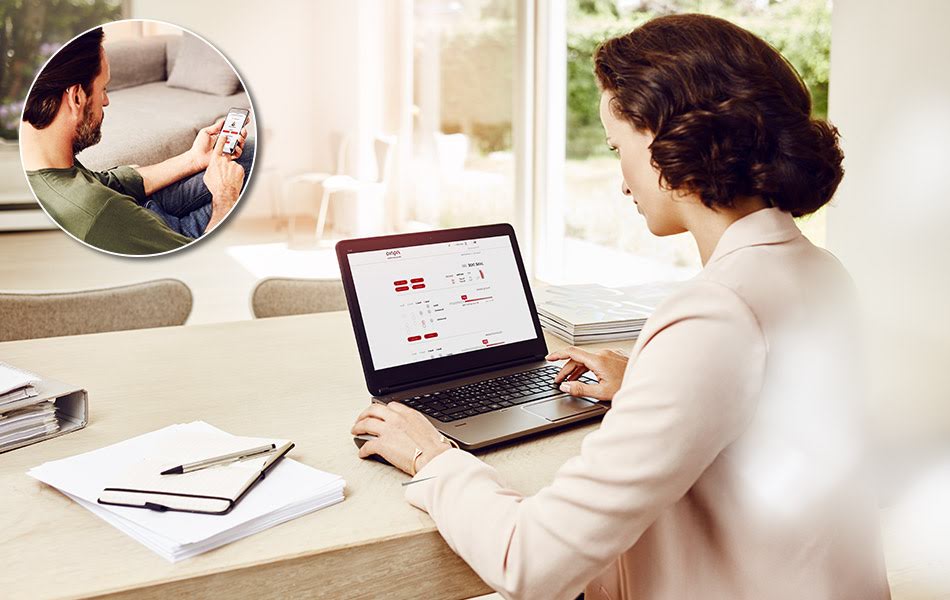
Well those lads just introduced a new app called “myHearing” at EUHA (international hearing aid conference in Germany). The app makes it possible for hearing aid users to directly contact their hearing care professional anywhere while wearing their hearing aids. They have the option to use different “CareChat” communication channels with the hearing care professional and also access a cloud-based knowledge tool for guided assistance on how to use and handle their new hearing aids.
Monitoring your progress
At the same time, hearing care professionals can monitor the progress of the user. The real game changer though is the fact that the professional can provide certain setting changes remotely. In essence, for the first time the professional can fine tune the devices on the go remotely.
With TeleCare, they say they are targeting the initial phase when a person with hearing loss first begins to wear hearing aids. Up to now, the user has been given a relatively large amount of information and is then sent on their way until a follow up. The app is designed to plug the gap during that period, allowing the user to undertake structured listening tasks and access the information needed at their leisure.
However, I see a huge market for this type of telehealth approach, it will mean that users will not have to wait until a physical appointment to have some settings changed or to deliver feedback. Like the Patient Insights app from Unitron which we have discussed, this will allow users to collaborate with their care professionals in a deeper manner.
A Simple process
It is a simple enough process, the professional loads up the app on the user’s smartphone (iphone or Android) at the first visit. The app communicates via secure channels with a cloud portal that the professional has access to.
What does it offer you?
So why should you buy into it, what does it offer you?
Listening exercises
Guided assistance
Personal progress: Feedback & ratings
CareChat: Text, voice and video communication
Frequently asked questions
Remote control function
So you have access to an extensive knowledge database in the cloud via the app. It automatically shows only the information that is relevant for the devices you are wearing, so you know the information is always relevant to you.
It gives you access to handling videos which clearly explain the typical questions that arise with first-time wearers Things like:
How do I place my hearing aids in my ears?
How do I take them out?
How do I change the batteries?
How do I change the programmes?
How do I adjust the volume?
How do I clean the devices?
And quite a bit more than that which means that the professional can concentrate on helping you hear better. It also offers targeted listening and handling exercises in coordinated stages which the professional can track.
Quick and easy contact with your hearing care professional
If you are having a problem getting an answer from the knowledge tool, you can quickly and directly contact the hearing professional with just one click via the app. You can do so by calling or text message. The daily rating system in the app also allows the hearing professional to monitor and respond to your experiences.
Remote adjustment of hearing aids
For the first time hearing care professional can remotely change certain parameters of the hearing aids. This allows almost instant response to feedback about experiences of a user in different situations. The changes are made in the professional’s portal and then sent directly to the app. You are informed that there are new settings on the app and you can accept them.
This is going to catch on
We think this is a fantastic leap forward for both hearing care professionals and hearing aid wearers. We think that it can only strengthen customer satisfaction. Your contact with the hearing professional as well as the handling of your hearing aids is simplified. It also means that you don’t necessarily have to physically attend the office every time you want a change made. That has to be a good thing.
We think that this is another innovation that will see widespread adoption across the hearing aid industry. We know that Unitron have been thinking about this for some time and we discussed the possibilities of cloud based data for hearing aids before. It is a technology that makes sense for everyone involved and it is good to see a disruptive innovation like this come from within the hearing aid industry.
The system from Sivantos will work with all Signia hearing aids and is optimised for the entire primax platform (Ace, Pure, Motion and Insio as well as the new Cellion and Silk). The market launch is currently taking place in Germany and the USA. By the end of the year, it will occur across Europe and in early 2017 in Asia.
If you like what you see, share it so others can benefit
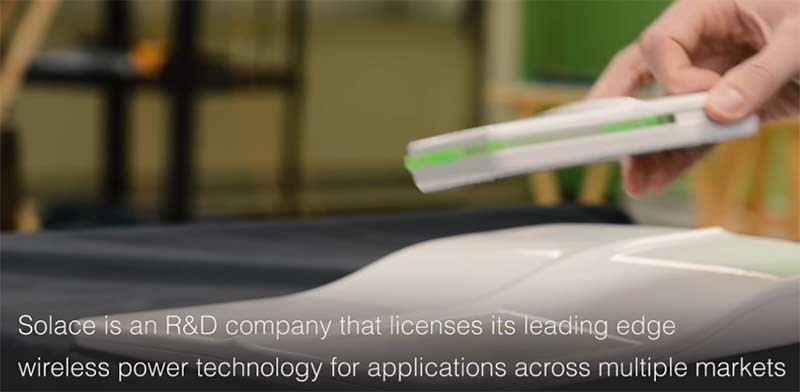
I was talking to these guys from Canada recently, the company name is Solace Power and they design and licence wireless charging technology. Why is this interesting? Because their system is such, that they are pretty sure it is ideal for hearing aids. Not just the BTE and RIC rechargeable devices we are seeing either. Their system should theoretically allow wireless charging of a custom product. Even better, it should add no volume and no weight, that means the possibility of even rechargeable invisible hearing aids, would you be interested?
70% of Patients Want Rechargeable
According to industry research, 70% of patients have indicated a preference for rechargeable hearing instruments. This has in fact helped to form the future product road map for many of the big hearing aid brands. Reliable rechargeable hearing aids that could be guaranteed to last a full day’s use are really only a thing of the recent past. Since their introduction though, they have become amazingly popular.
I said in an article a while ago that I felt the real battleground for the hearing aid manufacturers was probably going to be in the custom in ear hearing aid ranges. It isn’t easy to manufacture a rechargeable custom hearing aid, the problem is size and placement. Rechargeable devices are usually contact or near field (induction). Both of these methods present problems for someone who is making a very discreet hearing aid. The contacts on the shell or the induction coil within the shell would add weight and size. Something that no one really wants to do. But what if it could be done with no sacrifices, no extra volume or weight? Meet Solace Power.
Confused About The Right Hearing Aid For You?
Our buying guide, easing the confusion with clear easy to understand info, we guarantee it will help you pick the right hearing aid for you.
A Different Way to Wireless Charge
I am not going to bore you with the technical bits, but in essence Solace uses a system whereby the device to be recharged just needs to be close to the charging pad. It doesn’t need to touch, it just needs to be close. The device that is being charged has a receiver antenna in it which picks up the energy and sends it to the battery. Here is the really cool part, that receiver antenna can be a piece of special foil. It could be as simple as attaching that foil during manufacture to the battery, to the battery contacts, hell even to the custom shell of the aid.
So absolutely no space gain, no fiddly contacts and no big inductive coil. I think that has to be a winner. There are of course plenty of things that need to be worked out, how it is done, how it will work and will the system fit well with hearing aids. However, I have no doubt that these guys are probably working pretty hard on that.
Recharging Freedom
If it comes off, it could mean complete freedom, in essence the charger could be some sort of mat or tray that you simply dropped your hearing aids onto. Or a case that you simply dropped your hearing aids into. No messing around, no slotting them in just freedom. Combine this with actual rechargeable invisible hearing aids or CICs, and that has to be a big deal right?
Wireless Charging Of Hearing Aids, Would You Be Interested?
Here is the thing, would you be interested, would you like to have rechargeable custom hearing aids combined with this freedom of movement? Let us know on info@hearingaidknow.com
If you like what you see, share it so others can benefit
I’ve been wearing a pair of GN ReSound’s Linx 3D hearing aids for about a month now and I have to say I am more than happy with them. I have been wearing hearing aids for over 25 years, but funnily enough, this is my first pair of ReSound hearing devices – I was a little worried I might find it difficult to switch to a new style of sound after being so used to wearing other brands but the Linx 3D have been easy to wear and has sounded completely natural. You really need to try these out.
LiNX 3D bluetooth connectivity
One thing that has really blown me away about these hearing aids is the connectivity they have with other devices. I’d never really bothered considering bluetooth hearing aids before as I thought I just wanted good quality sound and speech recognition during my normal day – whilst the Linx 3D has that in spades, the ability to connect my aids to devices I already own and have the audio played straight in to my ears has totally changed the way I do things. Phone calls have stopped being something to avoid and are now a pleasure. I communicate with my business partner Geoff via instant message mostly, however, since I got the LiNX 3D, we now do phone calls!
I’ve split this review up in to several parts for two reasons, the first is to make it easier to read, the second is because I think there is much to talk about. So, here is how it will play out, let’s talk about the LiNX 3D:
1. What’s in the box? 2. Performance in every day use, speech in noise, etc. 3. Bluetooth connectivity for phone calls, iPad and music. 4. Personalisation, the phone app and never seeing my audiologist again.








 yourhearingaidknow