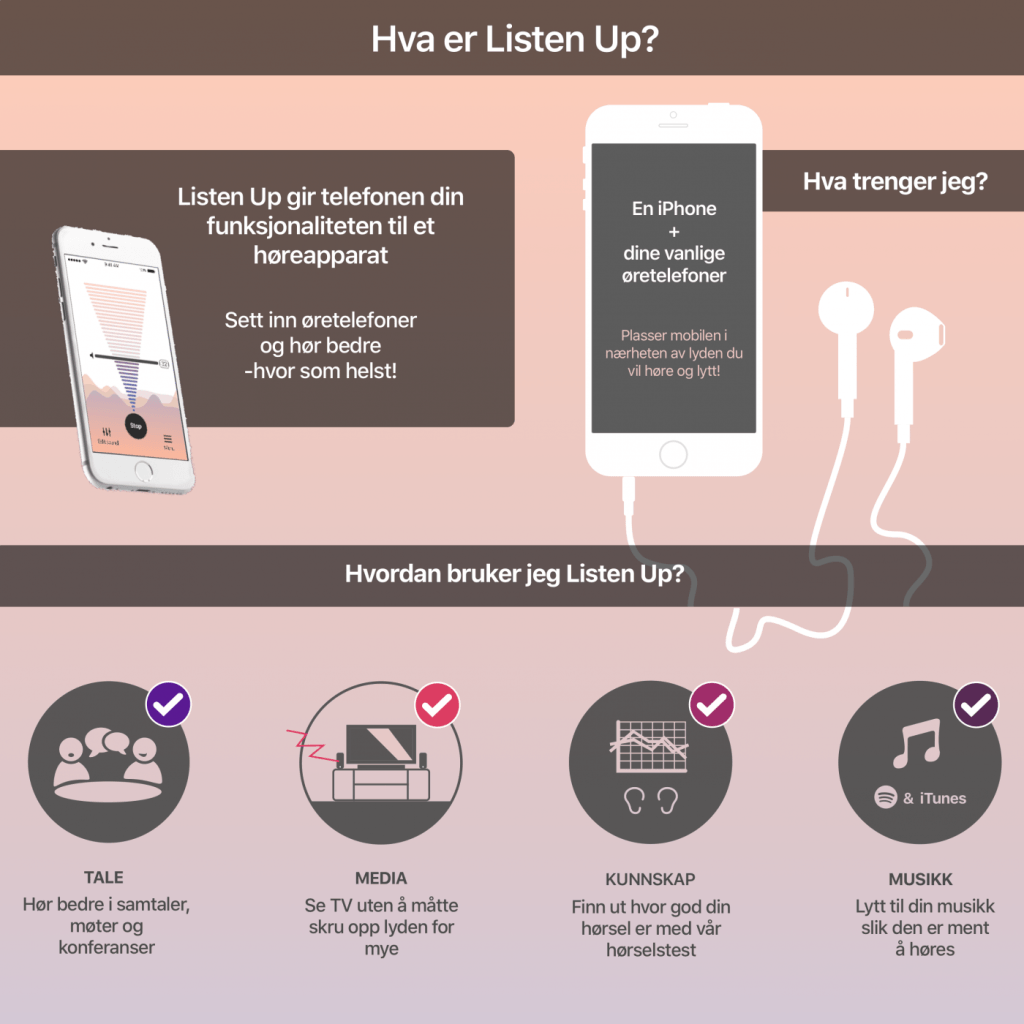
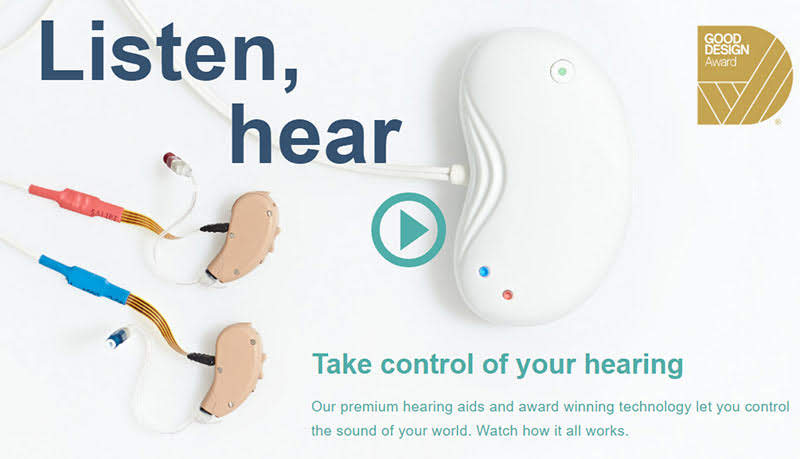
Norwegian company Listen a start up in Oslo has just raised funding to move forward with its product to market. The company has designed a digital hearing helper app, which when combined with a Smartphone and earplugs gives the ability to hear better in different situations.
The product offers custom amplification of sound to match a user’s hearing ability. There are separate sections for music listening and a filter for voice enhancement.
In essence the app turns a smartphone into a hearing aid by using the microphone to capture sound which it digitally processes and utputs through the ear phones. The company is currently planning to manufacturer it’s own hardware ( headphones or headsets) because they feel the different hardware on many of the different smartphones may not be up to scratch.
The app has both noise reduction and directionality features which they feel are not done justice through the existing smartphone hardware. So it makes sense for them to design and manufacture proprietary hardware to deliver the very best experience. They have had exploratory talks with several major technology companies that could participate in the development of the earplugs.
While the infographic below is in Norwegian, I think it gives a good idea of the power of the app.
Aimed at Occasional Users
The company believes that their product will be ideal for people who feel they only need a hearing aid in certain situations. Situations with a lot of noise, where people with even relatively minor hearing problems have difficulty. The envisage servicing the group who need hearing support “on demand.” In fact there has been several introductions aimed at this group including BOSE HearPhones of late.
Challenges To Overcome
There are still some technical challenges. For example, there is too much delay in audio bluetooth transfer in order for the company to make the system wireless. The microphone on smartphones is also not optimal for the full function of the product. Again, the money raised will help the company move forward in their research and they hope that a hardware partner will help them to introduce the product to market in 2017
If you like what you see, share it so others can benefit
Signia (the artist formerly known as Siemens) has introduced a new instant fit CIC range called the Silk™. It is a very small ready-to-wear CIC hearing aid, Signia say almost invisible. According to Signia, Silk offers high comfort, no waiting, and near-invisibility, which makes it a top choice for first-time hearing aid wearers. Further, Silk offers all of the audiological advantages of Signia’s primax™ technology platform and binaural OneMic directionality. So let’s talk a little bit about instant fit CIC hearing aids
Instant fit CIC hearing aids have been around for a long time both as analogue hearing aids and digital devices. The first ones I ever met weren’t programmable, Amplivox, now Amplifon used to have a set right at the bottom of their price list called the Poppet. It was set to a specific hearing loss and it came in one size, it either fit or it didn’t, it either worked for you, or it didn’t. We couldn’t programme it or change it in anyway.
The GN Resound Be
Around 2008, Resund introduced the Be, it was the first of their microphone in helix devices and it was an instant fit hearing aid. The original Be was similar in nature to a CIC, although because the microphone was removed from the device and attached by a wire it really doesn’t fall into the category. Resound are still the only manufacturer who uses this style of hearing aid, although now most of them are custom fit devices as opposed to instant fit.
The Be wasn’t a bad device, it had some issues with feedback and the damned microphone cover either kept getting clogged up with dry skin or just falling off. Otherwise, it seemed to work pretty well for the people I fitted with it. Although in fairness I didn’t use the instant fit very often, more often than not I fitted the custom version.
The Unitron Fuse
Unitron quickly followed with their own programmable instant fit CIC. They introduced the Fuse hearing aid around 2009, again it was an instant fit device which used different silicone tips to stay secure, it also had a special elbow which allowed the device to fold around different canal bends. They didn’t really catch on, I mean they were a cool idea and Unitron tried to ensure they would fit the bulk of people, but the profession wasn’t really enthused with them. I never got to play with them, I had moved to a manufacturer by the time they were introduced. I did speak to many who used it though, the feedback was generally okay. They said there was some fitting issues as it didn’t fit every canal and they weren’t exactly small, but overall they weren’t bad. Again though, they just didn’t really catch on.
The Siemens Vibe
Siemens has played with this concept before, it introduced a device around the same time that the BE was introduced called the Vibe. It wasn’t an instant fit CIC but it was similar in concept to the Be except in the reverse. The hearing aid fit in the helix of the ear while a speaker on a wire went into the canal. I only mention it here really because it was a fascinating piece of thinking from Siemens. In truth it was really a Receiver in Canal device but the strangest one you were ever likely to see. Again, I don’t think either the profession or the public were ready for the device, but it was an inspired piece of innovation.
They also introduced an instant fit CIC a couple of years later. It was similar in nature to both the Fuse and their new Silk device. In essence it was a CIC module that could be fitted with a series of different tips. It was programmable and it was based on their latest technology. Again, it didn’t really catch on, I know a couple of Dispensers had some issues with feedback (whistling) from the devices and that put them off. However, I think it was probably as much the consideration of the professionals and the buying public that stopped it becoming hugely popular. It simply just didn’t catch on.
The Signia Silk
Signia reports that Silk is the first completely-in-the-canal (CIC) hearing aid that’s both almost invisible and ready to wear. The devices are powered by Signia’s latest primax chipset and are designed to fit up to 80% of all ear canals. The Primax chipset has been around for a little while now and feedback from Dispensers and users is pretty good.
The device uses the flexible Click Sleeve to provide an immediate and comfortable fit. In essence Silk offers what all instant fit CIC devices have up to now, the possibility that you can walk in to the Audiology office and walk out the same day with a new CIC hearing aid without having to wait for a custom-built device. The question really is, will you want to?
Scott Davis, CEO of Signia said “First-time hearing aid wearers often prefer the near-invisibility that up until now could only be achieved with a custom-made CIC, yet they don’t like the extra wait time needed for the manufacturer to custom build the instruments,”. He also said, “Silk solves this problem by combining both the acoustic and cosmetic benefits of an advanced custom CIC with the immediate availability of a RIC. In fact, we think of Silk as a RIC without the wire.”
The Impediments to Adoption
Before I move on explaining a little about the device, I would like to look at the Signia statement. It is very rare that someone walks in to our offices looking for a hearing aid. Although, in some cases they will leave on the day with some sort of trial instrument. Hearing aid sales don’t really work in the way other purchases do, people don’t generally rock up and pick one to wear home.
But, and this is a big but, everything is changing at the minute, consumers, technology, even the way hearing aids are sold. Who isn’t to say that the idea of rocking up and walking out with a hearing aid won’t become main stream? I think there may be two impediments to adoption of this type of device, the first will be the lack of knowledge within the general public.
If you don’t know about it, you won’t ask, the second will be adoption of the idea by professionals. This compounds the first, you don’t know and they don’t tell you! A part of me likes the idea that you could rock up to my office be tested and fitted with an in the ear device all on the same day. I am just not sure how often something like that would happen.
A Great Trial Device?
I think the Silk would be an excellent trial device, a device that you could wear during a trial period to get a clear idea of what you can expect. I mean, if you liked it you could pay for it and move on, if you weren’t happy with the fit, it would be as simple as taking an impression and getting a custom fit device made. Either way, I think this type of device opens up possibilities and that is what I particularly like about them. Let’s talk a little more about the hearing aids.
Instant Fit Invisible Hearing Aid (almost)
So, the Click Sleeves are made of soft silicone and are available in six different types which allow the device to fit in the majority of ear canals and to fit the majority of hearing losses. I spoke to a chap from Signia who told me that they had been able to fit 48 of 50 people who attended a launch event with the Silk. That is an exceptionally good percentage. If that was to be replicated in the real world, it would mean that the devices could possibly fit 96% of people at least physically. With the right Click Sleeve in place the hearing aid sits quite deep in the canal making the device almost invisible.
Because Silk is powered by Signia’s primax platform, users of the device can benefit from their binaural OneMic directionality system and all of the other features that the Primax chipset offers. The device is also wireless so you can use your smartphone to adjust your hearing aids via the Signia touchControl™ app, and wirelessly stream virtually any audio device with the optional easyTek™ accessory.
The devices are built on fantastic foundations, the Primax and Binax chipset before it has been responsible for a turn around in the fortunes of Signia/Siemens. The concept behind the device is also good and it aligns with a lot of the conceptual ideas that Signia are bringing to the table right now like the remote fine tuning capability. It will be interesting to see if this idea has finally come of age and what the uptake on the devices will be both professionally and more importantly by Users. Knowing what I know about Signia devices I think these wil be pretty good devices, if you give them a try, let us know what you think.
If you like what you see, share it so others can benefit
If you are worried about hearing loss right now, I want you to read this article. Because there are things that you need to understand. A recent article by Joe Fleming of Vive Health really got me thinking about hearing loss, the early stages and taking action. As I said in the preface to that article, it is easy for professionals to forget the impact of hearing loss on the individual. I strive to understand the emotional impact as part of my consultation. Often though, when writing about hearing loss I don’t explore it. The article moved me to sit down and explore hearing loss and its effect on people. Not just the everyday hum-drum effects but also the deeper emotional effects wrought by hearing loss.
Important To You?
I think it is because there are a lot of outdated notions and ideas about hearing loss that are causing pain to many people. That pain is self-induced, however, it doesn’t take away from the fact that it is suffering that does not need to occur. The concept is simple, why suffer when you don’t need to? Let’s talk about the problems that hearing loss brings. More importantly, what happens at a personal level for people with hearing loss. So take your fingers out of your ears and listen up, you will thank me for it later.
The Family Dynamic
Dad, I said it twice! No, you didn’t, I didn’t hear you! I did! Many people can identify with that scenario, happens every day. It usually leads to frustration for both parties involved in the conversation. Woah, Dad, the TV is so loud, turn it down. Are You Deaf! Again, another everyday occurrence. What do you do? Turn the TV down and not hear clearly?
Or leave the volume high and face the ire of the family? No matter what course of action you take, it usually leads to frustration. Honey, what did he say? Honey, what did she say? Honey, what did they say? Damn it if they spoke clearly I would have no problems understanding them! Your wife or husband becomes your interpreter. Yes, more frustration. Sorry, what did you say? I said …. oh never mind! Frustration squared.
You Are Driving Them Mad. You Are Driving Yourself Mad Of Course But You Are Really Driving Them Mad!
I can go on and on because there are many more situations that happen on a day to day basis that lead to frustration. There isn’t much point because I want to talk about the effect of that frustration, not endlessly harp on about the situations.
Your Emotional Health
Life is about the joy of connecting, or at least it is for me. We are by nature social animals, social connection stimulates us. Social connection is important for our emotional health. In fact, many of us gauge ourselves by social connection. It is the one thing that qualifies who we are. Reinforces us as people. Social connection is one of the first things to fall prey to hearing loss. It is difficult to engage if you can’t follow the conversation.
Life Is Hard Enough Without Making It Harder For Yourself
People find it difficult to engage you if you aren’t following what they have said. People find it tiresome to keep repeating things. You might think if they cared they would just repeat it clearly so that you can understand. I would point out that they might think that if you cared, you might do something about your hearing! Touche as they say.
The Frustration Builds
That frustration builds and builds, bringing stress to your life. Social situations become stressful situations. Our natural reaction to stressful situations is to stay away from them. Our social life shrinks, we become isolated. Isolation is further driven by stress and frustration has now turned to anger. That shrinking social situation can lead to depression.
Now you are frustrated, angry and depressed. A recipe for happy family relations if I ever heard one.
Ignore The Wheedling Voice in Your Head!
The Sneaking Suspicion
Of course, all during this process you have had the sneaking suspicion. That filthy vile torment of the voice in your head saying “it’s old age!”, “you are getting old”. You know that wheedling voice, you have heard it before during your life. It’s the one that used to say “you won’t be able to”. Most of us know that voice well. Most of us just ignored it and soared in the joy of proving it wrong.
You have ignored it in the past, I have no doubt you did. You should ignore it now. Because like then, it is lying to you.
Infirm and aged
Such damn hogwash, rubbish and other words I can’t print. Hearing loss is not a sign of age, it is not a sign of infirmity. It is not a sign that you are past your best. It just is! It occurs, it occurs at any time of life. It occurs when we get older, sometimes it occurs earlier because of health or noise. It just is.
Lying to yourself about it and the impact that it has on you is when things go wrong. The lies we tell ourselves are the worst. They are the lies that will often hurt us most. In the case of hearing loss, that could not be truer. People are mumbling, no they aren’t you can’t hear them properly you can’t hear them properly. People just do not speak clearly any longer, yes they do. I find socialising such a drag, no you don’t you don’t go because it embarrasses you.
Again, let us not labour the point here. I will ask you one question, in the next two examples, who do you think looks old and infirm?
1. A man or woman who still loves the joy of connecting. They dealt with their hearing loss so that they could continue to live an active and healthy social life. So that they could watch the TV with their family together. So that they could communicate easily with the people around them. So that they could simply enjoy life.
2. A man or woman who refuses to acknowledge there is a problem. Who muddles through by saying what, huh, can you repeat that? A person who often gives the wrong answers to questions. A person who is often tired and angry. A person who eventually stops engaging.
I think I know the answer, don’t bother sending it in on a postcard. The real sign of being foolish and old is being person number two. If in fact, you are person number two, while I feel empathy for you, I am not here to encourage your delusion. Nobody is being fooled, get over it.
Life Is About Living, Get On With It
I want to leave you with one simple message. Your hearing is important to your joy in life. Don’t let outdated ideas and that damn wheedling voice in your head steal your joy. Go get your hearing tested, if you have a hearing loss, get it treated. Thank me later.
If you like what you see, share it so others can benefit
Craig Gill, drummer of the Inspiral Carpets, killed himself after suffering from tinnitus for 20 years. Gill’s wife has said there needs to be a greater awareness of the devastating effects of tinnitus after an inquest into his death returned an open verdict.
Gill told a coroner how she discovered her 44-year-old husband dead at their home in Greenfield, Greater Manchester, after returning with their children from a day out.
She told the inquest in Heywood, Greater Manchester, that her husband’s death had baffled everyone who knew him and that her husband had no history of depression or suicidal thoughts. “That’s what’s shocking about it. I have no idea where this has come from,” she told the senior coroner for north Manchester, Joanne Kearsley.
In a statement issued after the hearing, she said her husband’s tinnitus became “so unbearable he felt there was no cure” and urged more awareness of the problem and men’s mental health.
She said in the statement: “Instead of reaching out, on that day in November, Craig made the saddest and most tragic of decisions.”
Gill said: “For the past 20 years, Craig suffered from debilitating tinnitus, a condition caused by not protecting his hearing when enjoying the careers he loved the most – a successful musician, DJ and love of listening to music.
“His condition affected his day-to-day wellbeing and he suffered in silence with both sleep deprivation and anxiety.”
She said: “Although we struggle with the day-to-day existence of life without Craig, we are now able to discuss and promote awareness of tinnitus and men’s mental health. It takes courage for men to speak out, to talk to one another, to share their thoughts and their fears.
“If you are one of those men, like Craig, we urge you to reach out to those you love and find comfort in sharing your pain.”
Sarah Vokes who owns Correct Hearing in Nottingham was on BBC Radio Nottingham last year and we decided to highlight it. Correct Hearing is a part of the Hearing Aid Know Network of trusted Hearing Aid Providers in Nottingham. The piece was excellent, outlining the dramatic effect on quality of life of hearing loss on a sufferer. It also outlined the differences that hearing aids can make. As always, Sarah spoke a lot of sense and gave great advice. Colin, from Newark gave us a sense of his own experiences with hearing loss.
It was Colin’s excellent explanation of his hearing loss and its effects that really made us post this article. It is succinct, clear and insightful. It also helps anyone to understand what the dramatic effect of hearing loss is. No more talking from me, have a listen to this.
If you like what you see, share it so others can benefit
Find An Independent Hearing Aid Centre in Your Area
Arrange a consultation with a trusted Independent hearing healthcare professional in your area
Abid Khan of The Yorkshire Hearing Centre is one of our newest hearing aid centre network members. Based in the Spire Hospital on Lowfield Road in Hull, Abid offers warm customer care, the latest hearing aids and a dedication to clinical excellence.
So if you are buying hearing aids in Hull, his practice is most definitely a good place to start. Abid (friendlier than he looks honest) completed his BSc in Audiology degree at Leeds University, before being employed by Hull and East Yorkshire Hospitals NHS trust in 2008. He has extensive experience in diagnostic assessments of adults and children and works closely with the leading Ear Nose and Throat consultants in the Hull and East Yorkshire Hospitals NHS Trust.
Most of his patients come to him through recommendations or by referral from some of the most well-known ENT specialists in Yorkshire. He also accepts self referrals and direct referrals from GPs and insurers. One of the things he has a great interest in is Tinnitus and its treatments.
Tinnitus Therapy
As I said, Abid developed a special interest in Tinnitus Counselling and Management and has also completed an MSc in Tinnitus Management. He uses proven tinnitus therapy techniques to help people gain relief from their tinnitus. He offers both tinnitus retraining therapy and hyperacusis desensitisation therapy.
Yorkshire Hearing Centre
Hyperacusis Desensitisation Therapy
Hyperacusis is a condition whereby people suffer an increased sensitivity to certain frequencies and volume ranges of sound. People who suffer with hyperacusis can find it very difficult to deal with common everyday noise. Abid offers proven therapy that can help to overcome this debilitating condition.
Hearing Aids
Abid is completely Independent and he provides the very latest and best hearing aids from all the leading hearing device brands. His recommendation for hearing aids is based solely on your lifestyle needs and hearing loss. He like many other Independent hearing healthcare providers believe that this is the way to offer the best hearing solution. A solution purely based on what is best for you.
We would like to welcome him to the network, and we are very happy to have him on board. He is a trusted hearing healthcare professional with a huge amount of experience. As I said, if you are looking for hearing aids in Hull, The Yorkshire Hearing Centre is a good place to start.
If you like what you see, share it so others can benefit
More Comfort, Better Sound, Less Feedback, What’s Not To Like?
A recent introduction by Widex got us thinking, my wife says that is never a good thing. After the incident……. I am inclined to agree with her. Anyway, back to the introduction. They brought out a new type of custom tip for their Receiver In Canal and Thin Tube hearing aids. Custom tips are really fantastic pieces of kit and I realised that I have never explained why. So, let’s talk custom tips and why you should consider them if you are buying hearing aids.
Custom Hearing Aid Tips
RIC and Thin Tube hearing aids are pretty popular devices. They offer fantastic qualities in pretty discreet packages. RICs in particular are suitable for all types of and levels of hearing loss which makes them really attractive. Widex and other hearing aid brands have made custom tips for their Thin Tube and RIC digital hearing solutions for many years.
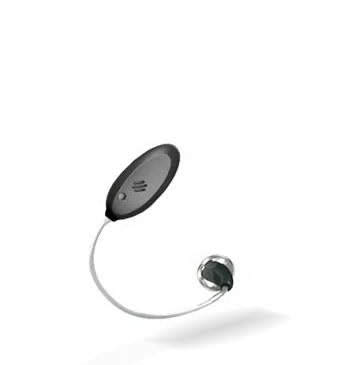
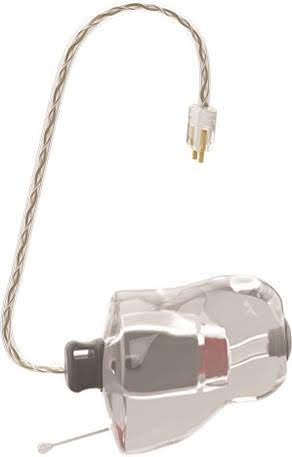
Widex has just introduced a new design of custom tip for theirs which looks like a really good option. They call it the Flex Hard Solid Shell, very utilitarian in their names is Widex, no fancy smancy rubbish here. They say that the new custom tip offers:
Longer tip length to optimise gain, reduce risk for feedback, and provide better retention.
Extended sound bore to provide double wax protection. By putting a Nanocare™ waxguard at the end of the receiver and then again at the end of the shell, the receiver has double the protection against wax and debris.
The custom tip is available for Widex EASYWEAR RIC S, M and P-receivers, and for both their THIN TUBE 0.9 and 1.4. This isn’t the only tip they make available and it joins the other custom tips in the line-up.
The design of the tip is interesting, it gives a deeper fit into the canal which offers better sound and probably a more secure fit. The extended soundbore with the doubled wax guard for RICs will also mean that the receivers are better protected. If you are buying RICs, wax is always your enemy, it will kill your receiver dead if you don’t take care of it. The double protection here should ensure that receiver failures are almost non existent. With the caveat, that you still need to change the damned wax guard, oh and try a drying kit as well. Your pocket will thank you. Receivers aren’t cheap!
Like I said, Widex aren’t the only hearing aid brand that offers custom tips. They are a great solution and they offer many benefits over the instant tips. If you are an active individual good retention in the ear is important. Custom tips offer pretty excellent retention and fit. I mean they are custom made to your ear canal, you can’t really get a better fit than that. So if you are buying hearing aids, consider getting custom tips for them.
If you like what you see, share it so others can benefit
Find An Independent Hearing Aid Centre in Your Area
Arrange a consultation with a trusted Independent hearing healthcare professional in your area
The other day I woke up in Barcelona. We’ve rented an apartment there for the summer.
It’s a lovely sunny day. Sunlight is streaming through the window, lighting up the entire bedroom.
I check my phone. I have an audio message from my girlfriend Elise on Whatsapp. I listen on speakerphone, pressing the loudspeaker into my ear (that’s my hack for when I’m not wearing My HAs)
I respond, she responds. We go on for a while.
I finally get up and step out of my bedroom. I don’t have my hearing aids in yet. But it’s ok. I’m alone in the flat. I can wear them later.
As I enter the hallway, I notice something fishy: there are lots of rubbish bins in the hallway that weren’t here the day before.
Somebody is in the flat!
A thief? No, it can’t be a thief because I’ve never met thieves who cleans.
I run back into the bedroom, put some clothes on (I was naked!) and put my HAs in.
I walk back to the kitchen where I meet Cintia. She’s the cleaning lady and I had no idea she would come today.
I introduce myself. We start chatting. She’s been in the flat for two hours!
I’d been sleeping and voice messaging in bed with my bedrooms doors open without knowing somebody was in the flat. I wasn’t even wearing pyjamas. Hey, Barcelona is hot!
How embarrassing.
Or, is it?
It’s not my fault if I can hear very little without my hearing aids on.
There’s nothing to be ashamed of.
But Cintia doesn’t know that. She doesn’t know that I’m partially deaf.
She might think I’m really weird for carrying on doing my business while some stranger is in the same apartment with me.
There was a time when I would have hesitated to explain the situation. I would have probably just avoided Cintia forever. And felt embarrassment because I wouldn’t know what she thought of me.
Nowadays though, I’ve been dealing with hearing loss consciously for quite a while so instead of leaving the situation unexplained and make room for potential misunderstanding, I tell Cintia:
“Wow you’ve been here two hours? I didn’t hear you at all because I am partially deaf and I can’t hear well at all when I don’t wear my hearing aids [point to and show hearing aids]. I’m wearing them now but I don’t wear them when I’m sleeping”
That was it. One sentence and everything was made crystal clear. No room for misunderstandings or awkwardness.
Cintia didn’t mind.
We both had a laugh and drama was already over before it started.
My younger self would have probably debated whether to say something about my hearing loss, then would have said nothing. And felt awkward or even ashamed.
By getting it out quickly, I dealt with this mini problem and moved on with my day.
So I told someone new about my hearing loss before 10AM. How about you? When was your last time you told anyone new?
P.S. One more thing… if you want to learn more about how you can too transform your life and hear better with hearing loss then hop over to my website and make sure to sign up to my free newsletter!
Gianluca teaches others how to live an exceptional life, even with hearing loss. If you’d like to read more stories like this one, join Gianluca’s free newsletter right now on getsuperhumanhearing.comand receive the free eBook ‘How to Hear Better at Dinner’.
Find An Independent Hearing Aid Centre in Your Area
Arrange a consultation with a trusted Independent hearing healthcare professional in your area
There has been growing speculation in relation to Over The Counter (OTC) hearing aids being made legal in the United States. The PCAST (PRESIDENT’S COUNCIL OF ADVISORS ON SCIENCE AND TECHNOLOGY) Report in relation to hearing technology in October 2015 recommended a major change to the laws governing the supply and provision of hearing aids. One of the recommendations it made was in relation to the hearing aid medical waiver. This has now happened, what does it mean for OTC hearing aids and more importantly, what will it mean for consumers? Let’s look at the background.
A Greedy Monopoly
For many years organisations in the States have been calling for changes to the rules governing hearing aid provision. The main reason for these calls has been the assumption that the high price of hearing aids has been the main block to adoption of them by the multitude of people who need them. I personally don’t necessarily subscribe to that argument, I know that cost is an issue in some cases, however, I don’t feel it is the general impediment that it has been painted to be.
In this debate both the manufacturers of hearing aids and the providers of hearing aids have been painted as greedy and supporting a monopoly. Unfortunately some of the representative organisations have not helped themselves with ridiculous paternalistic statements that seem to have been purposefully designed to irritate people.
Are We Greedy?
I know I am not, I would have to say the bulk of people who I know within the profession are not either. I charge for my time and service and then I deliver that time and service as I am sure many others do. The focus in this debate has been on the hearing aid as a product, it has not been on how that product is delivered and maintained. The problem though is that no matter what I say, it just looks like I am defending a monopoly.
On the 7th of December, the FDA issued the “Immediately in Effect Guidance Document: Conditions for Sale for Air-Conduction Hearing Aids,” which effectively ends federal enforcement of the hearing aid medical waiver. What does that mean for the consumer? The hearing aid medical waiver is a waiver that may be signed in lieu of having the required pre-hearing-aid-purchase medical evaluation. The wording of the original federal regulation can be seen here (21CFR801.421). In essence, it removes the need for a customer over the age of eighteen to get a medical evaluation of their hearing before deciding on hearing aids.
The FDA announcement does not change any rules regarding over-the-counter (OTC) hearing aids, but it did address them. “ FDA does intend to consider and address those recommendations in the future as appropriate, including those regarding a regulatory framework for hearing aids that can be sold directly OTC to consumers, without the requirement for consultation with a credentialed dispenser. FDA intends to solicit additional public input from stakeholders before adopting such an approach”.
In the press release ” the FDA Commissioner Robert Califf, M.D. was quoted as saying “Today’s actions are an example of the FDA considering flexible approaches to regulation that encourage innovation in areas of rapid scientific progress, The guidance will support consumer access to most hearing aids while the FDA takes the steps necessary to propose to modify our regulations to create a category of OTC hearing aids that could help many Americans improve their quality of life through better hearing.” I think that can be taken as a clear sign that with time, OTC hearing aids will become a reality.
For many years I have spoken with hearing aid advocates around the world, advocates like Steve my co author here on Know. Nearly all of them have been demanding more power over their hearing aids, the ability to make fine tuning changes themselves. I have always supported that idea, why shouldn’t we make their hearing care inclusive? One thing that has always struck me during these conversations is that what they called for was inclusion in the process not the exclusion of the professional. Even the most strident and independent want the ability to consult with a professional.
Would it surprise you to find out that I would support these type of hearing devices? Because I would.
Blamey Saunders Self Fitting Hearing Aids
You may find it surprising but I think these types of devices are a good thing, not a bad thing. However, they will only be a good thing if certain criteria are met. The devices will need to be fitted to your loss in some way, so there needs to be some way of testing your needs either built into the device or accompanying the device. Any testing procedure needs to be able to flag referable conditions, this is an imperative.
In my career I have identified four people with cancer through a hearing test. I of course did not make that diagnosis, I simply undertook the hearing test and referred them for further investigation because I was deeply unhappy with the results. Four people who went on to have life saving treatment because of a hearing test.
Hearing loss is more often than not run of the mill hearing loss, however, sometimes it is not. Sometimes it is a sign of some underlying nefarious condition that needs treatment. This is what scares me and other people within the profession. However, good technology can probably ensure that is not an issue. I think it is incumbent upon the FDA and any other regulatory body to ensure some sort of strong regulations are in place in relation to this.
What Will it Mean For You
If new legislation is brought forward to legalise the sale of OTC hearing aids it will mean that you can go to your local point of sale and buy a hearing aid just like you would buy an electronic device. You will then have to work out how to fit it and use it flying solo as it were. I think that this type of solution will not be a fit for everyone, even within the traditional manufacturers there has been a push towards giving users more control over the hearing devices.
Not For Everyone
Not every user is interested in having the control, in fact many want something that they put on and never have to think about. These types of devices will be ideal for some and not for others. There was a recent small scale study on the efficacy of self fitted hearing aids that I reported on. The conclusions were very interesting, although the study was small, it has added some weight to the call for further study. Its conclusions were as follows
“While limited, these data suggest that self-fitting aids may provide satisfactory benefit and performance to those who can manage the self-fitting process. Our findings show that at least one currently available self-fitting product is comparable to those measured with professionally dispensed hearing aids“
What they said in essence was that were people were “able to manage” it seemed that self fitting may not be a bad thing. By able to manage they meant technically aware and able, people who were au fait or familiar with technology. In this context, I think that OTC hearing aids will be very similar, they will be ideal for people who can manage them.
The Freedom To Mess it up
These devices will also give people the freedom to make a mess of their hearing, this is another factor that the FDA needs to consider. It needs to ensure that you can’t make your hearing worse through use of these devices. Again, I think technology can help here but it is an issue that needs to be raised. In essence, for these devices to be safe to use, users will need some education in relation to making them safe to use.
I have talked to others within the business for some time about adopting low cost devices that were sold on an over the counter type basis. I would adopt these types of devices, I would insist that I did a work up on your hearing or you had a workup done by someone I trust (this is to protect both you and me). I would then sell you the device for you to do with it what you wanted.
Other Assistive Devices
There are other types of devices I would also consider selling, devices like the HearPhones from BOSE. These devices are designed to help people hear in noise, they are assistive in nature, they are not hearing aids. I think they also have their place and I think it would be natural for us to offer them as solutions.
BOSE HearPhones Promo
If you wanted support or help other than warranty issue I would charge you for it. I think that is fair, my time is worth money, you would not expect to attend any other professional for consultation for free, so why would you expect to do so with me? I think that this may well be the future model, I don’t think the traditional model will die quite yet, I think this new model will probably run in tandem with the traditional model.
What About Traditional Manufacturers?
What will the traditional hearing aid manufacturers do if OTC come to pass? I don’t know, I can’t speak for them but I think they will have to re-assess their own ideas about provision channels. I don’t and would not hold that against them, it is just the way of the world and of business. I know some of them wouldn’t be eager to become involved, however, business is like an arms race, when one ups the game, the others must do so to survive. As well as that, many of the hearing aid manufacturers are public companies, their management teams will need to make decisions based on their share holders best interests.
What Will Be Your Experience?
I think that really depends on who makes the devices, hearing aids are a specialist electronic device. Hearing aid manufacturers are producing good devices based on years of experience and research and design. New entrants to the market don’t necessarily have that experience or the algorythms that make everything work.
A hearing aid is not just a simple amplifier, it does so much more than amplify sound. So it will be interesting to see what the first OTC hearing aids are like in relation to efficacy. If the traditional manufacturers become involved in this market it will mean that there will be some pretty good devices available.
Care of The Devices
Any buyer of these types of devices will have to actually take care of them, any vendor of the device will have to consider failure of the receiver. It is pretty simple, earwax and moisture kill receivers (the speaker part) and any seller of the devices will have to be aware of that.
At the moment, traditional hearing aid manufacturers accept when your negligence (and that is often what it is) kills one of their receivers during the warranty period. They simply replace them, even when they are gummed up with ear wax.
How will that work with over the counter hearing aids? Will they continue to replace the receiver even when you have been responsible for it’s failure? I mean at the moment, the hearing aid manufacturers don’t actually have to, but they do it. What will OTC manufacturers do?
Making The Right Choice
I try to be very careful about the recommendation I make, I try to take into account lifestyle, personal and ear canal conditions. For instance, if you are active, able and a bit tech smart, I will easily consider a RIC device or a custom hearing aid device for you. I would base that on the fact that you can easily take care of the device, ensuring that it is maintained in order that the receiver won’t fail.
If however, I think that the maintenance of the hearing aid may be a problem, or if in fact the ear canal is just too hostile (excess ear wax or moisture) I would nearly always recommend a BTE. As a purchaser of an OTC device, how are you to make the decision on that, if you make the wrong decision, what are you going to do?
Freedom
It is obvious that there are a lot of questions to answer, however I think that OTC hearing aids will bring freedom of choice, I think that can be a good thing and a bad thing. I don’t think consumers are stupid, generally, well most of them. I think that delivering freedom of choice will allow people to adopt amplification earlier. Will allow them test the water as it were, to understand what amplification can deliver to their life. That has to be a good thing.
We recently published a post in relation to a new study that was undertaken in relation to Over The Counter Hearing Aids as a delivery Model versus the traditional model. It came to the conclusion that OTC may be almost as good as the traditional model. However, while the study is excellent, it really isn’t as simple as that. Find out why at OTC Hearing Aids Almost as Good as Professional Fitted – New Study Says Over The Counter Hearing Aids as Good as Professionally Fitted
Combining The Best Hearing Care With Outstanding Eye Care in Glasgow
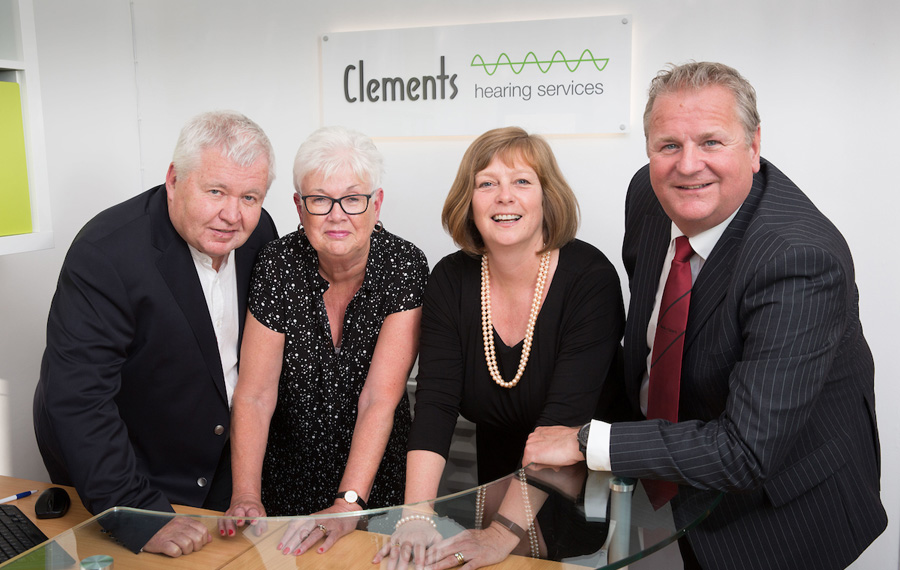
We have known Greg Clements for many years and he is a firm friend. Often during our conversations in the last few years he has discussed continuity of service. Greg has reached a time in his life where he is worried about what happens to his customers after he retires. Recently, he has taken steps to secure their future care.
Black and Lizars
Black and Lizars need no introduction to anyone who lives in Scotland, they have been actively delivering outstanding eye care for over 180 years, and are one of Scotland’s largest and most renowned optometrists. B&L are independently owned and have twenty four practices all committed to providing the highest levels of care, the latest innovations in clinical technology and exceptional customer service.
In recent years, they have diversified into hearing care which is now available in many of these practices. Greg saw all of these factors as core to his decision to make the move. The reputation of Black and Lizars is similar to the reputation of Clements Hearing as is their ethos. It made perfect sense for Black and Lizars to become involved in the business.
Staying Where He Is
Greg will continue to be the face of Clements Hearing Services for the foreseeable future and has no plans to retire just yet. However, Neil McCurrach (who we also know well) will be a regular feature in the Crow Road store. Neil is another lovely guy, he was my area manager in Amplifon when I first started, in fact he was responsible for my entry in hearing care (he is the one to blame!!!!).
I have no doubt that Neil will be a perfect fit for the customers. We wish continued success to Greg and Neil. So if you are looking for hearing aids, hearing care or ear wax removal in Glasgow, your first stop should be Clements Hearing Services.
If you like what you see, share it so others can benefit






 yourhearingaidknow