With the launch of their latest range of Smart Hearing Aids, GN Resound have also introduced a brand new way to access hearing care. They call it Resound Assist, and it allows you to access help when you need it, without attending the clinic. ReSound Assist is in the new ReSound Smart 3D app. It works with ReSound LiNX 3D – the first Smart Hearing™ aid with cloud enabled remote assistance.
Help when you need it
As good as the first fitting of hearing aids is, sometimes the hearing aid settings you like in the clinic perform differently in in the wild. Up to now, that has meant a trip to the clinic for fine tuning. With the introduction of Resound Assist, instead of trying to explain the situation at your next clinic visit, you can ask your hearing care professional for help right from an app on your phone.
Resound Smart 3D™ App
The ReSound Smart 3D™ app gives you more power over your hearing aids than ever before. Allowing you to optimise many of the settings yourself. The idea is to allow you to control your hearing experience. However, if you experience problems that you can’t fix, issues that need additional fine-tuning. Reosund Assist is just a click away and may even save you a visit to the clinic.
While the app delivers power of your hearing aids, Resound Assist delivers freedom to experience hearing care your way.
Updated settings at your fingertips
Your initial experience with your hearing aids is always about simply getting used to them. Once that period is over, we start to think about making the sound right for you. This is normal, the first month or two is just about getting used to amplification, only then can we work on real customised settings. So over time, your sound preferences can and will change.
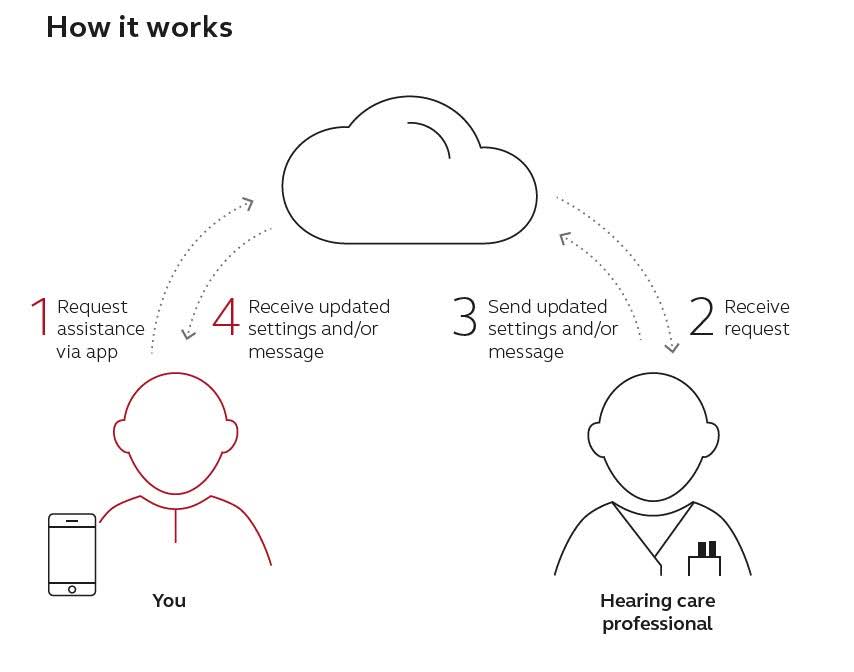
This new concept puts you in touch with your hearing care professional via a safe and reliable cloud connection. It allows you to get help on your terms. If you don’t want to, or simply can’t, visit the clinic, you can still get the help you need. No matter where you are, if you experience a problem, you can send a request for assistance right to your hearing care provider.
Request assistance anywhere
If you need improved settings for just one particular listening situation, it can be hard to describe the exact issue. The app is designed to help you work around the understanding gap. It actively helps you to create an accurate description (one your hearing care professional can really understand) so your hearing care professional can make precise adjustments based on that info.
The information that is sent is completely secure and consists of:
– A diagnostic assessment
– Your description of the issue
– An automatic record of your hearing aid settings
Receive updated settings anywhere
The Professional receives your request and all the details, they simply make changes on your settings on their fitting softare and send those settings changes back to you. You get a notification when your hearing care professional sends your new settings. Just place your hearing aids on top of your smartphone, tap install and try them out.
Go Back
Resound have also thought of a Go Back feature. If you don’t like the way the new settings sound, you can always go back to your previous settings.
We think this is a big step forward for users, it delivers freedom. While the app delivers power of your hearing aids, Resound Assist delivers freedom to experience hearing care your way. This feature might not be for everyone, in fact the power of the app might not be for everyone. I think though that for the people who want more control, these advancements will deliver it.
If you like what you see, share it so others can benefit
Experience The LiNX 3D For Yourself, Visit Your Local Hearing Professional
Arrange a consultation with a trusted Independent hearing healthcare professional in your area
A recent study that has just been published came to the conclusion that Over The Counter Hearing Aid delivery models may be just as good as the normal Audiology delivery method. While the study is an excellent piece of work and is at least the first step in understanding possible OTC delivery, there are some things that need to be pointed out. Firstly, every one of the participants had outstanding audiological work-ups before participation and secondly, every one of the participants was given a high end hearing aid from one of the big hearing aid manufacturers.
This is an outstanding study that has been well undertaken and I think it is the first building block of a base of study efforts that can show us the benefit of different delivery models. It was the first ever double blind study undertaken in relation to this matter and it showed that the outcomes from the two models of hearing aid delivery were similar. The study was published in the American Journal of Audiology. However, we need to be clear on what occurred and why it is not an exemplar of an OTC model in the wild.
High End Hearing Aids
Firstly and probably most importantly was the equipment used during the study. The hearing aids were top of the range technology from one of the big hearing aid brands. While this makes sense for the study it isn’t a true representation of the existing OTC market. There is also the question to be asked will it ever be a true representation?
The big hearing aid brands have extensive experience and research and design legacy when it comes to hearing solutions. That legacy has translated into hearing devices that have become ever more sophisticated and efficacious. The hearing aids used were Alera 9s from GN Resound and they have a pretty good reputation as good devices that deliver well for most people.
They are loaded with both industry wide and manufacturer specific features designed to help users hear in even complex sound situation. The study begs the question would the established hearing aid brands be involved in an OTC Market? If not, the question would be what experience will OTC manufacturers have and will any feature set offered, be similar or on par with the established manufacturers?
Thorough Audiological Work-ups
The participants also had thorough audiological work ups during the trial. These work ups were used during the set-up of the devices. While the OTC cohort chose their own models and had no support, the hearing devices were set to best practice targets based on sound audiological work. Again, this begs several questions, will this be the reality in an OTC market? Will OTC customers have thorough audiological work ups undertaken before choosing a device? Will those devices be fitted to those audiological results?
State of Play
The state of play at the moment is that OTC hearing aids or instant fit hearing aids don’t really exist. In essence there are devices available and they fall within two categories. There are devices available online from Eargo and the likes that are commensurate with hearing aids and can actually be programmed at source to a hearing loss once an audiogram is provided. Then there are devices available online that aren’t programmable and offer and average fitting for a theoretical average hearing loss. How this will change in the future is really anyone’s guess. However, the study undertaken would only be hugely valid to the experience if, and only if, the devices are programmable to a specific hearing loss.
The Big Brands
Secondary to that, it only makes sense if either the big hearing aid brands became involved with OTC and offered their top of the range devices to consumers directly. Or, the OTC manufacturers involved in this new market offered devices that were commensurate with top of the range hearing aid technology from the big hearing aid brands. So far anything we have seen has not really been the case.
There are some brands involved right now in lobbying for the OTC regulations, they really irritate me. They play on underlying prejudices to drive their agenda. This idea that the big hearing aid manufacturers have somehow been involved with a conspiracy to keep hearing aid prices high is laughable at best. The idea that their product would also help Americans with mild to moderate hearing loss is also laughable.
The devices are not fit for purpose, they cause occlusion which means they aren’t ideal for long term use. You might not know what that is but stick your fingers in your ears while eating a packet of crisps. Welcome to the occlusion effect, wonderful isn’t it? The battery life on the devices is a couple of hours at most and they are uncomfortable to wear. The lesson is simple, just because you can manipulate sound, doesn’t mean that your device can help people with hearing loss. Sorry, I am ranting.
What’s Available Right Now?
Right now there is a host of hearing devices available online in the US, most if not all are programmable to an audiogram that is submitted. Some of them have the ability for self-fitting and fine tuning. Many are at least comparable to entry level or lower mid-level hearing devices from the big hearing aid brands.
What Will Be Available in The Future?
That is perhaps the final thing we need to consider, what will be available in the future? How will OTC hearing aids be offered, what will they do and what customisation will be involved? The answers are vague at best, no one really knows. I think that this is something that will only become clear when that market begins to mature.
What You Might Need To Consider
If you plan to buy hearing aids online or over the counter in the future, here are things I think you will need to consider.
Are they programmable to a hearing loss?
Can you make fine tuning adjustments?
What is the return policy?
What is the repair policy
Can you actually manage them without help?
I think this final point is probably one of the most important points, are you tech savvy enough to manage programming and fine tuning if it is available? Will you be able to pick the right tube and tip and manage changing them? As always, we will continually follow up with changes in the market, in relation to this study, it is a fantastic study, exceptionally well done. However, it does not reflect the current market complexion. It is what the authors hoped it would be though, a spur to conversation and hopefully further study on delivery models.
You can read a little more about what we think of Over The Counter Hearing Aids at Over The Counter Hearing Aids – Are Over The Counter Hearing Aids The Answer, What Can The Consumer Expect?
If you like what you see, share it so others can benefit
While much research has been undertaken in the last few years, tinnitus is still a little-understood condition. However, we do understand that the impact of tinnitus can range from mildly irritating to devastating. While an effective cure has evaded medical science, we do know that there are several treatments that can work very effectively. One of those treatments is hearing aids, and they can work very well in specific circumstances. Let me explain.
Will Hearing Aids Help My Tinnitus?
I am often asked that question in consultation, the answer at the beginning is they might, but it depends. The first question to be answered is the underlying cause of the tinnitus, our search usually begins with an evaluation of hearing. If I find there is a hearing loss, well then I can usually answer that first question with a relatively assured yes, yes hearing aids may well help with your tinnitus.
How Do Hearing Aids Relieve Tinnitus?
In cases where tinnitus is accompanied by hearing loss, treatment of that hearing loss with hearing aids would normally reduce or eliminate the perception of tinnitus. While the action is not clearly or fully understood, the theory is clear. The tinnitus is a symptom of the underlying hearing loss, and therefore, when the hearing loss is treated, the tinnitus consequently fades.
Tinnitus Caused by Hearing Loss
As I have said elsewhere on this site, tinnitus is always a symptom of some underlying problem. It is not a disease in itself. The belief is that in the case of hearing loss, tinnitus is an action of understimulated neurons in the auditory brain centre.
So the sound is all in your head, but that does not mean you are imagining it
The hearing loss starves the neurons of stimulation, and for some reason, they either become stimulated by something else or become overactive. This manifests itself as a sound that only the person can hear. So the sound is all in your head, but that does not mean you are imagining it.
When hearing aids are worn, those neglected brain centres are stimulated by sound that is amplified by the devices. This ensures that the overactivity or stimulation by something else is eliminated. Therefore the perception of tinnitus is reduced or eliminated.
Does it Always Work?
Generally yes, for most people the perception of tinnitus is reduced or eliminated. For some though, it doesn’t have the required effect. More often than not, the reason for this is that the affected areas causing the perception of tinnitus are at a higher frequency than the hearing aids work at.
All is Not Lost
All is not lost for people like this, the hearing aids combined with sound therapy can often help them to reduce the impact of their tinnitus. Tinnitus can be a curse, but there are effective treatments for the condition. If you have ringing, buzzing or whistling in your ears that you are worried about, attend a hearing healthcare professional near you to find out what treatment may be suitable for you.
If you like what you see, share it so others can benefit
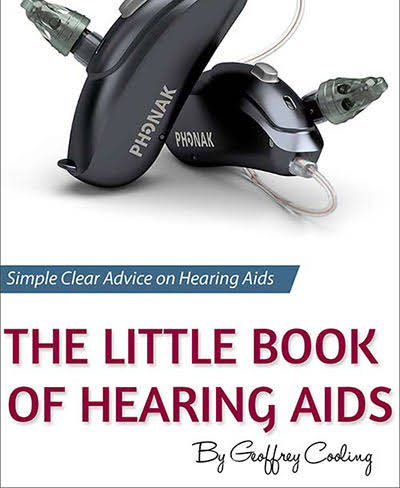
Last year we released a book called The Little Book of Hearing Aids which was well received. I was careful last year just to focus on hearing aids in a general manner because I thought that type of information was ideal to give a high level understanding. I got some great feedback of buyers asking for more info and suggesting topics. So I have updated the book for 2017. I have now focused on making the book the definitive hearing aid buying guide.
A Hearing Aid Buying Guide & Much More
As I spoke to people who had bought the book it became obvious that there were other subjects beyond just the hearing aids they were interested in. They were interested in stuff like what was the difference between National hearing aid providers and Independent hearing aid providers. Why were hearing aids so costly and what was the price based on? Who were the big hearing aid manufacturers and what was their latest hearing aid offering? What were Over The Counter hearing aids and what did they mean?
Definitive Hearing Aid Advice Guide
There were a lot of good questions so I set out this time around to answer them and more. So this edition is expanded and it covers a whole lot more subjects and I hope it can be seen as the definitive hearing aid advice guide.
What’s in The Little Book of Hearing Aids 2017?
A new section on Providers of hearing aids, what’s the difference and why might it matter?
A new section on buying a hearing aid, what do you need to know?
A new section on hearing aid prices, what goes into a price?
A new section on the hearing test, what you should expect to happen and why
A new section on hearing Aid Brands, who are the biggest?
Widex hearing aids, what’s on offer
Phonak hearing aids, what’s on offer
Starkey hearing aids, what’s on offer
Signia hearing aids, what’s on offer
Resound hearing aids, what’s on offer
The different hearing aid types
Their Pros and Cons
A section on rechargeable hearing aids
Hearing aid technology levels and what you can expect from them
Hearing aid features, what do they actually do and how will they help
A new section on Over The Counter hearing aids
How you can clean and care for hearing aid types
Hearing Aid Providers
People wanted to know what is the difference between a National hearing aid provider and an Independent? They also wanted to know why it actually might matter to them? I have tried to answer that clearly, explaining the difference between National hearing aid companies and Independents, covering own brand, hearing aid manufacturer vertical integration and why they might be offered one brand over another.
Buying A Hearing Aid
People also wanted clear guidance on what exactly they need to know about buying a hearing aid. They wanted to understand the price breakdown of hearing aids and they questioned what white label hearing aids are. They wanted to know what should happen during the hearing test and what was important. People also wanted to know what exactly they were paying for and what was the process after they purchased. Again I have covered all of these questions in the expanded edition.
Hearing Aid Prices
People really wanted to understand what goes into the price of a hearing aid. In the new edition I have covered how the prices are set and what they include. I also covered what unbundled hearing aid pricing is and how it might be something that more Providers adopt.
Hearing Aid Brands
As always, people were really interested in the big six hearing aid manufacturers. Who are they, who is the best and what are they offering right now. In this edition I have covered the manufacturers and their very latest product offerings. What they are, what the tech levels are and what hearing aid types are available.
Hearing Aid Types
As in the past I detail the different hearing aid types and their pros and cons, explaining clearly what you need to know.
Hearing Aid Technology
As in the past I cover what’s the real difference between mid range and high end hearing technology except for the price? I have also tried to clearly explain what the benefits of each technology level are and what they will deliver in the real world. .
Hearing Aid Features
Again I have tried to cover hearing aid features in a generic manner, allowing people a high level understanding of what they are and what benefits they will bring to them without getting too technical or naming manufacturer specific features.
Over The Counter Hearing Aids
This is a question that has just come up lately, I have tried to explain what they are, when are they coming and what will they mean for the consumer?
Don’t worry, we will still answer any questions that are sent to us.
If you like what you see, share it so others can benefit
Let’s talk rechargeable hearing aids, what are the types and their pros and cons?
Rechargeable hearing aids have surged in popularity in the last six months. The introduction of the latest wave of the devices ensured that Professionals were more confident in providing them and consumers were more confident about buying them. Some people have warned people off rechargeable hearing aids for different reasons, I think they are exceptionally beneficial, but there are pros and cons, let’s talk about the types and what they have to offer.
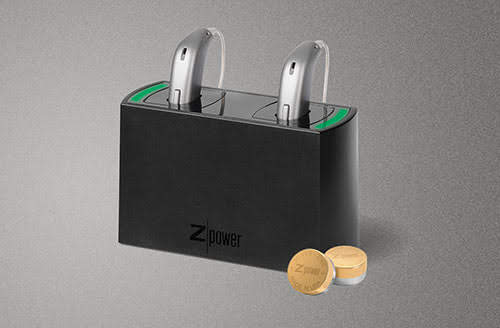
Rechargeable hearing aids have been around for a long time, however, there were never very popular because of power output. ZPower has coined the phrase one-charge-per-day standard, and it is a pretty good phrase (I wish I came up with it). In essence, the traditional rechargeable hearing aids did not meet the one-charge-per-day-standard. That only got worse when hearing aids became wireless and more users were streaming audio.
A New Generation of Rechargeable!
A new generation of rechargeable battery technologies has arrived and it promises to make life easier for consumers. In point of fact, two new rechargeable hearing aid technologies arrived on the market in 2016, Lithium-ion and Silver-Zinc both of these technologies offer something different with different pros and cons, but the one thing they both offer is, the one-charge-per-day-standard.
Lithium-ion Rechargeable hearing aids
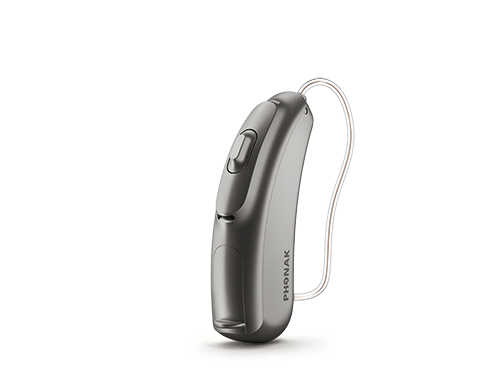
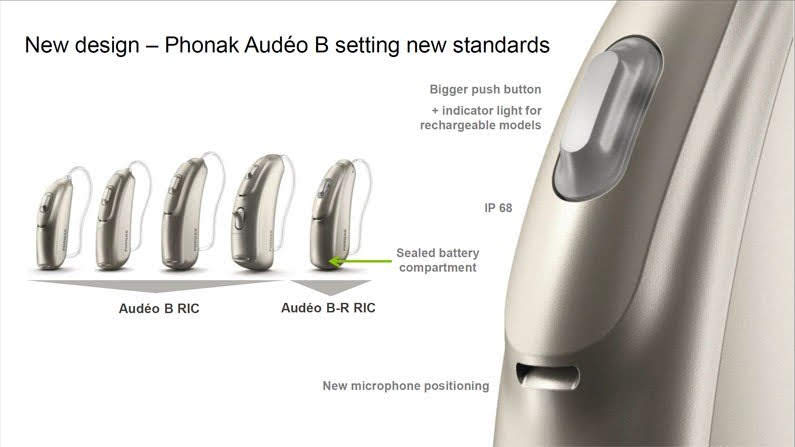
As of updating this piece four hearing aid brands offer Lithium-ion rechargeable hearing aids. Phonak offers the biggest range of rechargeable hearing aids including a new Kids rechargeable hearing aid, the new Naida Belong rechargeable hearing aids, the Receiver in Canal hearing aid (Audeo B-R) and a Behind The Ear hearing aid (Bolero B PR). Signia offer a Receiver in Canal option and a BTE option. Starkey introduced their own Lithium-ion powered rechargeable hearing aid in February 2018. Resound introduced the LiNX Quattro which is powered by a Lithium-ion cell in late 2018. The rest of the brands are expected to follow in 2019.
The Lithium-ion devices from the different hearing aid brands have one thing in common. They are sealed integrated power pack systems. These offer pros for safety and cons for the use case. Let me explain, Lithium-ion can be a fire risk if the battery is damaged, sealing the battery in the body of the hearing aid means that it is protected from mishandling.
However, sealing it in the case also means that it can not be replaced by the user. Lithium-ion can be expected to deliver for between four and five years, so that means the battery pack will have to be replaced after four or five years because it will not be delivering what it should. To do this, the hearing aids will have to be sent back to the factory and it will also have a cost attached. One addendum here, Signia’s power pack can, in fact, be replaced by your hearing aid provider in their office. From what I know, Phonak at least has said that they will replace battery packs in the future as a normal repair, which means it won’t be a ridiculous cost.
Update 20/06/2018: Phonak has undertaken accelerated testing with the Lithium-ion solutions. It appears that even after six years of use and recharging, there will still be enough power capacity to ensure a full day’s use of the hearing aid. Their findings have given more confidence to professionals when recommending these solutions. It means that you will get six or more years of use without having to change the battery pack.
In most cases, many people would be changing their hearing aids on a five to six-year cycle. However, even if there is some reason that a user can’t change their devices, it means that having to consider paying for the swapping out of the battery pack is only something that will happen after six or seven years.
The Cons of Lithium-Ion Rechargeable Hearing Aids
Safety: Lithium-ion is a poison, and hearing aids are small enough to swallow, presenting a hazard to children and pets. Lithium-ion has the potential to go on fire if damaged badly enough.
Sealed Case: The fire hazard of the tech dictates that the lithium-ion battery is integrated into a sealed case. If it runs out of power while still in use, the hearing aid cannot run on a normal disposable battery but must be taken out of commission while it recharges. And when a lithium-ion battery reaches the end of its life, it can’t be replaced by the user but must be swapped out by the manufacturer.
Power Limitations: If you stream a lot of audio (from an MP3 player or mobile phone, etc.), there’s a possibility that the batteries may not last the full 24-hour day. In fact, Phonak seem to think that if you stream up to about five hours, the aids will last 14 to 16 hours. This shouldn’t affect most people though since 12-16 hours would be a typical day of hearing aid use.
Larger Footprint: The footprint of Lithium-Ion is bigger than the other option which means bigger hearing aids.
The Pros of Lithium-Ion Rechargeable Hearing Aids
No more fiddly battery changes: The technology ensures that you no longer have to worry about the expense of disposable hearing aid batteries, nor do you have to worry about changing them.
24 hours of continuous use: The technology has finally reached the one-charge-per-day standard. You should be able to get up to 24 hours use with up to 5 hours of streaming.
Easy charging: Simply drop it in your charger, no hassle.
Silver-Zinc Systems
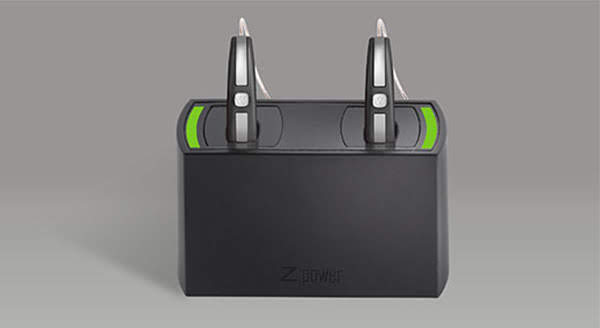
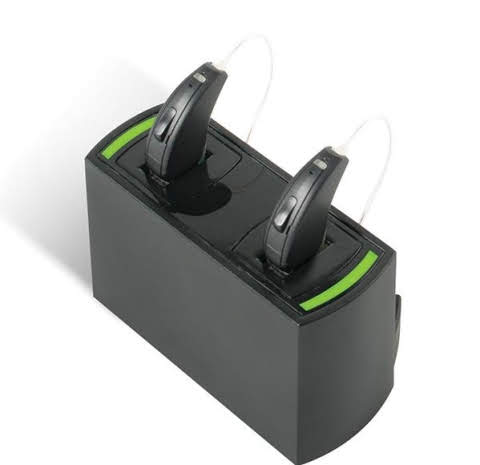
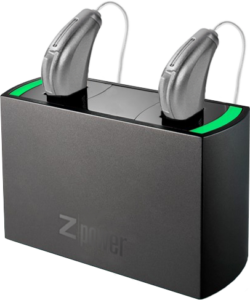
The primary producer of Silver-Zinc rechargeable hearing aid systems is ZPower. Originally ZPower offered a retrofit system which consisted of individually designed battery compartments and chargers for many popular hearing aid models. This allowed hearing aid users to change their current products to rechargeable hearing aids. However, in partnership with several hearing aid brands, there are now several Silver-Zinc powered rechargeable hearing aid options. Like the lithium-ion systems, they provide power for a day of use.
As of writing this piece, the two hearing aid brands offering Silver-Zinc rechargeable hearing aids are Unitron with their Moxi Fit R and Starkey with their Muse Micro RIC 312t R. Unitron has done something interesting though, they have made their rechargeable hearing aid system backwards compatible. If you currently own a Moxi Fit, you can buy the kit and make it rechargeable.
Update 20/06/2018: Many more hearing aid brands have introduced rechargeables with the ZPower system, including Widex, Bernafon and Oticon.
These systems are not integrated and sealed into the product, in fact, these systems are a little more forgiving than the Lithium-ion systems. If for some reason you don’t get to charge your hearing aid, you can simply slip in a disposable battery. Silver-Zinc is also more stable than Lithium-ion, it won’t explode into flame when damaged.
The Cons of Silver-Zinc Rechargeable Hearing Aids
Once a Year Replacement: Silver-Zinc batteries need to be replaced once a year. This represents a cost to you, however, they are cheap enough so the cost over four or five years probably balances out with the repair cost of changing a Lithium-Ion power pack.
Power Limitations: This is less of a problem with Silver-Zinc technology, because they are much more power dense. However, if you stream a lot of audio (from an MP3 player or mobile phone, etc.), there’s a possibility that the batteries may not last the full 24-hour day.
The Pros of Silver-Zinc Rechargeable Hearing Aids
No more fiddly battery changes: The technology ensures that you no longer have to worry about the expense of disposable hearing aid batteries, nor do you have to worry about changing them except for once a year.
24 hours continuous use: This technology is also one-charge-per-day standard. You should be able to get up to 24 hours use with up to 5 hours streaming.
Flexibility: Because they are removable, the rechargeable batteries can be easily replaced by standard disposable hearing aid batteries in the event of an emergency. The hearing aids can run on the disposables until they can be recharged at night. It also means that when it comes time to replace them, you can do it at home.
Safety: Silver-zinc is non-flammable, non-toxic and 100% recyclable.
Smaller footprint: Higher energy density means a silver zinc battery can come in a smaller package than comparable lithium-ion rechargeable batteries. This simply means smaller hearing aids.
Backwards Compatible: The technology is backwards compatible in at least one case and it can be added as an aftermarket system.
Update January 2019: I think the general feeling within the industry is that Lithium-ion cells are more reliable than the ZPower option. It is unfortunate but many of the Z-Power systems have developed problems and it has been both frustrating for the users and professionals alike. In truth, I like the Z-Power system a lot, but the problems seem to have over-ruled what is excellent tech.
There is a lot to think about when it comes to rechargeable hearing aids, not least what type is right for you. Each system has its pros and cons, and I don’t think you should be afraid of them. As always, we just think you should have all the knowledge you need to make an educated decision.
If you like what you see, share it so others can benefit
Find An Independent Hearing Aid Centre in Your Area
Arrange a consultation with a trusted Independent hearing healthcare professional in your area
What can you expect for Rechargeable hearing aids in 2017?
Rechargeable hearing aids were most definitely one of the big product hits of 2016. It quickly became obvious that the breakthrough provided by Lithium-ion and Silver Zinc battery technology was probably going to ensure that every hearing aid brand was going to move forward with an offering. I said then that I believed that every manufacturer would be looking at this and that I thought ITEs (in-the-ear custom devices) would be the real battleground. It certainly seems that will be the case, let’s take a look at what is happening in 2017 with rechargeable hearing aids.
The new rechargeable hearing aid movement was begun by hearing instrument models from two of the so-called Big Six manufacturers. Of course, Phonak’s Audéo B-R hearing aids were first to be released quickly to be followed by Sivantos Signia Cellion Primax hearing aids. Each of these hearing aids has an integrated lithium-ion rechargeable battery in the hearing aid’s sealed body, and both are delivered with a simple charging station. There will be pros and cons to this type of offering, but that is something I will talk about later. Let’s take a look at what is available and what is coming down the line.
Phonak has now introduced a rechargeable BTE hearing aid as part of their new Bolero Belong range. The announcement was made yesterday 2017-02-21. They have pipped everyone to the post again being the first to offer a Lithium-ion powered behind the ear device. The press release also talked about a new Virto (their custom aids) which would be made with a titanium shell. So I think rechargeable ITEs are probably a little way off, certainly Lithium-ion powered ones in any way. This page will be constantly updated throughout the year as things change and new products are released.
Widex introduces Rechargeable Beyond Z RIC
Update September 14th: Widex have today announced the launch of a rechargeable version of their popular Beyond Made For iPhone hearing aids. The device will be powered by the now almost ubiquitous Z Power system (should have bought shares!!!). The new rechargeable Beyond is named the Beyond Z and it is expected that it will be released in quarter four in the United States and Quarter 1 of 2018 everywhere else.
Unitron introduces a Rechargeable BTE
Update September 4th: Not to be outdone by their sister company, Unitron have now introduced a brand new rechargeable BTE on the Tempus platform.
Unitron
Stride M R Hearing Aids
A Rechargeable BTE
Unitron has rounded out their rechargeable offerings with a new rechargeable BTE, the Stride M R. It is their first ever rechargeable behind the ear hearing aid. here is what they said.
Wearers simply charge the hearing instrument overnight, for just 5 – 7 hours, and the hearing instrument is ready to perform for a full 24 hours, including 90 minutes of streaming or 16 hours of continuous streaming. Because hearing happens around the clock, Stride M R offers wearers the flexibility to swap rechargeable battery cells with traditional zinc-air batteries at any time, ensuring patients will never run out of charge.
It appears that the new rechargeable runs on Silver-Zinc rechargeable batteries and a similar charger to their Moxi. It also looks like they have made sure there is an auto on feature when you take the hearing aids out of the charger. Something that many users will welcome. The system that Unitron picked is a pretty good all round rechargeable system. It offers some pretty serious running time and also the benefit of being able to shove disposable batteries in when you forget to charge.
It is early yet, but we believe the hearing aids should be available in most of their levels of technology. As we receive more information, we will update you.
Resound Introduces Rechargeable LiNX 3D Made For iPhone Hearing Aid
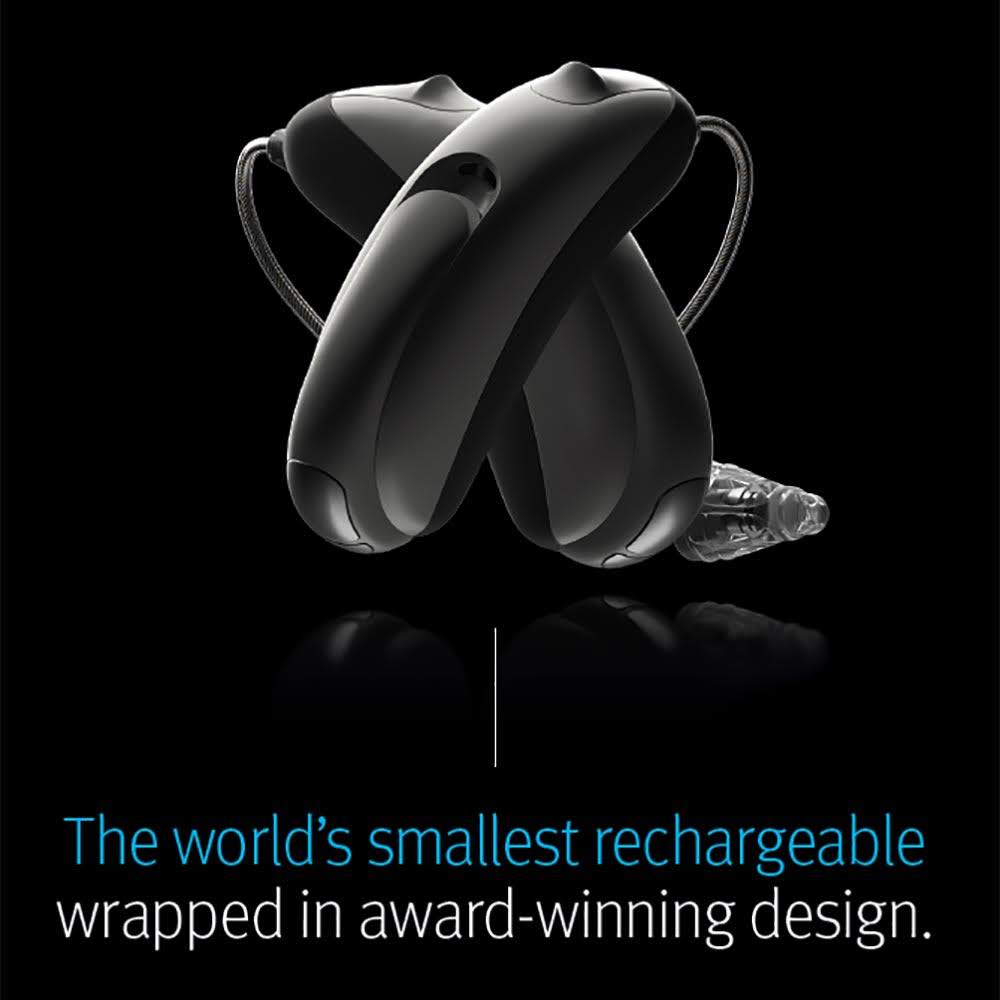
Update August 24th: Resound has announced the introduction of a new rechargeable model in the LiNX 3D range. They are the latest hearing aid manufacturer to introduce these popular options to their line up. They have also gone down the route of using the Z Power Silver-Zinc battery technology.
Resound
LiNX 3D LT61 DRWZ
The new addition to the LiNX 3D range is a completely new form factor and is similar in size if a little different from their existing LT61. The device is officially designated the LT61-DRWZ and it runs on a 312 rechargeable battery which is supplied by Z Power as is the recharging cradle technology. That means there should be plenty of power for a full day of use even if you are streaming audio and taking phone calls. The device is expected to available on the market in September.We would expect the prices to be similar to the LiNX 3D prices.
LiNX 3D LT61 DRWZ Prices
UK: From £1700.00 to £2200.00
Ireland: From €2400.00 to €3000.00
USA: From $2500.00 to $3200.00
Opn 1 Mini RITE Rechargeable
Oticon Introduces a Rechargeable Opn Model
In an announcement reported here in April, Oticon announced the expansion of the models on the Opn range which included a rechargeable model. They to have gone down the route of the Z Power Silver Zinc technology which makes a lot of sense. The hearing aids will be available in the UK and Ireland in November 2017
Oticon
Opn 1 Mini RITE Rechargeable
this is a wireless slimline Rechargeable ‘Mini-Receiver-In-Ear (miniRITE)’ hearing aid using a rechargeable Silver Zinc 312 battery (can also use disposable hearing aid batteries). All Oticon Opn miniRITE hearing aids sold since the introduction last year and going forward can be retrofitted to be rechargeable. They are so small they are practically invisible and come in a range of shades and bright colours.Four levels of receiver power allowing hearing losses from mild to severe to profound to be fitted with a discreet solution. The internet-enabled Oticon Opn comes with a number of additional features because it can connect to devices via the internet and Bluetooth. The hearing aids will connect directly to your Smartphone so you can make phone calls and listen to music without any intermediate streaming device.
Oticon Opn Prices
UK: From £1700.00 to £2200.00
Ireland: From €2400.00 to €3000.00
USA: From $2500.00 to $3200.00
Features
Speech Understanding
OpenSound Navigator™ Level 1
Balancing power effect 100%
Max. noise removal 9 dB
Speech Guard™ LX Level 1
Spatial Sound™ LX 4 estimators
Soft Speech Booster LX
Sound Quality
Clear Dynamics
Binaural Noise Management
Fitting Bandwidth 10 kHz
Processing Channels 64
Bass Boost (streaming)
Listening Comfort
Transient Noise Management 4 configurations
Feedback shield LX
Wind Noise Management
Binaural Coordination
Personalization & Optimizing Fitting
YouMatic™ LX 3 configurations
Fitting Bands 16
Multiple Directionality Options
Adaptation Management
Oticon Firmware Updater
Acoustic Notifications
Connecting to the World
Stereo streaming (2.4 GHz)
Made for iPhone®
Oticon ON App
ConnectClip (Coming in 2017)
Remote Control 3.0
TV Adapter 3.0
AutoPhone
Phonak
Audeo Belong Rechargeable Hearing Devices
As I said, the Audeo Belong hearing device range was the first of the Lithium-ion devices to be released. It is also the first Phonak hearing device range with a rechargeable option. However, Phonak offered the option as part of their new range of Belong hearing aids which came with an upgraded operating system, the latest version of Phonak’s SoundRecover2 and new microphones and programme buttons. It wasn’t introduced as a stand-alone product like the Cellion with Signia.
The range uses the existing Venture chipset and is available in four technology levels, the 90, the 70, the 50 and the 30. The rechargeable option is not available in the lowest 30 level of technology which means that if you want to get this amazingly popular device you will have to move up to the 50 level at the least. I would expect Phonak to expand the rechargeable hearing aid range to BTE devices this year, the technical challenge involved isn’t huge, however, it may mean a new case.
Audeo Belong Rechargeable Prices
We would expect the Audeo Belong Rechargeable hearing aid range to be sold at prices from £1100.00 to £2200.00 in the UK depending on the Practice and location. We would expect the range to be sold at prices from €1400.00 to €3000.00 in Ireland. We would expect the range to be sold at prices from $1500.00 to $3200.00 in the USA.
What are the key features
Rechargeable lithium-ion power cell
24 hours continuous use with up to 5 hours streaming
Hear The Latest Phonak Hearing Aids For Yourself, Visit Your Local Hearing Pro
Arrange a consultation with a trusted Independent hearing healthcare professional in your area
Phonak
Bolero Belong Rechargeable Hearing Devices
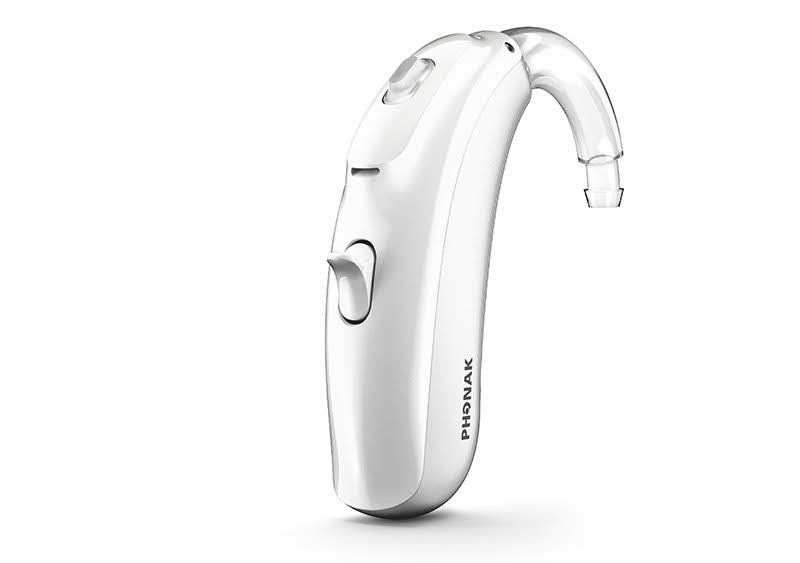
Phonak has launched its new Bolero Belong platform of BTE hearing aids, including the anticipated lithium-ion rechargeable Bolero B-PR. It is the first Lithium-ion rechargeable BTE to the market and the first Phonak BTE hearing device range with a rechargeable option. They say that it will deliver 24 hours of hearing with one simple charge (expected results when fully charged, and up to 80 minutes wireless streaming time).
Bolero Belong Rechargeable Prices
We would expect the Bolero Belong Rechargeable hearing aid range to be sold at prices from £1100.00 to £2200.00 in the UK depending on the Practice and location. We would expect the range to be sold at prices from €1400.00 to €3000.00 in Ireland. We would expect the range to be sold at prices from $1500.00 to $3200.00 in the USA.
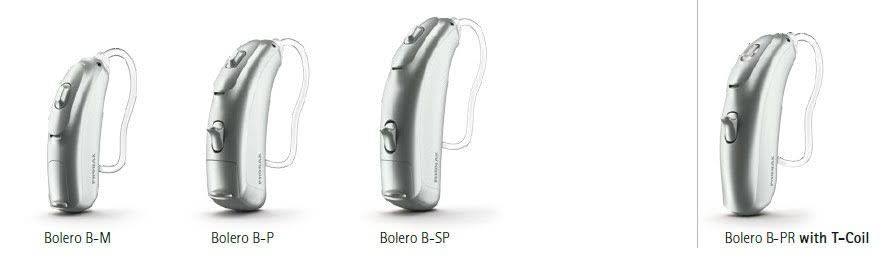
The range will be a full model line up with Bolero B models—including B-M, B-P, B-SP, and the rechargeable B-PR. It will run on the new improved AutoSense OS and will come in the usual four levels of technology. There was no word on the availability of the rechargeable device in the 30 level of technology but we assume that as is the case with the Audeo, it will not be available in the lowest tech level.
What are the key features
Rechargeable lithium-ion power cell
24 hours continuous use with up to 5 hours streaming
Easy charging
Unique OneShell design
Only available in the 90, 70 and 50 level of tech
Signia
Cellion Hearing Aids
Signia quickly followed Phonak with the Cellion™ primax™ hearing aids. Signia have always had a rechargeable option in their hearing aid line-up, but this was the first time they moved to Lithium-ion to power them. The devices have been designed to be smart, they turn off when dropped into the charger and turn on automatically when they are taken out again. Signia say that the rechargeable lithium-ion power cell lasts 24 hours straight without charging with unlimited audio streaming.
Like the Audeo B-R, the Cellion is a Receiver in Canal hearing aid and it can be used with a variety of receivers which will allow them to cover hearing losses from mild to profound. Signia have three levels of technology and the devices are available in all levels of technology. The devices are also rated to ip68 which is for all intent and purpose almost waterproof. Again, I would expect Signia to offer Lithium-ion powered BTE devices this year as well.
Cellion Rechargeable Hearing Aid Prices
We would expect the Cellion hearing aid range to be sold at prices from £1400.00 to £2200.00 in the UK depending on the Practice and location. We would expect the range to be sold at prices from €1800.00 to €3000.00 in Ireland. We would expect the range to be sold at prices from $1900.00 to $3200.00 in the USA.
What are the key features
Rechargeable lithium-ion power cell
Auto on function when the aid comes out of the charger
In October last year, I reported that Starkey had released a statement that announced that Starkey would partner with an Israeli start-up company called Humavox to introduce a brand new wireless recharging system for their hearing aids.
I said then that Humavox were known for true wireless charging systems. Humavox has designed a radio frequency system that allows them to charge a device via radio signals. Sounds fanciful but that is exactly what it does.
It does this in the near field, In essence, what it would have meant was that the charging station and the devices to be charged would just have to be in proximity to each other. This would have meant that the devices would just have to be dropped into a case or box for them to be charged, really simple and easy. However, just recently, Starkey has announced a new partnership with Zpower to bring a rechargeable hearing aid option to market this month.
Starkey
Muse™ micro RIC 312t R
The Muse™ micro RIC 312t R is just one of the styles available on Starkey’s® “made for music” hearing aid platform. The rechargeable offering is not a Lithium-ion device and nor is the power pack integrated. The power pack is actually ZPower’s innovative silver-zinc battery technology. Which is used with their charger to give at the very least 24 hours of use. Going with this option will allow Starkey customers to switch to normal disposable batteries if they are caught out. From what we can see the Muse micro RIC 312t R will be available in the full three levels of technology.
What are the key features
Rechargeable silver-zinc power cell
24 hours continuous use, no word on streaming yet
Available in all levels of tech
Easy to replace battery pack
User can use disposable batteries if needed
THere are huge advantages to using this type of system, it does allow the user to switch to disposable batteries when needed. This is almost like an aftermarket add on for Starkey, I think it may be a stopgap offer until their own integrated Lithium-ion offering gets released. Although, even if they do release an integrated offering, it will still be an excellent side offering.
Looking For The Latest Hearing Aids or a Hearing Test?
Arrange a consultation with a trusted Independent hearing healthcare professional in your area
Unitron enters the fray
Unitron Rechargeable Hearing Aids
In early February it seemed that Unitron was about to enter the fray with their very own offering. They tweeted on February 3rd that if people were attending the JDVAC convention that they should stop by and take a look at their new rechargeable Moxi Fit-R. They also mentioned on Linkedin that the Moxi Fit-R would be the smallest rechargeable hearing aid ever.
Going to #JDVAC 2017 Convention? Stop by the Unitron booth, and be among the first to preview Moxi™ Fit R, a revolutionary rechargeable.
It made perfect sense for Unitron to do so, like Phonak it is part of the Sonova group so the technology available could transfer. However, Unitron is now famous for doing their own thing, they decided that Silver-Zinc and a ZPower collaboration was the way forward for them. As with the Phonak Audeo, their first foray into this field will be with their RIC offering, it will be interesting to see if they extend it to their Stride BTE devices. We will let you know more as we find out.
Unitron
Moxi Fit R Hearing Aids
Smallest Rechargeable Hearing Aids Ever
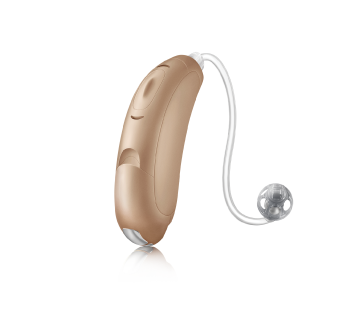
Unitron has introduced a new rechargeable hearing aid option with the new Tempus platform. In typical Unitron style though, they have done it their own way, not just is it not an integrated option, but it is also backwards compatible! The New Moxi Fit R is the smallest rechargeable hearing aid ever, the rechargeable kit can also be bought separately and be fitted to existing Moxi Fits.
What are the key features
30 hours of use on one charge (24 hours with streaming)
The most stable battery tech
Smallest ever rechargeable hearing aid
Easy to change to a disposable if you forget to charge
Backward compatible to older models
Offered in all levels of tech, Pro, 800, 700, 600 and 500
With the introduction of the Moxi Fit R, Unitron now has both the smallest ever RIC hearing aid, the recently introduced Moxi Now, and the smallest ever Rechargeable hearing aid in their line-up. Using the silver-zinc technology gives them real advantages that are similar to the Starkey option. They have also made the tech backwards compatible which is an outstanding idea. The tech is very stable and very safe, lastly, it has a much smaller footprint than Lithium-ion which means much smaller hearing aids. Not just that, the system is also more forgiving for users, forget to charge your hearing aids and you can just slot in a disposable battery, no harm, no foul. On top of that, the rechargeable option will be available in every technology level.
What about GN Resound?
GN Resound Rechargeable Hearing Aids
Will Resound go rechargeable in 2017? I think the answer here will be yes, right now you can actually buy a rechargeable conversion kit from ZPower for Resound hearing aids. So for Resound to take it one step forward and integrate the tech will not be a difficult R&D task. It seems to me that Resound have been delaying a new release since last year, I think that there may be several reasons for that.
An integrated health monitoring hearing aid?
I believe that Resound is going to do something radical with their new hearing aid range. I think that it may be the very first integrated health platform. That is just my belief, but I base it on some deductive reasoning. No matter, I think we can expect a rechargeable option from Resound soon enough. Again, it might make sense for them to use a ZPower partnership solution for their needs.
Widex Rechargeable Hearing Aids
I wrote an article a while ago about a new Widex fuel cell powered hearing aid technology that Widex hope to bring to market. I think that if Widex can get it to work, they will offer it rather than a Lithium-ion option. Although Widex tends to do things their own way so they might offer both.
The fuel cell tech really excites me and Widex gave us the sense late last year that it might be close. I would be really happy to see it happen because it has the potential to change hearing aids forever. Here is hoping.
An update here from August 2017, Widex will deliver a Z Power based rechargeable hearing aid system in September or October 2017. It will be based on the Silver-Zinc battery technology which is a good choice. They haven’t given up on fuel cells though and they still hope to launch in 2018.
Pros and Cons of Rechargeable Hearing Aids
The rechargeable option does have pros and cons. I mean it is an excellent solution, charge them and you get 24 hours of power with no damn fiddly batteries. However, the question should be, how long will the Lithium-ion power pack last? Will it be four or five years? If it needs replacing it could be difficult. I mean it is a factory job because the power packs are generally integrated.
I don’t know how long the power packs will last, but if they need to be replaced you will have to send them away. I would hazard a guess and say that Lithium-ion power packs will probably last about five years, give or take. The secondary option from ZPower is a little different, while it is an excellent rechargeable solution, it isn’t integrated. Which will mean that it can be changed out really easily if it is needed.
The ZPower option will also mean that if you are stuck, caught out by forgetting to charge your aids, you can easily stick a disposable battery in and keep going. I think it is all round a good solution. The silver-zinc solution is also a safer solution, it is more stable and because it is, you can produce smaller power packs, which can mean smaller hearing aids. None of the Lithium-ion hearing aids is the most svelte.
Don’t get me wrong, they are by no means huge hearing aids, but there are smaller devices. However, the limitations of Lithium-ion mean that they can’t at present be made very small. The silver-zinc option needs to be changed once a year though more or less. The cost of the silver-zinc rechargeable batteries is not prohibitive though.
In finishing, right now most of the options are RIC devices, however, Phonak have been quick to introduce a Lithium-Ion powered rechargeable BTE hearing aid in their new Bolero line up. I would expect rechargeable BTE hearing aids from many of the hearing aid brands to start appearing this year. As I have said before, ITEs will be the real challenge. Fitting the power pack in something that small will be a challenge for every R&D team, however, it is a challenge I think they will all take up. Rechargeable hearing aids are too popular not to.
After losing the hearing in my left ear due to sudden sensorineural hearing loss I decided to try a CROS hearing aid. Receiving my CROS hearing aid was a positive experience. I was hoping it would give me some hearing ability on my left side. I was hoping it was going to give me a chance of hearing some elements of speech on my left side; to help me gain some confidence in communicating with others. I was hoping the hearing aid would provide me with some support with hearing in situations with background noise.
Contra Lateral Routing of Signal (CROS) is a hearing aid technology for people with unilateral hearing. The CROS system is for people who have relatively normal hearing in one ear and hearing that can’t be aided in the other. The receiving behind-the-ear device on the deaf side transmits the sound to a device on the good side. The user hears the amplified sound from the deaf side in their good ear. The person hears the sound from the good side naturally in their good ear, without any amplification.
I would be trialling the device for three months to see if it would be useful for me. If I decided that it wasn’t helpful, then I would be entitled to a full refund. The CROS hearing aid technology is relatively new, and I’d read that some people really benefit from their CROS hearing aids. I even read someone’s account saying that, with the aid they were able to hear in background noise, and it was like they didn’t have a deaf side anymore.
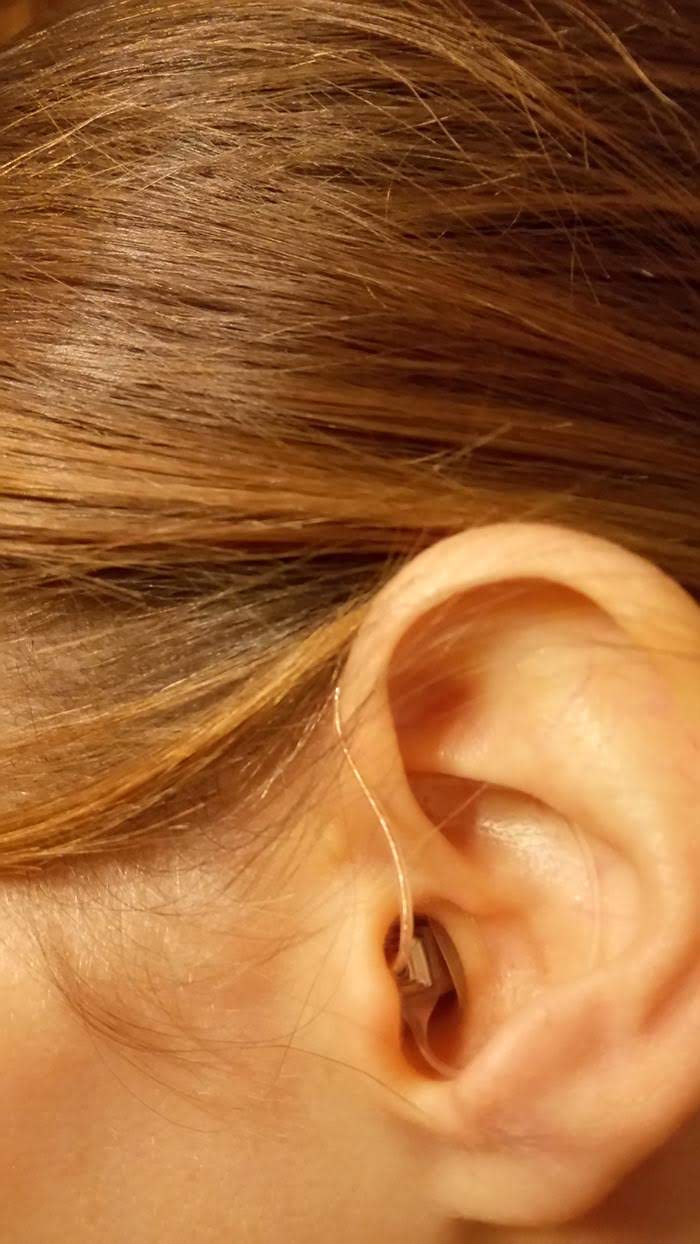
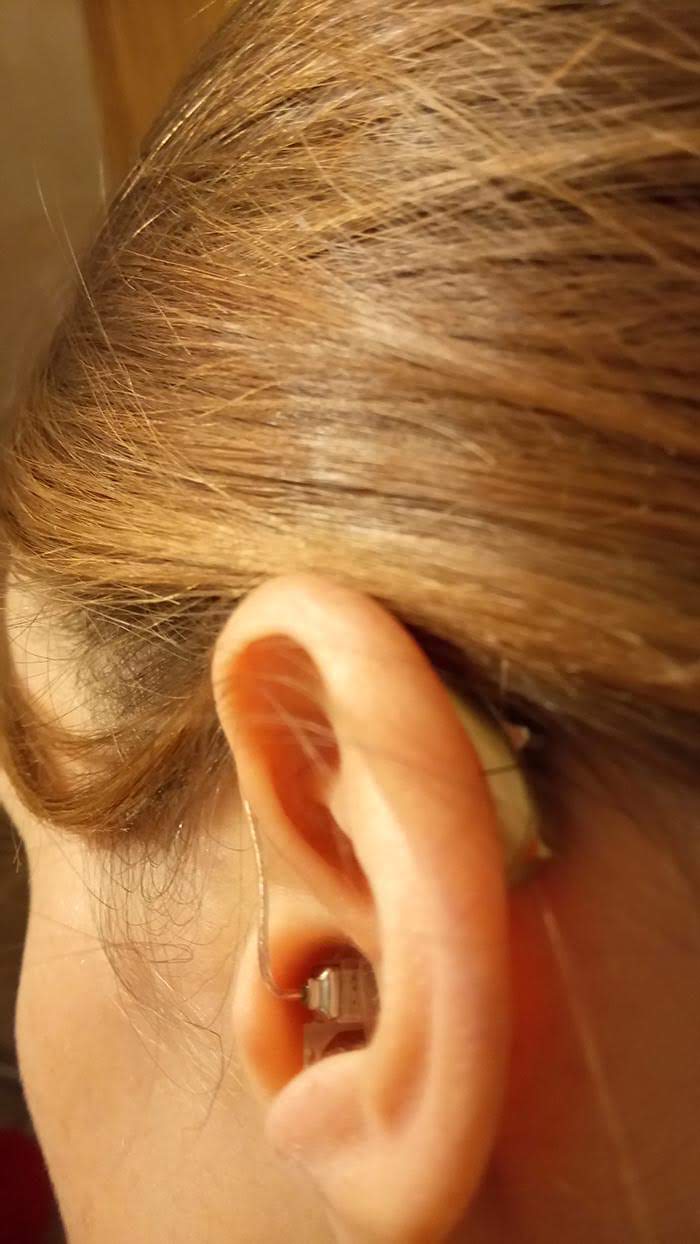
I was very happy with the way my hearing aid looked. The aid components were a similar colour to my hair and if I chose to wear my hair down, they were almost invisible. However, I actually liked other people to see them. When traveling on the Metro for example, I would tuck my hair behind my ears so that they were visible. I liked that my disability could now be seen. Before I received my hearing aids, I had felt some frustration at the fact that people had no visible clue of any difficulties I might be having with communication. But with the hearing aid, if I failed to react to someone on my deaf side, or didn’t move out of the way for someone, I had a visible reason for my lack of response. This made me feel more relaxed on public transport, and in the city. I didn’t feel like I was constantly looking to my left to check if there was someone there, or if the lips of the person next to me were moving.
The main positive outcome of my CROS hearing aid was that it was really wonderful to have some sense of hearing again in my deaf ear. If someone was speaking to me on my deaf side, the aid would make a high-pitched distorted sound, similar to a ‘beep’, for each syllable spoken. These beeps would alert me to turn and focus my attention to my deaf side. Without the aid I would be clueless to the presence of anyone next to me on this side. It was comforting to know that if there was a sound on my deaf side, such as someone speaking, or a car approaching from the left whilst I was crossing a road, then I would be alerted.
I also had some frustrating experiences with my CROS hearing aid. The component in my deaf ear kept popping out. I would fit the mold correctly inside my ear, and within minutes, the aid would have squeezed its way out, so that it was no longer fitted snugly. This meant that throughout the day, I would keep having to push the mold back into my ear. Also, although I was happy that I would be made aware if someone was speaking on my deaf side, the hearing aid didn’t help me understand speech. The high pitched beeping that occurred in time with spoken syllables became an uncomfortable sensation. After my hearing loss, I had developed a sensitivity to noise, and the aids job was to amplify sound; this obviously did not help my sensitivity situation. I became frustrated because I couldn’t make sense of the beeps. I knew they represented words, but however hard I tried I couldn’t hear any difference in the tones to identify letter sounds or words. My good ear was also hindered. My brain seemed to be paying so much attention to the strange sensations and uncomfortable noises brought on by the introduction of my hearing aid, that it struggled to concentrate and understand speech. So in effect, the aid actually hindered my ability to follow conversation.
One of my hopes had been for the aid to help me hear better in background noise. This was not the case. The mix of music and chatter experienced in a restaurant was overwhelming for my CROS hearing aid. It would produce screeching sounds and amplify all the noise I didn’t want to focus on. Going out for a meal for a friend’s birthday with a group of people, was a confidence draining experience. I was only able to focus on one person talking, if I could get close enough to them with my good ear to hear them. This meant that I wasn’t involved in the dynamics of the group chatter. I felt isolated and I resorted to smiling and nodding at people to fake my following of any group discussion or jokes. This is a similar overview of my restaurant experiences with more than one person, when I am not wearing an aid. With the aid, the screeching noises also made it difficult for my good ear to focus on conversation.
The amplification of sound from my CROS hearing aid of everyday city noise such as motor cycle exhausts, building works and sirens, was at times very uncomfortable. Therefore a walk around the city would result in me opening up my aids or covering them to stop them working when confronted with one of these overly intense sounds. My life in a busy city didn’t seem to be a suitable place for my hearing aid. The city noises when amplified were just too uncomfortable, and weren’t helpful in aiding me to decode speech or make sense of the noises around me. The only place where the amplification of noise didn’t cause too much noise discomfort was at home…but home was the one place I felt like I didn’t really need to wear my hearing aid. At home I could generally hear OK when speaking with my boyfriend in the relatively quiet environment of our apartment.
There were also some strange experiences. One day, I had fitted the right component of the aid into my ear, when I started to hear what sounded like a radio. I had no idea where the noise was coming from. I thought that it was maybe something to do with the Bluetooth connectivity of the aid. Later I thought that it could have been noise being picked up from the television that was playing some distance away in the living room. Another time, I fitted the aids into my ears, and I realized that they felt much better; the sounds being produced seemed more natural and I wasn’t receiving the uncomfortable screeching noises. Then I realized the reason they were feeling more natural, was because the battery had died – The aids weren’t turned on! I was hearing normally in my good ear, but without the interference of the beeping from the device into my deaf ear!
I had willed my CROS hearing aid to work for me, but it hadn’t provided me the support I had hoped for. After three months of wearing it, I decided to return it. The audiologist told me that at present, there was no other option available that could possibly provide me with any help. I know however, there is an implant called a Bone Anchored Hearing Aid (BAHA) that could be of some help. This would obviously involve an operation, and I plan to do some research into availability and cost. But for the time being I will continue to live with my unilateral hearing; learning new strategies to help me communicate in everyday situations.
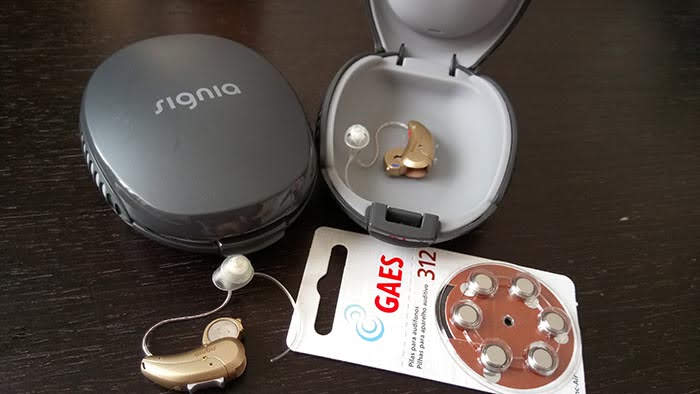
Here’s a few pictures of the CROS.
Find An Independent Hearing Aid Centre in Your Area
Arrange a consultation with a trusted Independent hearing healthcare professional in your area
I had an interesting experience yesterday that brought home the reason why we always ask for a family member to attend a hearing test. The Patient scored themselves very lowly on their hearing handicap form, while the family member scored them rather highly according to their perception of what was going on. When I began to discuss this with them, it was obvious that there was a large disparity between how good the Patient thought their hearing was and what everyone else thought. The reason why is relatively simple and it isn’t the most obvious one of pure denial, there is a bit more going on than that. Let’s talk about why.
Hearing Loss is a Family Sport
Hearing loss affects every member of the family, not just the person who suffers from it. Communication is a problem, often frustrations creep in. Family members may feel that the person with hearing loss is in denial or just ignoring the impact of the hearing loss. If the person with hearing loss has withdrawn from their social circle, family members may be concerned about their well-being. Hearing loss tends to have an effect on the entire family.
Denial is Not Just A River in Egypt
A great old Dublin saying, “De Nile is not just a river in Egypt”, usually uttered as someone shakes their head and throws their eyes to heaven. There is a lot of talk about denial in hearing loss and there is certainly an element of denial involved in many cases. However, denial is fed by a misunderstanding of how hearing loss works.
Cultural Understanding of Hearing Loss
Firstly, most people really don’t understand how acquired hearing loss works or how it will affect someone’s ability to hear. Most of our understanding of hearing loss is formed by TV, Radio and Theatre. In that world hearing loss is not just something to laugh at, it appears to be all about raising the volume. “Speak Up, Speak UP, What Did You Say?” It is all very Monty Pythonesque.
Hearing Loss is Rarely About Pure Volume
Run of the mill acquired hearing loss is very rarely about volume, it is nearly always about balance in sound. In fact, hearing loss that is about pure brute force volume is quite rare and it is usually something that is present from, or related to something, from birth. In normal, run of the mill acquired hearing loss, there is an imbalance in the ability to hear sounds. Some sounds can be heard quite well or even normally, while other sounds may not be heard at all. Ruth Kirkham, one of our contributors here on Know, talks about her own realisation about hearing loss here.
I Can Hear The Voice!
Quite often, someone with hearing loss can hear someone’s voice very clearly, they just can’t really understand what some of the words are. If you think about that for a minute, you can see why it is easy to think that the problem is, in fact, the speaker, not the listener, if they can hear the voice, surely the problem is that the speaker isn’t speaking clearly enough?
The actual problem is that more often than not, someone with hearing loss can’t hear consonants in speech. So basically words sound indistinct and mumbled. The person isn’t mumbling, you just can’t hear them properly. However, you can see why it is easy to think that the problem is the speaker rather than your own. That is in fact why people take so long to realise they are having problems. It is also why they are loathe to release the idea that it isn’t them, it’s everyone else.
Helping You Make a Realisation
When family members attend a hearing test, they will often help their loved one towards a realisation in relation to their hearing ability. It is the family who really understands the effect of hearing loss on the person who has it. They see and understand when there are problems, even clearer than the person who is suffering them. Don’t forget, as a person with hearing loss, you don’t miss what you have missed. Or to put it another way, you don’t know what you don’t hear.
People around you do. While you may be unsure about the depth of the problems you are having, the people around you tend to see them clearly. I have often witnessed a Patient come to a clear realization of their problems simply through the testament of a family member. Quite often, it is the first time that the discussion about their hearing loss is undertaken in a clear and focused manner.
More often than not, it also leads to the sharing of worries that have been unsaid. Concern that has often been unvoiced.
Keeping You Honest
The other thing that a family member will often do, is to keep you honest. I have spoken elsewhere on the site about not fooling yourself. As I said, family members tend to see what is really happening and generally aren’t afraid to give you the unvarnished truth. Nor are they afraid to speak up when you are lying to yourself.They have a way of telling you how it is. I find the reaction to hearing loss a very strange thing, it seems to be one of the few health issues that are surrounded by personal stigma.
Hearing loss is not a statement on you, it just is!
People will outright lie to themselves about their ability to hear in order to protect themselves from the thoughts in their heads! It never fails to surprise me, I have said it before, and I have no doubt I will say it again, hearing loss is not a statement on you, it just is.
Helping Them Understand
Your family doesn’t really understand hearing loss any more than you do. Attending the appointment will also allow them to understand the issues. It will also allow them to become familiar with your hearing loss and the effects it has on your ability to communicate. The hearing test will make it very clear to them exactly what the issues are and why you have the problems you do.
Moving Forward
If you move forward with hearing aids, the involvement of your family with your ongoing rehabilitation plan is important. They need to understand the advantages and limitations of the hearing aids you have chosen. They also need to understand how they can help you, especially during the early stages of rehabilitation.
A Better Understanding of Progress
As you move forward with hearing aids, family members can also help to assess your progress. They can also help identify areas where you are still having issues with your hearing. I love when family members are involved in the process, they are a secondary source of information which allows a full picture of what is going on. They are also a validation of the problems. Let me explain that.
When someone has an issue hearing they automatically think it is their hearing loss and the fault of the hearing aids. Sometimes, it isn’t. There have been times where a Patient has spoken about problems with a particular situation or a particular person. The family member has chimed in and said, I hadn’t a clue what they were saying either! Or I couldn’t really make it out with all the noise going on either. In essence, if they can’t hear, neither should the Patient be able to.
In contrast to that, some Patients may think they are doing pretty well in some situations and the family member may be able to point out where there are some deficiencies. All in all, the inclusion of the family in the process has to be seen as a good thing for both the Patient and for them.
If you like what you see, share it so others can benefit
An Innovative, Integrated Wireless Hearing Aid Accessory
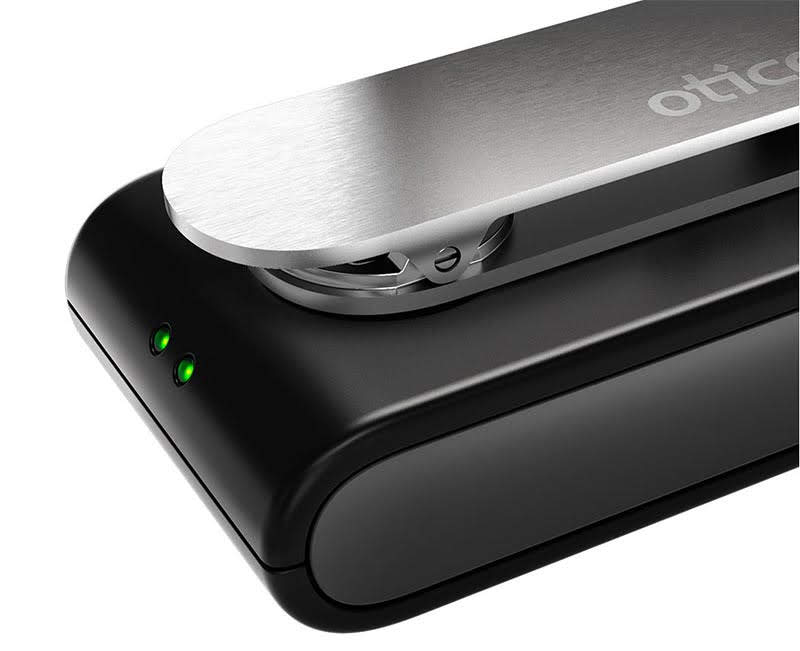
Oticon is releasing the ConnectClip to most markets soon, it’s a big event because it is an amazing little product. In a first, Oticon has introduced an integrated wireless accessory. It will turn your Oticon Opn™ hearing aids into a wireless stereo headset with ConnectClip, so you can make hands-free phone calls and stream music from your smartphone. Or listen to someone speaking from a distance using its remote microphone functionality. You can even use ConnectClip as a discreet remote control for your hearing aids. There is no other wireless accessory like this.
Streaming Audio
The ConnectClip will allow you to stream the sound from any modern smartphone, tablet or computer directly into your hearing aids. Low energy use and a microphone for capturing your speech make your hearing aids into a wireless headset with all the benefits that come with the hands-free experience.
High-quality audio capability lets you stream stereo music from any of your devices straight into your ears. A richer sound with more details delivers a quality experience that is less strenuous to listen to.
Remote Microphone
Not satisfied with delivering an outstanding streaming audio experience, Oticon went a step further. The ConnectClip also functions as a remote microphone, which means you can give it to someone who is speaking and then hear their voice clearly and directly in your hearing aids. Ideal to help you hear better in more complex situations.
Remote Control
Yep, streaming audio and remote microphone just wasn’t enough, so they added a remote control functionality as well. You can use your ConnectClip as a remote control. That means that you can control the volume of your Opn hearing aids, switch programmes, and turn them on and off remotely.
One Integrated Device, Great Value
Oticon has delivered one integrated device that offers fantastic value. An audio streamer, a remote mic and a remote control in one. I really think this device builds on the innovation shown with the Opn devices. I am looking forward to the next step, I am fascinated to see what Opn custom hearing aids offer us.
If you have an Oticon Opn device, I think you will not regret investing in the new ConnectClip. I for one can’t wait to try it out.
If you like what you see, share it so others can benefit
Ear syringing doesn’t work and could even permanently damage your ears
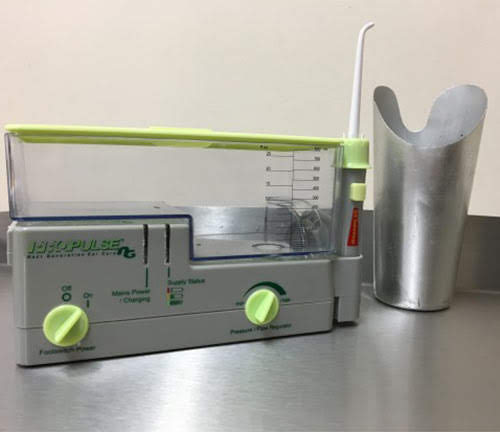
The National Institute for Health and Care Excellence (NICE) has released new guidance on the ear wax removal method of ear syringing. They have advised that traditional ear syringing, (using a large syringe to pump water into the ear), is potentially harmful and should no longer be used. NICE recommends that all medical practitioners should instead use ear irrigation which uses an irrigation machine that introduces water under controlled pressure. You can see one of the machines below.
Discredited Method of Ear Cleaning
It has been known for many years that ear syringing was a discredited method of ear cleaning so it is good that NICE has produced guidance on it. I remember many years ago reading about a paper that was published in the British Medical Journal in relation to ear syringing.
The paper detailed that there were significant problems associated with ear syringing on a regular basis. The problems were detailed as;
failure of wax removal 29%
otitis media (mid-ear infection) 17%
perforation of the eardrum 15%
and trauma to the external auditory meatus (ear canal) 11%
The study was undertaken using a postal survey of 312 practising G.P.s in the Edinburgh area who were serving 650,000 Patients. These figures and the complications mentioned are why NICE has released its guidance. It is also why most Audiologists who offer ear wax removal offer micro-suction earwax removal or irrigation as their ear cleaning methods.
If you like what you see, share it so others can benefit


 yourhearingaidknow